Streamline your creative marketing collateral workflow
Learn how to streamline your creative marketing collateral workflow with proven frameworks, the right tools, and AI-powered strategies for faster, better results.

TL;DR:
- A structured workflow improves marketing collateral efficiency by addressing common blockers like unclear briefs and version control.
- Key components include strategic briefs, resource planning, production workflows, review standardization, and asset management.
- Effective workflows rely on clear ownership, process discipline, and appropriate automation tools to enhance creative output and measurement.
Managing marketing collateral without a clear workflow feels like running a relay race where nobody knows who holds the baton. Emails pile up, asset versions multiply, and deadlines slip while teams debate which file is final. For content creators and marketing professionals, this kind of friction doesn’t just waste hours — it drains creative energy and erodes campaign quality. The good news is that a structured, modern workflow replaces that chaos with focus and speed. This guide walks you through how to audit your current process, adopt proven methodologies, choose the right tools, and measure real results so your creative output consistently lands with impact.
Table of Contents
- Assessing your current creative workflow
- Key components of a modern collateral workflow
- Essential tools for workflow automation and collaboration
- Step-by-step workflow implementation
- Measuring success and continuous improvement
- Our take: Why creative workflow success is more than tools and templates
- Take your creative workflow to the next level with Orias AI
- Frequently asked questions
Key Takeaways
| Point | Details |
|---|---|
| Identify bottlenecks early | Regular workflow audits help spot where assets, approvals, or communication break down before they slow projects. |
| Use the right tools | Modern DAM, AI, and workflow software reduce friction, duplication, and missed deadlines. |
| Standardize processes | Checklists, templates, and automated reviews ensure consistent, on-brand collateral for every campaign. |
| Integrate automation | Automating steps like version control and approvals frees up creative energy for impactful storytelling. |
| Continuous improvement | Tracking KPIs and team feedback drives long-term efficiency and creative excellence. |
Assessing your current creative workflow
Once you understand the costs of a chaotic workflow, it’s time to evaluate where your current process stands. Most teams don’t realize how much time they lose until they map it out. A single campaign can stall at three or four different points: waiting for a brief to be approved, hunting for the right asset version, or chasing a stakeholder for feedback. These aren’t random inconveniences — they’re predictable patterns.
Common blockers tend to cluster around a few recurring issues:
- Unclear briefs: When creative direction is vague, teams produce work that misses the mark and requires multiple revision rounds.
- Uncontrolled versioning: Without a single source of truth, designers and copywriters work from outdated files, duplicating effort.
- Manual review cycles: Approval chains handled through email threads create delays and lose context fast.
- Communication gaps: When strategy, creative, and distribution teams operate in silos, handoffs break down.
Capacity management and standardized handoffs are crucial to preventing bottlenecks, and that starts with an honest audit of where your process actually breaks.
To run a quick workflow audit, ask your team these questions:
How long does it take from brief to first draft? Where do projects most often stall? How many revision rounds does a typical asset go through? Who has final approval authority, and is that clear to everyone?
If the answers vary widely across team members, that inconsistency itself is a signal. Understanding digital content workflow basics gives you a foundation for spotting exactly where structure is missing and where to focus your improvement efforts first.
Key components of a modern collateral workflow
With weak points identified, it’s crucial to understand what sets a high-performing creative workflow apart. The difference between a reactive, ad hoc process and a scalable one comes down to five core building blocks.
According to marketing operations research, these five components form the backbone of effective collateral production: strategic brief, resource planning, production workflows, review standardization, and asset management. Each one feeds into the next, creating a chain that’s only as strong as its weakest link.
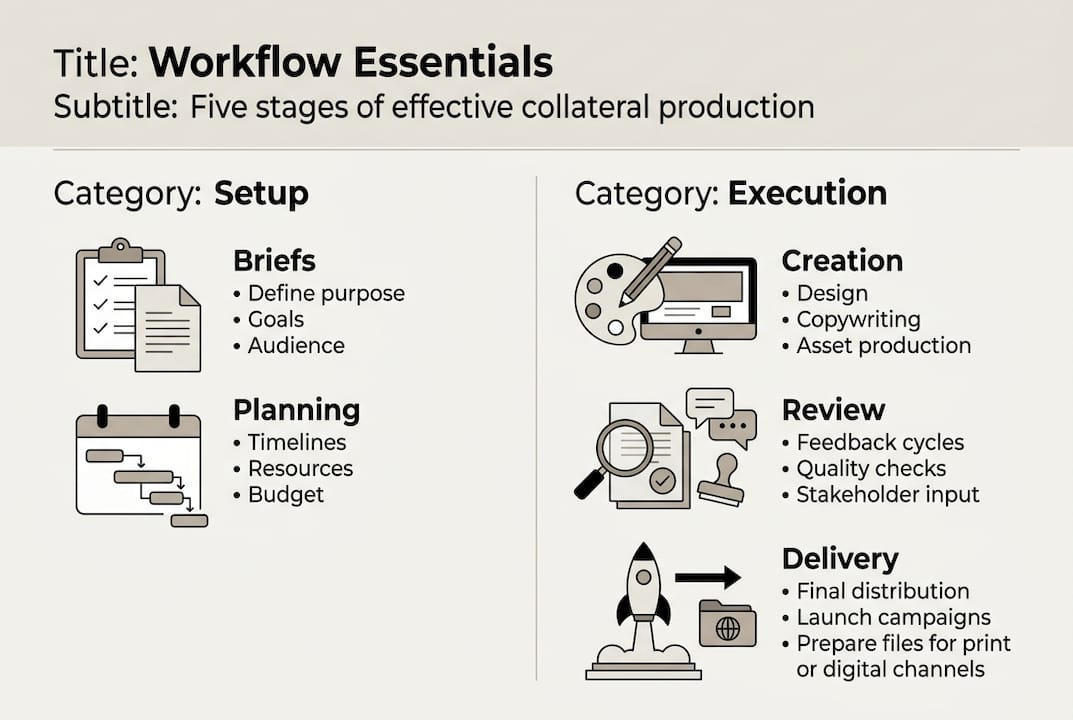
Here’s how a structured approach compares to the typical ad hoc method:
| Component | Ad hoc approach | Structured approach |
|---|---|---|
| Brief | Verbal or informal | Written, approved template |
| Resource planning | Reactive assignments | Pre-mapped roles and timelines |
| Production | Untracked iterations | Versioned, milestone-based |
| Review | Email threads | Centralized, timestamped feedback |
| Asset management | Shared drives | DAM system with metadata |
A numbered sequence helps teams internalize the flow:
- Brief: Define the campaign goal, audience, tone, and deliverables in writing.
- Plan: Assign roles, set timelines, and identify dependencies.
- Produce: Execute asset creation within agreed parameters.
- Review: Collect feedback through a single, structured channel.
- Manage: Store, tag, and distribute final assets for reuse.
Building an efficient creative process means treating each of these stages as non-negotiable rather than optional. Strong visual storytelling ideas also emerge more naturally when the production environment is structured and predictable.
Pro Tip: Build reusable brief templates and production checklists for your most common asset types. This alone can cut briefing time by half and reduce first-draft revision cycles significantly.
Essential tools for workflow automation and collaboration
Now that you know what steps are necessary, powering your workflow with the right tools is mission-critical. The market for creative workflow software has matured considerably, and top solutions for 2026 include platforms like monday.com, MediaValet, Bynder, Marq, Adobe Firefly, Cliprise, and Frame.io, each addressing different parts of the production chain.

Here’s a breakdown of tool categories and what they solve:
| Tool category | Examples | Primary function |
|---|---|---|
| Digital asset management (DAM) | MediaValet, Bynder | Centralized storage, tagging, retrieval |
| Project management | monday.com, Asana | Task tracking, timelines, role assignment |
| AI generation | Adobe Firefly, Orias AI | Visual and copy asset creation |
| Review and approval | Frame.io, Ziflow | Structured feedback and sign-off |
| Brand templating | Marq | On-brand asset self-service for teams |
When evaluating tools, prioritize these features:
- Version control: Every asset iteration is saved and labeled, so no work is lost or confused.
- Automated approvals: Route assets to the right reviewer automatically based on asset type or campaign.
- Cloud sync: Teams working across time zones need real-time access to the same files.
- AI generation: Speeds up first-draft creation for visuals and copy variants.
- Integration capability: Tools that don’t connect to your existing stack create new silos.
One risk worth naming: tool overload. Adding five platforms that don’t talk to each other creates more friction, not less. Follow structured workflow tips to evaluate tools against your actual workflow gaps, not just feature lists. Strong visuals for engagement also become much easier to produce consistently when your asset library is organized and accessible.
Pro Tip: Centralize all final assets in a DAM system with clear naming conventions and metadata tags. Teams that do this report dramatically faster asset retrieval and fewer instances of off-brand materials going live.
Step-by-step workflow implementation
With the right toolset, it’s time to put your optimal workflow into action, step by step. Transitioning from a manual or legacy process doesn’t require a full organizational overhaul. It requires a clear sequence and disciplined execution.
- Set the brief: Use a standardized template. Define deliverables, audience, tone, deadline, and success criteria before any creative work begins.
- Build your tool stack: Select platforms that cover DAM, project management, review, and AI generation. Confirm integrations work before launch.
- Assign roles and resources: Every asset needs a clear owner, a reviewer, and an approver. Ambiguity here causes the most delays.
- Execute asset creation: Use AI tools for first drafts, visual variants, and copy alternatives. Reserve in-house talent for strategy, refinement, and final judgment calls.
- Automate review and distribution: Set up approval workflows so assets move through sign-off stages without manual nudging.
Hybrid models that keep strategy in-house while using AI or outsourcing for execution consistently outperform pure in-house approaches at scale. This isn’t about replacing creative talent — it’s about directing it where it matters most.
For platform-specific guidance, reviewing a creative workflow for YouTube offers a practical model that translates well to other content formats. Teams producing music or visual campaigns can also benefit from exploring AI for music visual collateral to see how AI accelerates release-ready asset production.
Pro Tip: Schedule a brief weekly checkpoint — fifteen minutes is enough — to compare actual progress against the brief. Catching drift early costs far less than correcting it after production is complete.
Measuring success and continuous improvement
Launching the workflow is just the start; long-term impact hinges on regular analysis and process updates. Without measurement, you’re optimizing by feel rather than by fact.
The KPIs that matter most for collateral workflows are:
- On-time delivery rate: What percentage of assets are delivered by the agreed deadline? Anything below 80% signals a systemic issue.
- Revision count per asset: High revision counts point to brief quality problems or unclear feedback processes.
- Campaign performance outcomes: Click-through rates, engagement, and conversion tied to specific asset types reveal what’s actually working.
- Cycle time: How many days does it take from brief to final approved asset? Tracking this over time shows whether your workflow is improving.
Feedback loops are equally important. Build a standing post-campaign review into your process where creative, strategy, and distribution teams share what worked and what didn’t. This isn’t a blame session — it’s a structured conversation that feeds directly into the next brief.
Teams that invest in marketing operations excellence and AI maturity consistently outperform their peers on campaign outcomes and operational efficiency.
Use your project management platform’s reporting features to surface bottlenecks automatically. If a particular review stage consistently delays delivery, that’s where you redesign the process. Applying best practices for continuous improvement means treating your workflow as a living system, not a fixed procedure.
Our take: Why creative workflow success is more than tools and templates
Here’s the uncomfortable truth most workflow guides skip: tools and templates don’t fix a culture problem. We’ve seen teams with best-in-class DAM systems and project management platforms still miss deadlines and produce inconsistent work. Why? Because the underlying issues were about ownership and clarity, not software.
The most effective workflows we’ve observed share one trait that no tool can replicate: every team member understands not just what they’re producing, but why it matters and who owns each decision. That clarity eliminates the second-guessing and approval loops that slow creative work down.
There’s also a real risk in over-optimizing. When process becomes the focus instead of the output, teams fall into what we’d call process paralysis — spending more energy maintaining the system than creating within it. The fix isn’t fewer processes; it’s ensuring every process step has a clear owner and a clear purpose.
Exploring unique creative workflows often reveals that the most productive teams protect space for spontaneous iteration within a structured framework, not outside it. Structure and creative freedom aren’t opposites — they’re partners when the workflow is built with intention.
Take your creative workflow to the next level with Orias AI
If the frameworks in this guide resonate, the next step is putting them into practice with tools built specifically for creative teams. Orias AI is designed for exactly this kind of work — transforming rough ideas, references, and campaign directions into publish-ready visual and promotional assets without the usual back-and-forth.
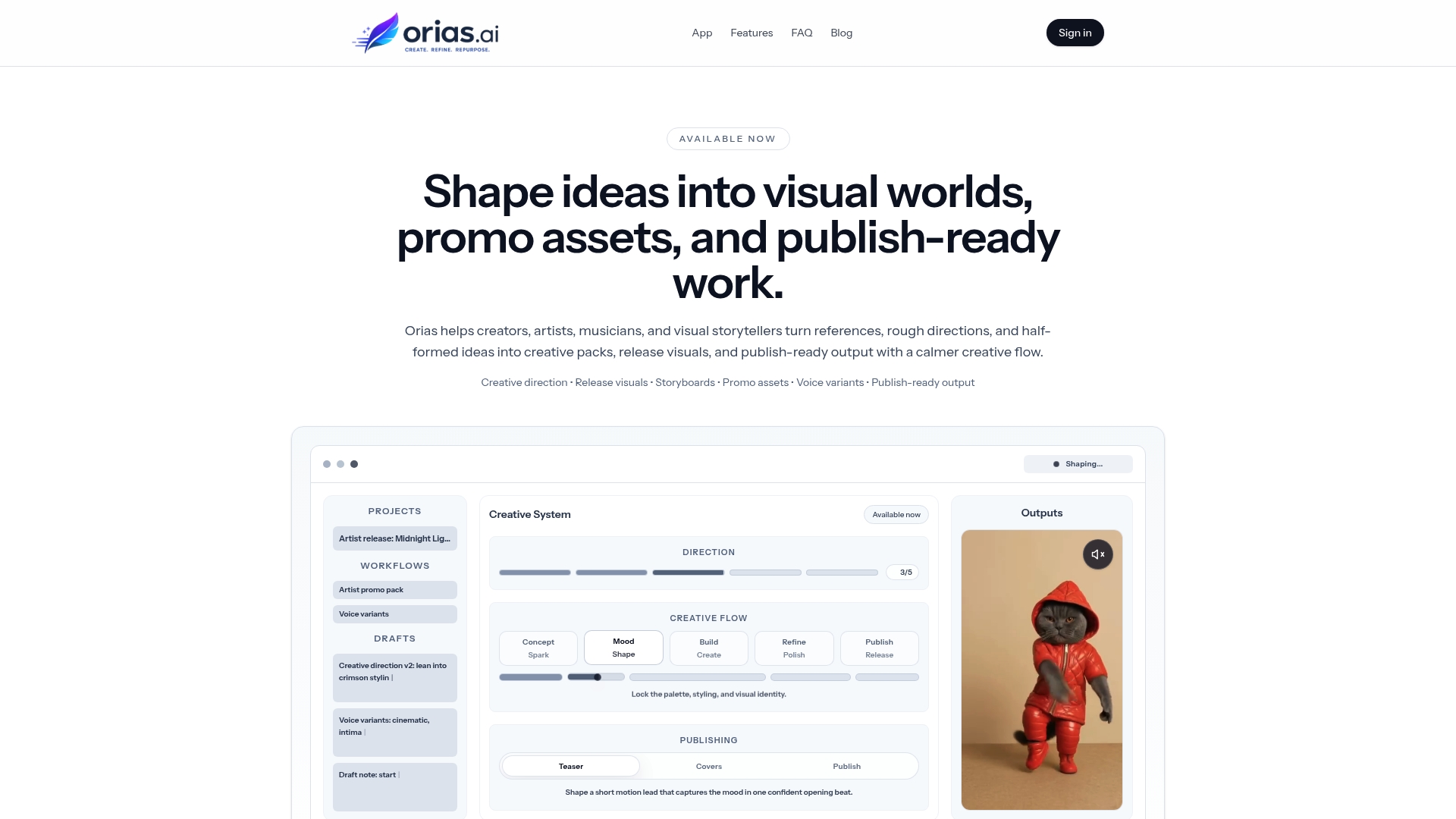
The Orias AI creative workspace gives you a structured environment for developing visual identity, generating asset variants, and exporting campaign-ready packs — all within a single, focused platform. Whether you’re managing a product drop, a content series, or a brand campaign, Orias AI reduces the manual overhead so your team can stay in creative flow. Explore what’s possible and see how much faster your next campaign can move.
Frequently asked questions
What is a creative marketing collateral workflow?
A creative marketing collateral workflow is a structured set of steps for planning, producing, collaborating on, reviewing, and managing assets like ads, visuals, and campaign materials. Strategic briefs, resource planning, and version control are core components of any effective workflow.
What are the best tools to manage marketing collateral?
Leading tools in 2026 include MediaValet, Bynder, Marq, monday.com, Adobe Firefly, and Frame.io for asset management and collaboration. These 14-15 top solutions cover DAM, AI generation, project management, and structured review processes.
How do you measure workflow efficiency for marketing collateral?
Key metrics are on-time asset delivery, revision count per asset, and campaign performance outcomes. Tracking these consistently helps teams spot bottlenecks and proves the value of marketing operations excellence over time.
How can AI streamline creative workflows?
AI automates versioning, approvals, and asset generation, reducing cycle times and enabling teams to scale output quickly. AI maturity is consistently identified as a distinguishing factor among leading marketing teams.
Why do some teams still struggle despite using advanced tools?
Without clear briefs, defined ownership, and structured feedback loops, even the best tools can’t resolve workflow bottlenecks. Structured methodologies and process audits matter as much as the technology stack itself.
Recommended
- Streamline creative projects: structured workflow for artists - Orias AI
- What is a digital content workflow? Streamline creative projects - Orias AI
- Boost creativity: best practices for an efficient creative process - Orias AI
- AI Creative Workspace for Visual Storytellers, Content Creators and Artists - Orias AI


