
Innovative visual storytelling ideas for artists and creators
Discover innovative visual storytelling ideas for artists and creators. Learn how to select and apply AI-powered methods that boost engagement and creative impact.

TL;DR:
- AI tools enhance efficiency but require human input for emotional depth and originality.
- Structured AI methods like archetype generation improve consistency, especially for campaigns and series.
- Combining AI automation with personal symbolism and oversight ensures authentic, standout storytelling.
Choosing the right visual storytelling approach has never been more demanding. Content expectations are rising fast, audiences are harder to impress, and AI tools are multiplying the options available to every creator, artist, and marketer. The pressure to stand out is real, and the sheer volume of methods can make selection feel paralyzing. But here’s the upside: AI is genuinely reshaping what’s possible. HubSpot generated 300,000 images in just four months using AI image tools, scaling their output by 150%. That kind of leverage is now available to independent creators too. This article walks you through a clear framework for selecting ideas, the most effective AI-powered storytelling methods, and how to decide which approach fits your specific project.
Table of Contents
- Criteria to select visual storytelling ideas
- Top innovative visual storytelling ideas using AI
- Comparing AI-driven storytelling methods
- Situational recommendations: choosing your approach
- Why authentic storytelling beats automated visuals
- Enhance your visual storytelling with Orias AI
- Frequently asked questions
Key Takeaways
| Point | Details |
|---|---|
| Balance AI and craft | AI tools speed up storytelling, but authentic intent makes visuals memorable. |
| Choose ideas strategically | Use clear criteria to select techniques that fit your audience and goals. |
| Prioritize emotional depth | Human oversight is essential for nuanced, impactful stories that stand out. |
| Leverage scalable assets | Mass image platforms empower large campaigns with rapid creative output. |
Criteria to select visual storytelling ideas
Before you pick a tool or technique, it pays to get clear on what you actually need from your storytelling. Not every AI-powered method fits every project, and chasing novelty without a filter leads to wasted time and inconsistent results.
Start by asking three foundational questions about your project:
- What emotional response do you want to trigger? Engagement, awe, empathy, and humor all require different visual languages. Defining this upfront shapes every decision that follows.
- How much originality does your audience expect? Niche communities often reward distinctive, personal visuals. Broader audiences may respond better to familiar, structured formats.
- What are your production constraints? Time, budget, and technical skill all determine which tools are realistic options for your workflow.
Once you have answers, you can evaluate AI tools more honestly. The key insight here is that AI excels at structured archetypes, such as the Hero or Wise Old Man, but struggles with emotional nuance, particularly with complex archetypes like the Shadow or Trickster. That’s a meaningful limitation for storytellers whose work depends on psychological depth or moral ambiguity.
This doesn’t mean AI tools are unsuitable. It means you need to know where they add value and where they need your input. A well-structured creative process treats AI as a starting point, not a final answer. You bring the intent, the symbolism, and the emotional specificity. The tool brings speed, structure, and iteration capacity.
It also helps to understand the difference between formulaic and authentic approaches. Formulaic storytelling follows proven patterns, which can be efficient and effective for campaigns that need volume. Authentic storytelling prioritizes personal meaning and originality, which builds deeper audience connection over time. A strong digital content workflow often combines both, using AI-generated structure as scaffolding and human creativity as the finish.
Pro Tip: When evaluating any AI storytelling tool, test it against a project you know well. If the output feels generic or emotionally flat, that’s a signal to increase your creative input, not to abandon the tool entirely.
Top innovative visual storytelling ideas using AI
With a clear selection framework in place, you can explore the most effective AI-powered storytelling ideas available right now. These aren’t theoretical concepts. They’re practical methods creators are already using to produce stronger work.
- AI-powered archetype generation. Tools trained on narrative theory can help you map your story to proven character archetypes and thematic structures. This is especially useful for visual series, brand campaigns, or any project that needs thematic consistency across multiple assets. You define the emotional core; the AI suggests structural frameworks that align with it.
- Mass image creation for campaigns. This is where AI delivers the most obvious efficiency gain. As HubSpot demonstrated by generating 300,000 images in four months, AI image platforms can scale visual output far beyond what any manual production process allows. For marketers running multi-channel campaigns, this means more variants, faster testing, and lower cost per asset.
- Narrative mapping tools. These tools help you visualize story arcs, plot emotional beats, and identify gaps in your visual sequence before you commit to production. Think of them as storyboard assistants that flag pacing issues early. They’re particularly valuable for video content, where writing better hooks and maintaining retention across a sequence requires careful planning.
- Style and mood generation. AI tools can generate multiple visual directions from a single brief, letting you compare mood, palette, and composition before committing to a direction. This accelerates the creative decision process significantly.
The tradeoff is worth acknowledging directly:
“AI democratizes access but may homogenize interpretations. It boosts engagement by up to 22% but can reduce interpretive diversity, particularly in educational contexts.”
For creators focused on engagement visuals, that 22% engagement lift is compelling. But the homogenization risk is real. The solution is intentional differentiation: use AI for structure and volume, and use your own creative judgment to introduce the details that make your work recognizable.
Comparing AI-driven storytelling methods
After reviewing several innovative ideas, it’s useful to compare their practical strengths side by side. Different methods serve different creative goals, and understanding these distinctions helps you allocate your time and tools more effectively.
| Method | Ease of use | Customization | Emotional depth | Best for |
|---|---|---|---|---|
| Archetype generators | Moderate | Medium | Low to medium | Brand consistency, series work |
| Image generation platforms | High | High | Low | Campaign volume, rapid prototyping |
| Narrative mapping tools | Moderate | High | Medium | Video content, complex story arcs |
| Style and mood generators | High | Medium | Low to medium | Visual identity, mood boards |
| Manual craft with AI assist | Low to moderate | Very high | High | Niche projects, personal work |
The table reveals a clear pattern: ease of use and emotional depth tend to move in opposite directions. The tools that are fastest to use generally produce the least nuanced emotional output. This is consistent with what empirical NLP analysis shows, that AI handles structured archetypes well but falls short on emotional complexity.
For creators working on branding, image generation platforms offer the best return on time invested. They produce high volumes of usable assets quickly, and customization options have improved significantly. For educators or storytellers working with layered themes, narrative mapping tools paired with manual refinement tend to produce more meaningful results.

Engagement is another variable worth tracking. AI-assisted visuals consistently outperform unoptimized manual work in click-through and retention metrics, particularly on social platforms. But the ceiling for engagement is higher when human creative judgment is applied on top of AI-generated structure. A solid creative workflow for YouTube illustrates this well: the best-performing creators use AI for thumbnails and pacing analysis, but they make the final call on emotional tone and visual identity themselves.
The practical takeaway is that no single method dominates across all use cases. Your choice should be driven by your project’s primary goal, whether that’s volume, depth, speed, or distinctiveness.
Situational recommendations: choosing your approach
Comparing methods gives you options. Applying them well requires matching the right approach to your specific situation. Here’s how to think about that decision based on project type and audience goals.
For artists and independent creators: Prioritize tools that allow deep customization and support your personal visual language. Archetype generators and narrative mapping tools work well here because they offer structural support without overriding your creative voice. Pair AI-generated frameworks with your own symbols, color choices, and compositional instincts.
For marketers running large campaigns: Mass image generation is your strongest lever. Volume, consistency, and speed matter most at scale. Use AI to produce multiple variants quickly, then apply human judgment to select and refine the assets that best fit your audience’s expectations.
For educators and content creators in knowledge-based fields: Be cautious about over-relying on AI-generated visuals. The homogenization risk is highest here, where interpretive diversity directly affects learning outcomes. Use AI for layout and structure, but ensure the visual narrative reflects genuine conceptual depth.
Across all these scenarios, one principle holds: human oversight is essential for intentionality. AI can augment your storytelling, but it cannot replace the subtext, personal symbols, and emotional specificity that make a narrative resonate. This is especially true when your audience is sophisticated or when your work is meant to build long-term brand identity.
Here’s a quick situational guide:
- Massive campaigns: Image generation platforms, style generators, rapid variant testing
- Niche or personal projects: Narrative mapping, archetype tools, manual craft with AI assist
- Series or brand consistency: Archetype generators, mood boards, visual identity tools
- Short-form social content: Hook-focused tools, style generators, AI thumbnail optimization
If you’re evaluating AI creation alternatives, the same logic applies: match the tool’s strengths to your project’s primary need rather than defaulting to the most popular option.
Pro Tip: Pair AI-generated structure with one or two personal symbols that are specific to your creative identity. This small addition significantly increases the distinctiveness of your output without adding much production time.
Why authentic storytelling beats automated visuals
Here’s a perspective worth sitting with: the most technically impressive AI output often performs worse than simpler, more personal work. Not because the technology is flawed, but because audiences respond to intention. They can sense when a visual was produced to fill a slot versus when it was made to communicate something specific.
Human oversight is essential not just for quality control but for meaning-making. AI tools are genuinely powerful for structure, volume, and iteration. But they don’t know what you’re trying to say. They don’t carry your history, your references, or your reason for making the work.
The creators who get the most from AI are the ones who use it to boost creativity without outsourcing their creative judgment. They treat AI as a production layer, not a creative director. The result is work that’s both efficient and genuinely expressive. That combination is harder to replicate than any single tool advantage, and it’s where your real competitive edge lives.
Enhance your visual storytelling with Orias AI
If these ideas have clarified what your next project needs, the right platform can make execution significantly faster and more focused.
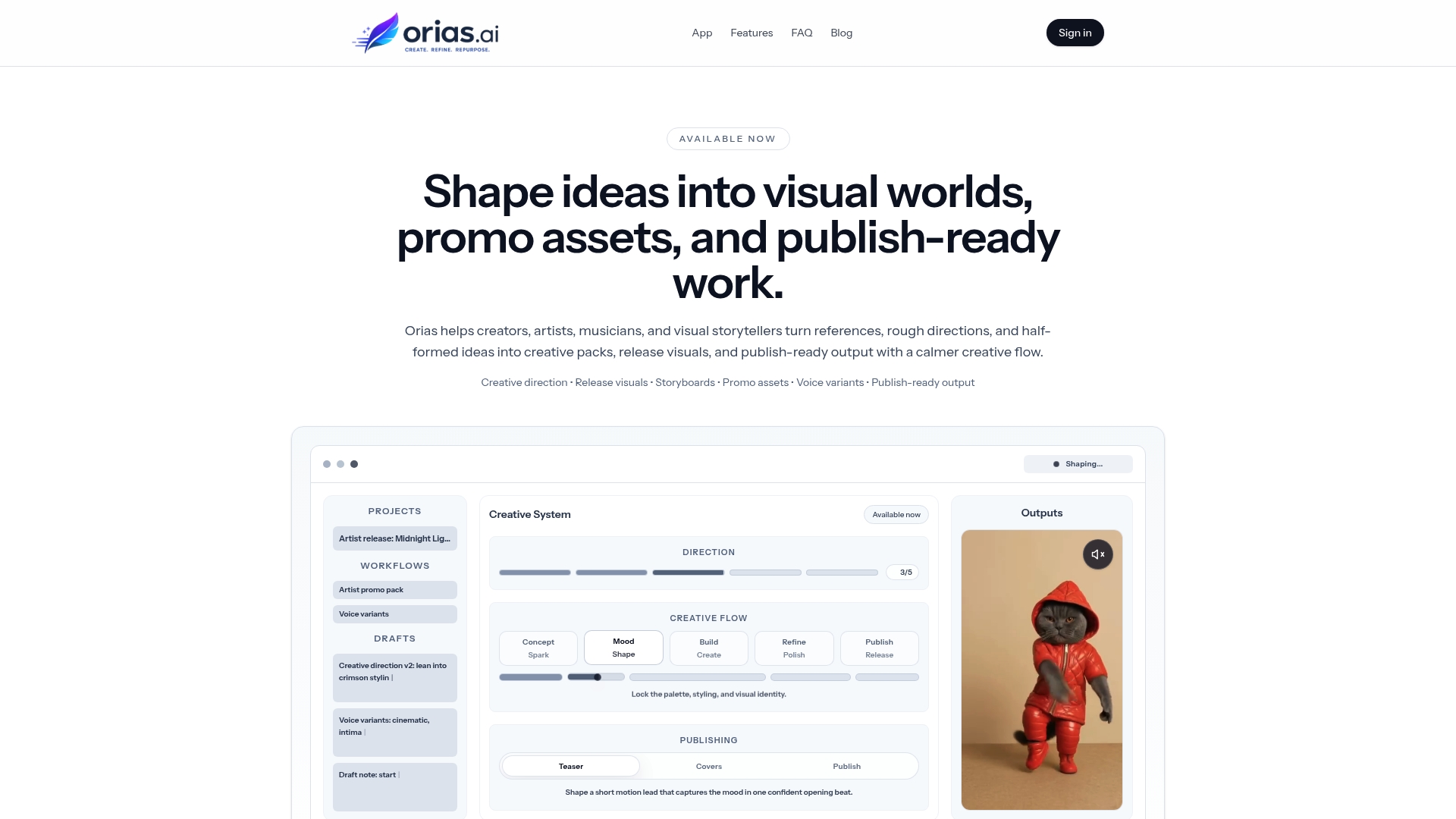
Orias AI is built specifically for visual storytellers who want to move from rough concept to publish-ready assets without losing creative clarity. The platform supports image generation, narrative direction, mood shaping, and multi-variant output, all within a focused workspace designed to reduce friction and keep your creative intent intact. Whether you’re building a campaign, developing a visual series, or preparing a content release, the Orias AI creative workspace gives you the tools to iterate quickly and ship work that actually reflects your vision. Explore what’s possible when structure and creativity work together.
Frequently asked questions
How can AI tools help visual storytellers stand out?
AI tools speed up asset creation and offer structured ideas, but success depends on blending automation with personal creative choices. AI boosts engagement by 22% in some contexts, but distinctiveness still comes from the creator’s intent and judgment.
What are the risks of relying solely on AI for storytelling?
Relying only on AI can produce formulaic content and reduce emotional depth, making your work harder to distinguish from generic output. AI struggles with emotional nuance and complex archetypes, which are often the elements that make storytelling memorable.
Which AI-powered storytelling method is best for large campaigns?
Mass image generation platforms are ideal for scalability and campaign volume, offering speed and variant flexibility at scale. HubSpot’s 300,000 images in four months demonstrates how effectively these tools handle high-output demands.
How can I ensure my storytelling remains unique when using AI tools?
Infuse personal intent, symbols, and emotional nuance into AI-generated frameworks to create distinctive narratives. Human oversight is essential for preserving the subtext and personal meaning that automated tools cannot generate on their own.
Recommended
- Blog | Creative Workflows for Artists & Musicians - Orias AI
- AI Creative Workspace for Visual Storytellers, Content Creators and Artists - Orias AI
- Promo visuals guide: boost creator engagement 650% - Orias AI
- Boost creativity: best practices for an efficient creative process - Orias AI
- How to Tell Great Stories That Captivate Audiences | Prodcast