Visual tips for music releases: boost engagement with AI
Learn how to create standout visuals for your music releases using AI tools, genre strategies, and pre-release promo plans that drive real engagement in 2026.
TL;DR:
- AI tools enable quick, professional-quality visuals tailored to platform specifications and genre standards.
- Consistent, cohesive visuals across all release assets enhance recognition and listener engagement.
- Strategic pre-release visuals and short-form repurposing significantly boost visibility and streaming results.
Streaming platforms host over 100,000 new tracks uploaded every single day. That means your cover art, thumbnail, and promo visuals have a fraction of a second to earn a click before a listener scrolls past. Most independent artists pour energy into production and neglect the visual layer entirely, which is where discovery actually happens. In 2026, AI-driven tools have changed that equation. You no longer need a design budget or a creative agency to produce assets that look intentional and professional. This article walks you through the standards, tools, workflows, and genre strategies that turn visuals into a real growth driver for your next release.
Table of Contents
- Set standards: Essential criteria for music release visuals
- AI-powered visual assets: Tools and workflows
- Genre-driven visual strategy: Matching music and visuals
- Maximize visibility: Pre-release and promo visuals
- Why visuals drive results: What most artists miss
- Unlock your creative potential with Orias AI
- Frequently asked questions
Key Takeaways
| Point | Details |
|---|---|
| Follow platform standards | Meeting strict cover, thumbnail, and video requirements ensures your music is seen and accepted everywhere. |
| Leverage AI for efficiency | AI-driven tools save time and money, enabling indie artists to compete with professional-quality visuals. |
| Match visuals to your genre | Tailoring design elements to your musical identity creates audience recognition and cohesion. |
| Boost reach with pre-release tactics | Effective teasers and short-form content amplify engagement across social platforms before launch. |
| Consistency matters most | Unified visuals across all assets build memorable branding and outperform hype-driven approaches. |
Set standards: Essential criteria for music release visuals
Before you generate a single asset, you need to understand what platforms actually require. Skipping this step means your cover art gets rejected, your thumbnail gets cropped awkwardly, or your branding looks inconsistent across storefronts. Getting the basics right is non-negotiable.
Cover art specifications
Album cover art must meet strict size, color, and content requirements across major platforms. Here is a quick reference:
| Spec | Requirement |
|---|---|
| Dimensions | 3000 x 3000 px (minimum 1400 x 1400 px) |
| Color mode | RGB |
| File format | JPG or PNG |
| Max file size | 25 MB |
| Content rules | No URLs, social handles, or explicit content unless flagged |
For detailed platform-specific rules, check the album artwork requirements published by distribution services. These are updated regularly and vary slightly between Spotify, Apple Music, and Amazon Music.
Video and thumbnail standards
Thumbnails must be clear, bold, and optimized for mobile and emotional impact. A YouTube thumbnail that looks great on a desktop monitor can become unreadable at mobile size. The same principle applies to your Spotify Canvas loop and Instagram preview frame.
Key formatting rules for video assets:
- YouTube thumbnails: 1280 x 720 px, under 2 MB, JPG or PNG
- Spotify Canvas: 9:16 vertical, 3 to 8 seconds, looping MP4 or video file
- Instagram Reels cover: 1080 x 1920 px, centered subject
- TikTok cover: 1:1 or 9:16, bold text in the top third
Branding consistency
Your visuals should feel like they belong to the same world. That means locking in a color palette (two to three primary colors), one or two typefaces, and a consistent photographic or illustrative style. A cohesive visual identity signals professionalism and builds recognition across every touchpoint, from your press photo to your merch mockup.

For a broader look at how these elements work together in practice, the promo visuals best practices guide covers layout, hierarchy, and contrast in detail.
Pro Tip: Export your cover art at thumbnail size (roughly 100 px wide) and check whether the text and key visual elements are still readable. If they are not, simplify the composition before you finalize anything.
AI-powered visual assets: Tools and workflows
Having defined the standards, let’s explore how AI-driven tools make pro assets accessible. Three years ago, producing a music video or a polished Canvas loop required either a videographer or weeks of self-teaching motion design software. Today, several platforms handle that process in minutes.
Overview of leading AI tools
AI tools enable independent artists to produce professional assets quickly and affordably. Here is how the main options compare:
| Tool | Best for | Avg. time to output |
|---|---|---|
| Neural Frames | Audio-reactive video, psychedelic visuals | 5 to 15 minutes |
| Vibesdrop | Social promo clips, lyric videos | 3 to 10 minutes |
| PeakMV | Spotify Canvas, looping visuals | 2 to 8 minutes |
Each tool analyzes your audio and generates visuals that sync to the energy and tempo of the track. You feed in a reference image or a text prompt, set a mood, and the tool handles the rest. For a broader range of AI video creation options, several newer platforms also support batch export, which is useful when you need multiple format variants from one session.
The workflow difference
A traditional design workflow for a single release might take three to five days: briefing a designer, waiting for drafts, revising, and exporting multiple formats. An AI workflow compresses that to a single afternoon. You generate a base visual, iterate on mood and color, then export for each platform format.
This speed matters most during pre-release windows, when you need teasers, trailers, and social assets ready simultaneously. AI visual storytelling approaches also give you more creative control because you can test five different visual directions in the time it used to take to brief one.
For structuring your overall creative process best practices, pairing AI tools with a clear brief and mood reference dramatically reduces the number of revision cycles.
Pro Tip: Layer your personal style on top of AI outputs by adding your own photos, handwritten elements, or brand colors. This bypasses the generic AI look and reduces the risk of your visuals resembling another artist’s output.
Genre-driven visual strategy: Matching music and visuals
With AI tools established, genre-specific strategies help refine your visual identity. Not every visual style works for every sound. Audiences have trained expectations, and when your cover art matches those expectations while adding something fresh, recognition happens faster.
Genre conventions inform visual design choices, affecting how quickly audiences connect with and recognize your work. Here is a practical breakdown by genre:
- Hip-hop: Bold typography, neon accents, high contrast, urban textures. Faces and direct eye contact perform well on covers.
- Pop: Saturated color, clean layouts, strong focal point. Bright backgrounds with minimal clutter drive click-through.
- Indie/folk: Lo-fi textures, muted palettes, film grain, hand-drawn elements. Authenticity signals matter more than polish here.
- Electronic/ambient: Abstract geometry, gradient washes, motion-forward visuals. Cover art that hints at movement works especially well for Canvas loops.
Building visual cohesion across a release
Build cohesion across your cover art, press photos, videos, and merch by treating them as one visual system rather than separate projects. Choose your palette and typography before you start generating assets, and apply them consistently.
Your magnetic visual identity becomes the thread that connects a listener’s first impression on a playlist to their experience on your Instagram grid and eventually to your live show visuals.
“Consistent branding across visuals builds recognition. Recognition builds trust. Trust drives streams, saves, and shares.”
Pro Tip: Before finalizing any visual, export it at the smallest thumbnail size your platform uses and view it next to three competing artists in your genre. If it does not stand out or read clearly at that size, it needs more contrast or a simpler composition.
Maximize visibility: Pre-release and promo visuals
A strong visual strategy must include tactical promo and pre-release steps for maximum reach. Releasing a track without a pre-release visual plan is like opening a restaurant without a sign. The product might be excellent, but no one knows it exists.
A three-week pre-release schedule
Pre-release funnels using teasers, BTS, and trailers increase curiosity and measurably improve release-week performance. Here is a simple framework:
| Week | Content type | Goal |
|---|---|---|
| Week 3 | Behind-the-scenes clips, mood teaser | Build anticipation |
| Week 2 | Lyric snippet, cover art reveal | Drive pre-saves |
| Week 1 | Full trailer, short-form hook clip | Convert followers to listeners |
Short-form repurposing
Every piece of visual content you create for a release can be cut into multiple short-form clips. A 3-minute music video yields at least four to six TikTok or Reels clips when you identify the strongest visual hooks. TikTok engagement rates average 3.7% while Instagram sits at 0.48%, which means short-form clips with strong visual hooks should be your primary distribution format.
For a full breakdown of how to structure your release timeline and repurpose content efficiently, the YouTube workflow guide covers sequencing in detail. For a broader release checklist, the music release guide is a solid reference for independent artists.
Pro Tip: A/B test a static image post against a short looping video clip for the same release moment. Most artists find that motion content outperforms static by a significant margin, but the gap varies by audience and genre. Let the data guide your format decisions going forward.
Why visuals drive results: What most artists miss
The tactical approaches above set you up for success, but the biggest difference often comes down to mindset and consistency. Most artists treat visuals as an afterthought, something to sort out after the mix is done. That order needs to flip.
Visual quality drives engagement before a single note plays. A listener decides whether to click based on what they see, not what they hear. Empirical case studies show 10x stream growth when artists pair strong visual strategies with their releases. That is not a marginal improvement. It is a fundamental shift in how discovery works.
AI levels the playing field, but relevance still matters more than production value. A Canvas loop that feels emotionally connected to your track will outperform a technically polished loop that feels generic. The visual engagement findings consistently show that specificity and branding cohesion outperform expensive but unfocused visuals.
Organic short-form content also regularly outperforms paid promotion for independent artists. Spotify Canvas with AI boosts shares by 145% and saves by 20%, which is a return on effort that paid ads rarely match at the same budget level. Consistency over time compounds those results in ways that one-off campaigns simply cannot.
Unlock your creative potential with Orias AI
If you are ready to put these strategies into practice, having the right workspace makes all the difference. Building a release visual system from scratch across multiple tools is time-consuming and easy to lose track of.
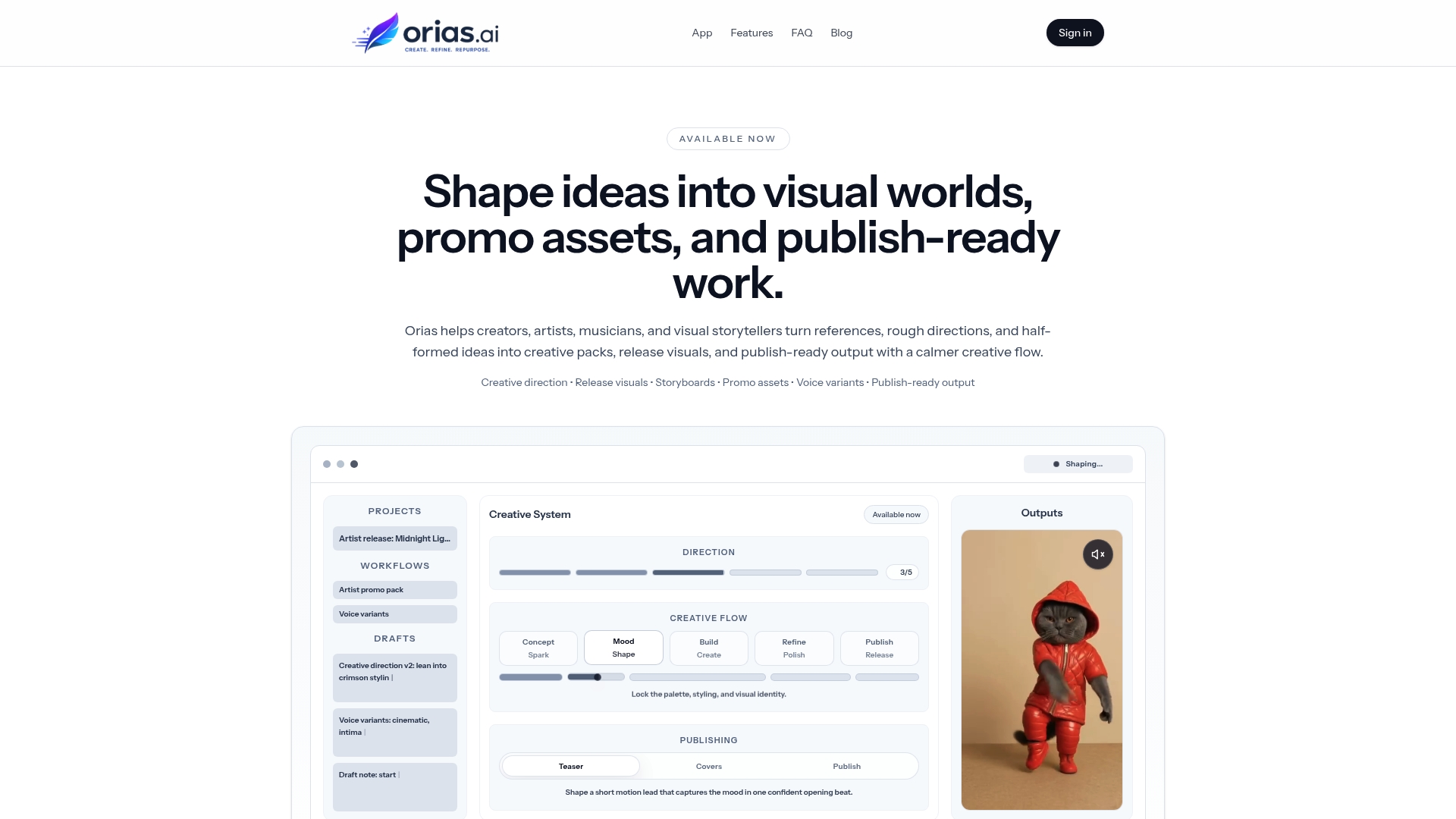
Orias AI brings your entire visual workflow into one focused environment. You can develop creative directions, generate cover art and promo assets, refine your visual identity, and export publish-ready packs without switching between five different apps. The platform is built specifically for musicians and creators who want to move from idea to release-ready visuals with speed and clarity. Whether you are planning a single drop or a full album campaign, Orias AI gives you the tools to build a consistent, compelling visual presence without the overhead.
Frequently asked questions
What are the current cover art requirements for music platforms?
Most platforms require a square image at 3000x3000 px, RGB color mode, JPG or PNG format under 25 MB, with no URLs, social handles, or explicit content unless properly flagged.
How does AI optimize visuals for music releases?
AI-driven tools create audio-reactive visuals by analyzing your track’s tempo and energy, then generate synced assets that musicians can export in multiple platform formats quickly and at a fraction of traditional design costs.
What genres benefit most from visual branding?
All genres benefit from strong visual branding, but genre-based visual strategies show that bold neon works especially well for hip-hop recognition while saturated clean layouts drive higher click-through for pop releases.
How can I increase engagement with promo visuals?
Use a structured pre-release funnel with teasers and BTS clips, then repurpose content into short-form hooks and A/B test static versus motion formats to identify what drives the highest engagement for your specific audience.