Boost creativity: best practices for an efficient creative process
Balancing originality, speed, and promotional reach is one of the hardest challenges visual artists face. You want your work to feel authentic, but you also need to ship consistently, manage assets, and get your output in front of the right audience. Most creators hit a wall not because they lack talent, but because their process is fragmented. The good news is that structured workflows and AI tools now make it possible to move from raw concept to polished, publish-ready assets without sacrificing the creative instinct that makes your work yours. This guide breaks down six essential stages and the best practices that keep each one running smoothly.

Table of Contents
- Map your workflow: The six essential creative stages
- Ideation and research: How to harness constraints and AI for inspiration
- Prototyping and feedback: From thumbnails to AI-assisted revision
- Organize for impact: Asset management, time-blocking, and promotion best practices
- Choosing and refining your workflow: Personalized strategy with AI integration
- A creator’s perspective: AI as a creative ally, not a replacement
- Level up your workflow with AI tools
- Frequently asked questions
Key Takeaways
| Point | Details |
|---|---|
| Structure accelerates creativity | A defined workflow unlocks efficient ideation, production, and iteration for creators. |
| AI enhances, doesn’t replace | Use AI for faster brainstorming and revision, but trust your skills for the final output. |
| Organization multiplies output | Asset management and time-blocking ensure you scale projects and outreach sustainably. |
| Personalization is key | Regularly adapt your workflow to fit your style, goals, and available technology. |
| Human originality wins | Authentic creative voice will always set you apart—even in the age of AI. |
Map your workflow: The six essential creative stages
With the challenge clear, let’s break down your process into manageable, actionable phases. Structured creative workflows give you a repeatable system so you spend less time figuring out what to do next and more time actually creating.
The creative process for visual artists typically follows structured stages, and understanding each one helps you spot where your time actually goes. Here are the six core phases:
- Ideation: Generating raw concepts, themes, and directions
- Research: Gathering references, studying audience needs, and mapping context
- Sketching/Prototyping: Translating ideas into rough visual form
- Feedback and revision: Iterating based on critique and self-review
- Detailed rendering: Finalizing assets with full color, typography, and polish
- Delivery and promotion: Exporting, publishing, and distributing finished work
Each stage has a distinct purpose. Skipping or rushing one creates downstream problems. A weak research phase, for example, often leads to a revision spiral that eats hours later.
A helpful way to see the efficiency gap is to compare traditional and AI-assisted approaches side by side:
| Stage | Traditional workflow | AI-assisted workflow |
|---|---|---|
| Ideation | Manual brainstorming, mood boards | AI generates concept variants in minutes |
| Research | Manual reference gathering | AI clusters patterns and suggests references |
| Sketching | Hand or digital drafts only | AI generates rough visual prototypes |
| Feedback | Peer review, slow turnaround | Instant AI critique plus peer input |
| Rendering | Fully manual | AI handles repetitive texture and color tasks |
| Promotion | Manual copy and scheduling | AI drafts captions, schedules, and variants |
For a deeper look at how these stages connect to content output, the creative workflow for YouTube is a practical reference. Understanding story structure essentials also helps you apply narrative logic to visual projects, not just scripts.
Ideation and research: How to harness constraints and AI for inspiration
With your stages mapped, the creative process always begins with inspiration and research. The counterintuitive truth is that fewer options often produce better ideas.
Time-boxing and constraint-based experiments reveal authentic style, which means limiting your palette, theme, or format forces you to solve problems creatively rather than defaulting to familiar patterns. Here is a practical constraint-based brainstorming sequence:
- Set a 20-minute timer and commit to a single color palette or visual theme
- Sketch or note at least five distinct directions within that constraint
- Use an AI tool to generate three to five variations on your strongest concept
- Compare outputs and identify which elements feel most authentically yours
- Carry those elements forward as the foundation of your visual identity
AI integrates into creative stages including idea development, research, and rapid prototyping, making it a genuine accelerator rather than a gimmick. AI tools can surface patterns in your previous work, flag recurring motifs, and suggest directions you might not have considered.
“The most effective creators use AI not to replace their instincts, but to pressure-test them. The hybrid approach, human intuition guided by AI pattern recognition, consistently produces more original output than either alone.”
For more on applying AI in ideation and short-form writing, that resource covers how the same principles apply to caption and hook writing across platforms.
Pro Tip: Cap your initial ideation session to three constraints maximum. More than that and you are problem-solving logistics, not generating creative ideas.
Prototyping and feedback: From thumbnails to AI-assisted revision
Once you have a compelling idea, rapid prototyping and revision take center stage. The goal here is to fail fast and learn faster, not to produce a polished piece on the first pass.
Effective prototyping follows a clear sequence:
- Thumbnail sketches: Quick, low-detail compositions to test layout and hierarchy
- Rough digital mockups: Slightly more detailed versions to test color and tone
- Storyboards (if applicable): Sequential frames to map visual flow for video or series work
- First-pass renders: A near-complete version used to gather structured feedback
AI supports prototyping and revision by enhancing human iteration rather than replacing it. That distinction matters. AI can flag compositional imbalances, suggest color corrections, or generate alternate layouts in seconds. But the decision about which direction aligns with your creative intent is always yours.
Here is how AI-assisted feedback compares to peer critique in practical terms:
| Feedback type | Speed | Depth | Best used for |
|---|---|---|---|
| Peer critique | Slow (days) | High contextual insight | Conceptual and emotional resonance |
| AI critique | Instant | Technical and structural | Composition, color, hierarchy |
| Self-review | Variable | High personal insight | Alignment with your original intent |
| Combined approach | Fast | Broadest coverage | Final iteration before delivery |
For visual identity prototyping, the same iterative logic applies whether you are building a single asset or an entire brand system. When reviewing narrative-driven work, script analysis for feedback offers a useful framework for evaluating story logic alongside visual choices.

Revisions should stay human-led. Use AI to surface options, but always evaluate them against your original creative brief.
Organize for impact: Asset management, time-blocking, and promotion best practices
Your assets are ready, but consistent organization and effective outreach dictate long-term impact. A strong creative output loses momentum without a reliable system behind it.
Organization via time-blocking admin tasks and inventorying past work supports sustainable creative practice, and the creators who scale their output most effectively treat organization as part of the creative process, not an afterthought.
Here is a practical asset management sequence:
- Tag every file on export: Use consistent naming conventions that include project name, date, and version number
- Back up to two locations: One local drive and one cloud service, updated after every session
- Build a simple inventory: A spreadsheet or tool that logs what you have, where it lives, and its current status
- Schedule weekly admin blocks: Dedicate 30 to 60 minutes per week to filing, tagging, and reviewing your inventory
- Separate creative and admin time: Block your peak creative hours for making, not managing
Time-blocking is especially effective for promotional outreach. Batch your caption writing, scheduling, and platform updates into a single weekly block rather than interrupting creative sessions with admin tasks. For ongoing creative workflow tips, the blog covers practical methods for maintaining output across different project types.
Pro Tip: Use an AI tool to draft your promotional captions and post descriptions in bulk at the start of each week. Reviewing and approving pre-drafted content takes a fraction of the time it takes to write from scratch.
Choosing and refining your workflow: Personalized strategy with AI integration
The final step is choosing the right combination of best practices for sustainable growth. No single workflow fits every creator, but a few guiding questions help you build one that does.
Structured processes combined with AI acceleration yield efficient, personal workflows, but only when the structure reflects your actual goals and output needs. Ask yourself:
- What is my primary output format: single images, series, video, or mixed media?
- Which stage currently takes the most time and why?
- Which tasks genuinely require my creative judgment versus which are repetitive?
- How often do I need to publish to meet my goals?
- Which tools do I already use, and where are the gaps?
With those answers, you can map your workflow against two broad models:
| Workflow model | Strengths | Limitations | Best for |
|---|---|---|---|
| Traditional (manual) | Full creative control, no tool dependency | Slower output, harder to scale | Deep, craft-focused projects |
| AI-augmented | Faster iteration, broader output | Requires tool familiarity, risk of over-reliance | High-volume creators, campaign work |
The YouTube creative workflow advice is a strong reference for creators managing recurring content cycles. Regardless of which model you choose, schedule a monthly workflow review. Identify what slowed you down, what worked well, and adjust one variable at a time.
A creator’s perspective: AI as a creative ally, not a replacement
With strategies compared, here is a candid take from within the creative community. The loudest debate around AI in creative work tends to miss the actual point.
Contrasting views on AI range from “it amplifies creativity” to “it threatens craft,” but the creators getting the best results are not picking a side. They are using AI to do the repetitive, time-consuming work so they can invest more energy in the decisions only they can make.
Human originality will command a premium as AI-generated content becomes more common. The creators who stand out will not be the ones who avoided AI or the ones who leaned on it entirely. They will be the ones who used it to surface their own tendencies and then doubled down on what makes their perspective distinct.
“Your authentic voice is the only asset AI cannot replicate. Everything else is a tool.”
The Orias AI platform is built around this principle: give creators a faster path through the mechanical stages so the human creative judgment gets more space to operate.
Pro Tip: Run your last five projects through an AI analysis tool and look for recurring elements. Those patterns are your style. Lean into them intentionally rather than letting them emerge by accident.
Level up your workflow with AI tools
Ready to streamline your process? Take action with a dedicated creative platform.
The stages covered in this guide, from ideation to promotion, are exactly what the Orias AI workspace is built to support. You can bring in references, rough concepts, or emotional directions and get back structured visual assets, promo packs, and publish-ready output without the usual back-and-forth.
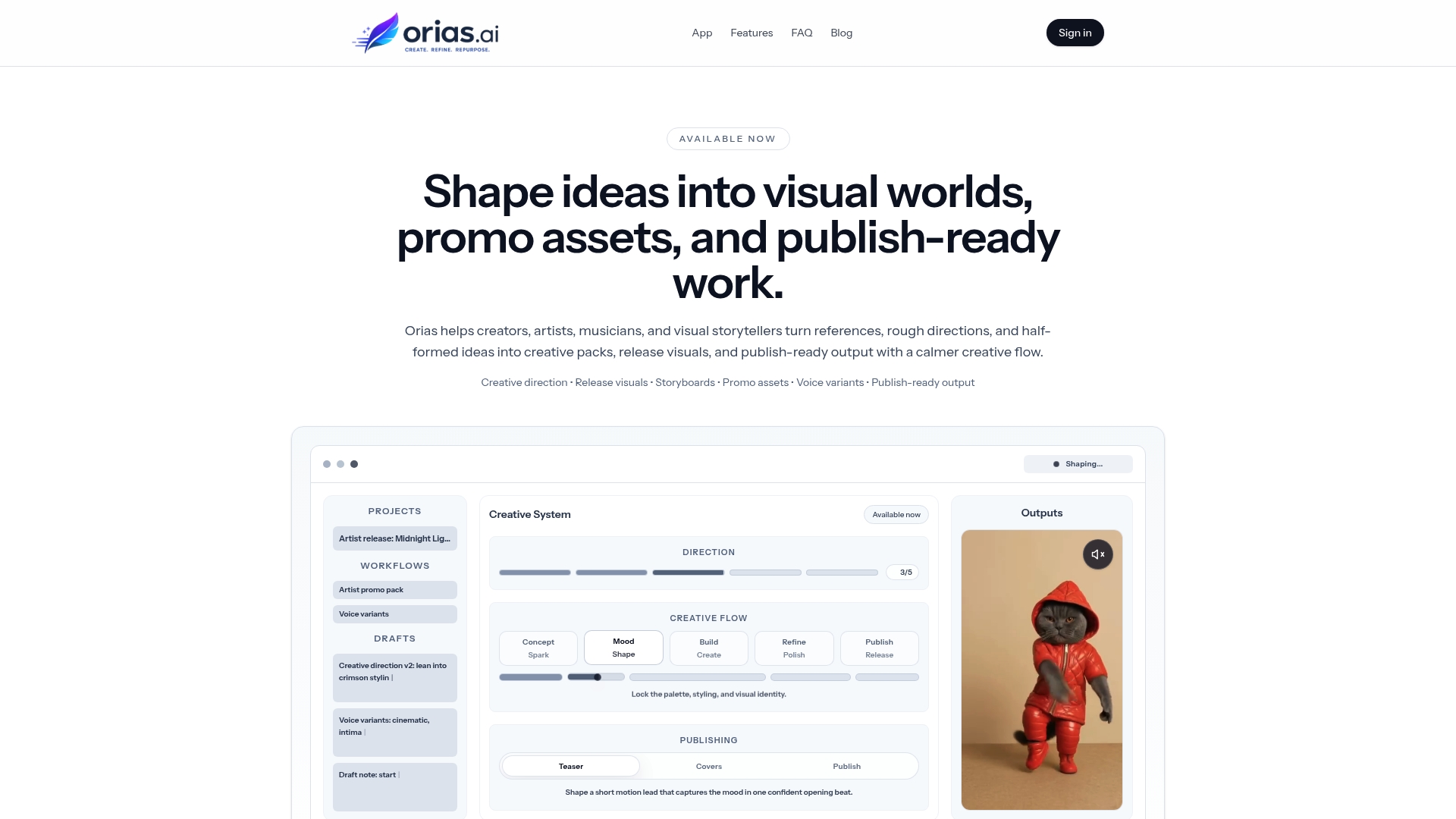
Orias.ai is designed for creators who want to move faster without losing the creative clarity that makes their work recognizable. Whether you are managing a campaign drop, building a visual identity, or just trying to keep your asset library organized, the platform gives you a calm, focused workspace to do it all. Explore the tools and start building your optimized workflow today.
Frequently asked questions
What are the critical stages of the creative process for visual artists?
The six main stages are ideation, research, sketching, refinement and feedback, detailed rendering, and final delivery. Visual artists typically follow structured stages through each of these phases to produce consistent, repeatable results.
How does AI assist with creative workflows without replacing artists?
AI helps generate ideas, prototypes, and feedback, but human skills shape and finalize the creative work. AI integrates into creative stages as an accelerator, not a decision-maker.
What is time-boxing and why is it effective?
Time-boxing sets specific time limits for a creative task, which encourages focused output and authentic style discovery. Constraint-based experiments reveal authentic style by removing the paralysis of unlimited options.
What are the best ways to organize creative assets for efficiency?
Tag files consistently, schedule regular backups, and use an inventory tool to track and manage your work. Inventorying past work supports sustainable creative practice and reduces time lost searching for assets.
How can I develop a personal workflow that actually fits my needs?
Start with standardized steps, integrate tools that match your output format and style, and adjust with regular monthly reviews. Structured processes combined with AI acceleration yield workflows that are both efficient and personally sustainable.
Recommended
- AI Creative Workspace for Visual Storytellers, Content Creators and Artists - Orias AI
- Master the creative workflow for YouTube: a practical guide - Orias AI
- Blog | Creative Workflows for Artists & Musicians - Orias AI
- How to Write Better Hooks for TikTok, Reels & Shorts - Orias AI
- Master film script analysis tips to improve storytelling


