Streamline your campaign release workflow for max impact
Learn how to build a campaign release workflow that saves time, boosts reach, and delivers consistent results for every creative release.

TL;DR:
- A structured campaign workflow ensures consistent, intentional release strategies that build momentum.
- Preparing key assets and using scheduling tools streamline promotion and reduce last-minute stress.
- Refining your workflow over time develops a recognizable creative identity that fosters audience trust.
Table of Contents
- What is a campaign release workflow and why it matters
- Before you start: Tools and assets you need
- Step-by-step guide to building your campaign release workflow
- Common roadblocks and how to fix them
- Evaluating results and optimizing future campaigns
- The overlooked secret: Your workflow is your signature
- Take your campaign workflow further with Orias AI
- Frequently asked questions
Key Takeaways
| Point | Details |
|---|---|
| Workflow clarity | A structured campaign workflow saves time and amplifies your creative reach. |
| Preparation is key | Gathering your tools and assets in advance prevents last-minute stress and errors. |
| Iterate and optimize | Continuous post-campaign reviews make each future release more effective. |
| Organic reach | Smart, process-driven promotion can outperform paid ads and stretch your budget. |
What is a campaign release workflow and why it matters
A campaign release workflow is a step-by-step process for planning, creating, and distributing your promotional assets around a release. Think of it as a production pipeline: you move from concept to published content in a defined sequence, rather than scrambling to figure out what comes next. For musicians, visual storytellers, and content creators, this kind of structure is the difference between a launch that builds momentum and one that fizzles quietly.
The benefits are direct and measurable:
- Time savings: A defined process eliminates repeated decision-making. You know what to do and when.
- Higher engagement: Consistent, well-timed assets across platforms create a coherent audience experience that drives interaction.
- Repeatable success: Once you have a workflow that works, you can run it again and again with minor adjustments for each project.
- Reduced stress: Knowing your next step removes the mental load of figuring it out under pressure.
Understanding how a digital content workflow functions at a structural level is a strong starting point. A workflow is not just a checklist. It is a living system that reflects your creative process and adapts as your audience grows.
Real creator data backs this up. Multi-account organic reach can drive 888K views in just 7 days when paired with a consistent posting strategy. That kind of result does not happen by accident. It happens because someone had a clear plan for what to post, where to post it, and how often.
For creators working with limited time or scattered assets, a workflow is not a luxury. It is the foundation of any release that performs. If you are still figuring out how to make your visuals work harder for you, a solid promo visuals guide can help you understand what asset types move the needle most.
The core insight is simple: structure does not limit creativity. It protects it by removing the friction that slows you down.
Before you start: Tools and assets you need
Before you build your workflow, you need the right resources in place. Jumping into execution without the right tools leads to bottlenecks mid-campaign. Here is what to gather first.
Must-have asset types for any campaign release:
- Cover artwork or key visual
- Short video snippets or reels (15 to 30 seconds)
- Caption variations for different platforms
- Behind-the-scenes (BTS) photos or clips
- Press or bio copy for distribution platforms
- Story-format graphics sized for mobile
| Category | Tool examples | Primary use |
|---|---|---|
| Visual creation | Canva, Adobe Express, Orias AI | Artwork, graphics, promo visuals |
| Scheduling | Buffer, Later, Hootsuite | Multi-platform post scheduling |
| Analytics | Spotify for Artists, Instagram Insights | Performance tracking |
| Project management | Notion, Trello, Airtable | Workflow organization |
| Video editing | CapCut, DaVinci Resolve | Short-form video assets |
For creators building a YouTube creative workflow or managing music releases, the tool stack will vary slightly. But the categories above apply across almost every release type.
One area that new creators often underestimate is BTS content. Artists with zero fans consistently grow fastest when they focus on process breakdowns and behind-the-scenes material. Audiences connect with the making of something, not just the finished product. This is especially true on TikTok and Instagram Reels, where authenticity outperforms polish.
Pro Tip: Before your next release, create a simple asset folder with subfolders for each platform. Label them by format and size. This one habit cuts your prep time significantly and keeps your campaign organized from day one. For more on how visuals affect music release performance, explore these visual tips for music releases.
Getting organized before you start creating is not about being overly systematic. It is about protecting your creative energy for the work that actually matters.

Step-by-step guide to building your campaign release workflow
Once you have your tools and assets ready, you can build the workflow itself. Here is a practical sequence you can copy and adapt for your next release.
- Plan your campaign: Define your release date, target platforms, and key message. Decide how many weeks of content you need and map it on a calendar.
- Create your core assets: Produce your primary visuals, video clips, and written copy before scheduling anything. Batch creation saves time and keeps your visual identity consistent.
- Schedule your posts: Use a scheduling tool to queue content across platforms. Stagger your posts strategically so you maintain presence throughout the release window.
- Distribute and engage: Publish your content and actively respond to comments and shares in the first 24 to 48 hours. Early engagement signals boost algorithmic reach.
- Review your analytics: After the campaign window closes, pull your data and document what worked. Use this to refine your next workflow.
| Step | Single release | Album or story project |
|---|---|---|
| Planning window | 2 to 3 weeks | 6 to 8 weeks |
| Asset volume | 5 to 10 pieces | 20 to 40 pieces |
| Scheduling complexity | Low | High |
| Analytics review | 1 week post-release | Ongoing |
For a deeper look at how to structure this process, a structured workflow for artists breaks down the sequencing in practical detail.
Pro Tip:Releasing singles every 6 to 8 weeks is one of the most effective strategies for staying visible in music streaming algorithms. Consistent output signals activity to platforms and keeps your audience engaged between major releases. Pair this cadence with the workflow steps above and you have a system that compounds over time. You can also explore best practices for your creative process to keep your output quality high across every release.
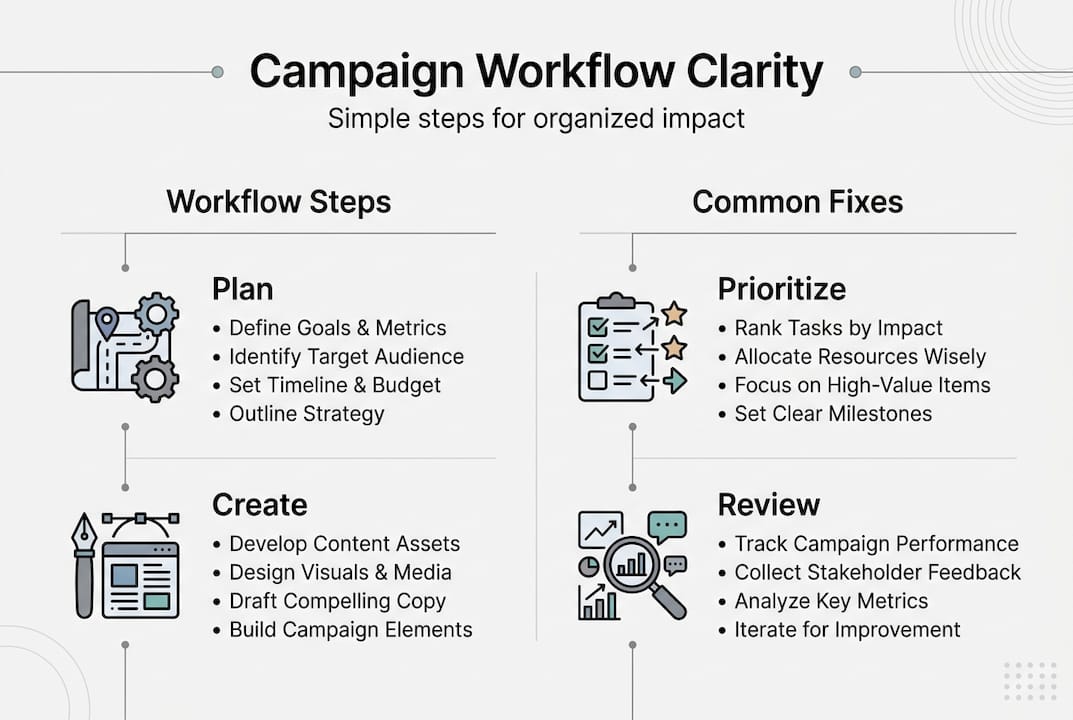
Common roadblocks and how to fix them
Even with a solid workflow in place, creators run into recurring problems. Knowing what they are in advance means you can sidestep them before they derail your campaign.
Common workflow pitfalls and their fixes:
- Overcomplicated assets: Trying to produce too many variations leads to delays and inconsistency. Fix: define a minimum viable asset set for each release and stick to it.
- Scattered platforms: Managing five platforms without a scheduler creates chaos. Fix: consolidate to two or three core platforms and use a scheduling tool for everything.
- Last-minute panic: Waiting until release week to create content guarantees rushed work. Fix: build a two-week buffer into your planning window.
- Ignoring data: Posting without reviewing performance means repeating mistakes. Fix: schedule a 30-minute post-campaign review after every release.
- Weak captions: Visuals get attention but captions in music marketing drive the action. Fix: write caption variations in advance and test different hooks.
Paid ads for music typically cost between $0.05 and $0.30 per stream, which adds up quickly and often underperforms compared to organic strategies like multi-account posting or playlist pitching.
Organic methods take more planning but deliver more sustainable results. A well-structured content workflow makes organic promotion scalable because you are not reinventing the wheel each time. You are running a refined system.
The fix for most workflow problems is not more tools or more budget. It is more clarity about what you are doing, why, and in what order.
Evaluating results and optimizing future campaigns
A workflow that never improves is just a routine. The goal is a feedback loop that makes each campaign sharper than the last. Here is how to build that loop.
- Pull your platform data: Gather reach, engagement rate, saves, and click-through data from every platform you used. Do this within one week of your campaign ending while the context is fresh.
- Identify your top-performing asset: Which post, clip, or visual drove the most meaningful engagement? Note the format, timing, and caption style.
- Document what did not work: Be honest about underperforming content. Was it the format, the timing, or the message? Write it down.
- Update your workflow template: Make one or two specific changes to your process based on what you learned. Small, targeted iterations outperform sweeping overhauls.
- Set a benchmark for next time: Define one metric you want to improve in your next campaign and build your strategy around it.
Multi-account strategies can be tracked and refined over time for consistently better results. The same principle applies to any repeatable workflow: the more data you collect and act on, the more precise your process becomes.
Pro Tip: Create a simple campaign log in a spreadsheet or Notion doc. After each release, record your top metric, your best-performing asset, and one thing you would change. Over time, this becomes an invaluable reference for pattern recognition. Pair this habit with the best practices for an efficient creative process and your output will improve with every cycle. Tracking visuals for engagement separately from copy performance also helps you understand which creative element is driving results.
The overlooked secret: Your workflow is your signature
Here is something most marketing advice skips over: your workflow is not just a productivity tool. It is a creative signature. The creators and musicians who build lasting audiences are not the ones with the biggest ad budgets or the most elaborate assets. They are the ones whose releases feel consistent, intentional, and recognizable.
When you refine your workflow over multiple campaigns, you are not just getting faster. You are developing a repeatable creative identity. The way you sequence your content, the visual language you return to, the timing of your drops — all of it adds up to something audiences recognize and trust.
Most creators chase reach before they have built that identity. The result is a lot of noise and very little retention. The smarter move is to treat your workflow the way you treat your art: iterate on it, refine it, and make it distinctly yours. Explore more perspectives on this approach through creator workflow insights from practitioners who have built sustainable systems.
Consistency is not boring. It is how you become someone worth following.
Take your campaign workflow further with Orias AI
Building a campaign release workflow from scratch takes time, but the right tools make it significantly faster. Orias AI is built specifically for creators, musicians, and visual storytellers who want to move from concept to publish-ready assets without the usual friction.
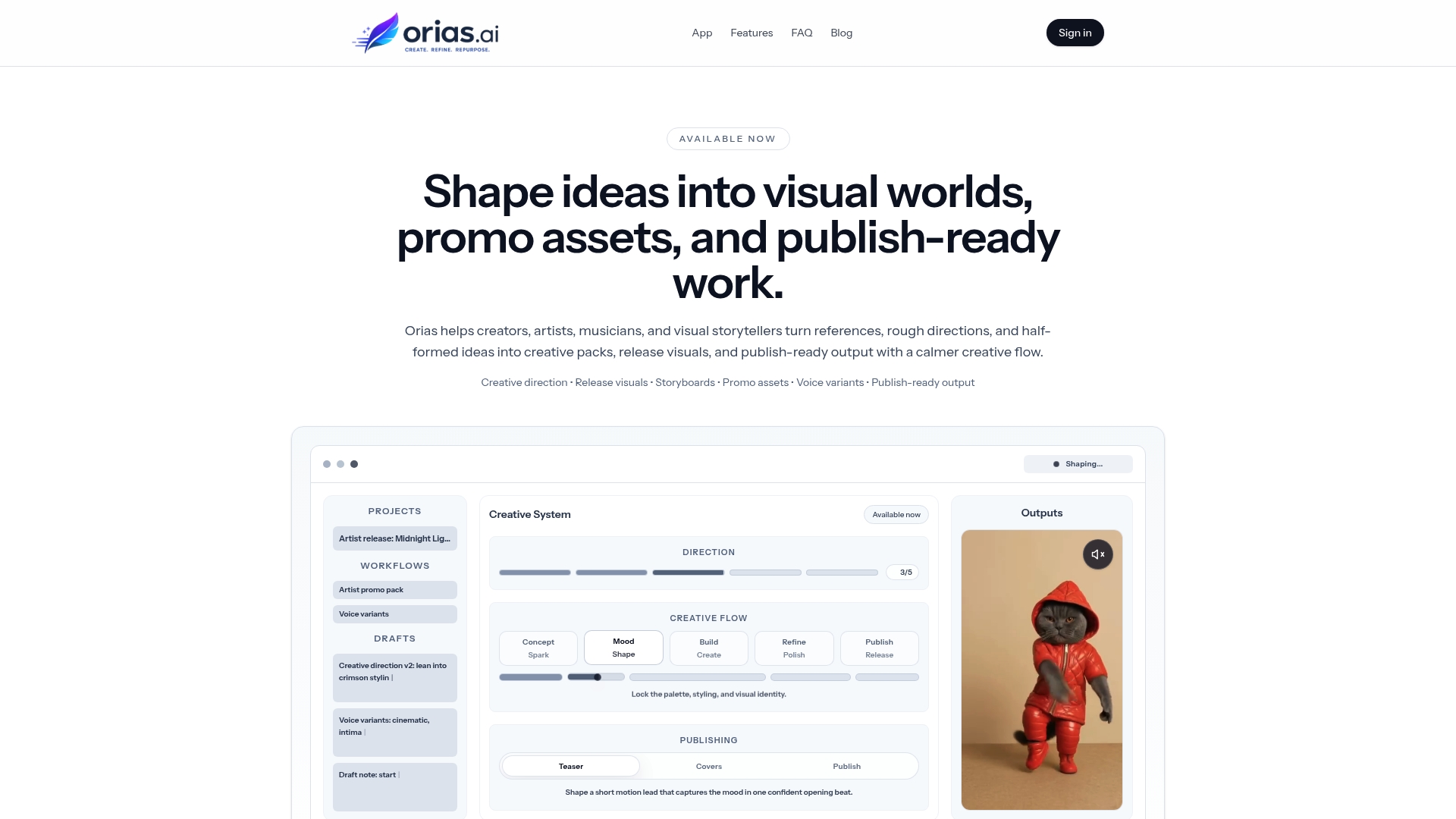
With the Orias AI creative workspace, you can plan your campaign direction, generate visual assets, refine your promo materials, and export a complete creative pack — all in one place. The platform is designed to reduce the back-and-forth that slows most releases down, so you spend more time creating and less time managing files. If you are ready to put the strategies in this guide into practice with AI-powered support, Orias AI is where to start.
Frequently asked questions
What is the most important part of a campaign release workflow?
Having a step-by-step system for creating, scheduling, and distributing assets is essential. A sequential release process helps creators streamline and scale their campaigns without losing consistency.
How often should musicians release new content for best algorithm reach?
Releasing a single every 6 to 8 weeks keeps you visible in music algorithms and grows your audience steadily. Singles every 6 to 8 weeks consistently perform best for algorithmic exposure across major streaming platforms.
What tools can help analyze campaign performance?
Use integrated analytics in social platforms, streaming dashboards, and tools like Spotify for Artists or Instagram Insights to track campaign impact. Analytics and tracking tools are necessary for meaningful workflow improvement over time.
Is organic or paid promotion better for music campaigns?
Organic strategies like multi-account posting can deliver high reach at a fraction of the cost of paid ads. Multi-account organic promo is more cost-efficient than paying $0.05 to $0.30 per stream through paid advertising.