Testing Creative Angles with AI Before Launch
Test creative angles with AI before launch using structured prompts, visual variants, audience signals, and human review for stronger campaigns.
TL;DR:
- Testing creative angles with AI means exploring different ways to frame the same idea before committing to a campaign, release visual, promo asset, or content series.
- The practical takeaway is to test the angle first, then the asset: clarify the promise, mood, audience tension, visual world, and platform format before producing final creative.
- AI can speed up variation and comparison, but human judgment should decide what feels original, credible, on-brand, and ready to publish.
A strong creative launch rarely fails because the creator had no ideas. It usually fails because the idea reached the audience through the wrong angle: the hook was too vague, the visual mood felt disconnected, the promise did not match the work, or the campaign tried to speak to everyone at once.
For artists, musicians, creators, and visual storytellers, this matters before the pressure of launch week. Once the release date, campaign calendar, or content schedule is close, every creative decision feels more expensive. Changing the core angle late can mean rewriting captions, replacing visuals, redesigning thumbnails, cutting new short-form edits, or rebuilding the entire asset set.
AI is useful here because it can help you compare creative directions before you produce the final assets. It can turn a rough idea into multiple hooks, audience framings, visual treatments, release narratives, and promo concepts. But AI should not be treated as a magic “best idea” machine. It is better used as a structured testing partner: fast at generating options, useful for mapping differences, and helpful for spotting gaps — while the final decision stays with the creator.
This guide shows how to test creative angles with AI before launch without making your work feel generic. You will build an angle board, generate controlled variants, evaluate platform fit, read early signals, and apply a final human review before anything goes live.
Table of Contents
- Separate the Angle from the Asset
- Build an Angle Board Before Generating Visuals
- Use AI to Pressure-Test Hooks, Moods, and Promises
- Turn the Best Angles into Controlled Creative Variants
- Read Test Signals Without Killing the Creative Idea
- Run a Final Human Review Before Anything Goes Live
- How Orias AI Supports Pre-Launch Creative Testing
- Frequently Asked Questions
Key Takeaways
| Point | Details |
|---|---|
| Test the angle before the output | A visual, post, video, or ad can look polished and still communicate the wrong idea. Start by testing the audience tension, promise, mood, and story frame. |
| Keep variables controlled | Compare one major difference at a time: hook, visual metaphor, tone, format, or audience segment. Random variation makes results hard to interpret. |
| Use AI for structured variation | AI is strongest when it generates options from clear creative direction, not when it is asked for random “viral ideas.” |
| Platform fit matters | A launch angle may need different expressions across TikTok, YouTube, Instagram, Spotify, email, and website assets. |
| Do not outsource taste | AI can create options, but final selection still requires human review for originality, brand fit, ethics, rights, and emotional accuracy. |
Separate the Angle from the Asset
A creative angle is not the same as a finished asset.
The asset is what people see: a short-form video, release poster, thumbnail, carousel, landing page hero, campaign visual, email header, or teaser clip. The angle is the strategic lens behind it. It answers: why should this audience care, and what emotional doorway brings them into the work?
For example, a musician launching a new single could frame the same release several ways:
| Angle | What it emphasizes | Possible asset direction |
|---|---|---|
| Emotional confession | The song as a private truth finally spoken | Intimate portrait visuals, handwritten textures, quiet captions |
| Cinematic world-building | The song as part of a larger visual universe | Trailer-like teasers, atmospheric stills, symbolic objects |
| Fan participation | The song as something listeners can attach their own story to | Prompt-based Reels, duet-friendly clips, community questions |
| Transformation | The song as a before-and-after moment | Split-screen edits, contrast-heavy visuals, release countdown |
AI can help generate all four directions quickly, but the important decision is not which output looks coolest. The real decision is which angle best matches the artist’s voice, the audience’s expectations, and the purpose of the launch.
This is also where many creators make the first mistake: they test too late. They ask AI to generate thumbnails, captions, or visuals before they know what they are trying to prove. The result is usually a pile of attractive but disconnected options.
Prompt:
“Here is the project: [describe the release, campaign, video, product, or creative work]. Generate 8 possible creative angles. For each angle, explain the audience tension, emotional promise, visual mood, hook style, and why it might work before launch.”
This keeps the AI focused on strategic framing before production.
Build an Angle Board Before Generating Visuals
Before asking AI for final visuals or copy, create an angle board. This is not a mood board full of random inspiration. It is a decision tool that helps you compare possible launch directions.
An angle board should include:
- Core idea
- Target audience
- Audience tension
- Emotional promise
- Visual world
- Tone of voice
- Hook examples
- Platform fit
- Risks or clichés to avoid
- Asset types needed
For a digital creator launching a new video series, one angle might be “behind-the-scenes honesty.” Another might be “highly edited cinematic authority.” Both could work, but they create very different expectations. The first invites closeness. The second signals expertise and polish.
A practical AI prompt for angle boards
Use this structure:
“Create a creative angle board for [project]. Give me 6 distinct launch angles. For each one, include: audience insight, emotional promise, visual direction, hook examples, best platforms, asset ideas, possible weakness, and what would make it feel generic.”
The last part matters. Asking what would make an angle feel generic forces a useful critique. It helps you avoid default AI patterns: vague empowerment language, overused neon gradients, cinematic words with no actual concept, or hooks that sound like every other creator in the feed.
What to look for when comparing angles
Do not choose only the most dramatic option. Choose the angle that can survive a full campaign.
Ask:
- Can this angle produce at least 10–20 assets without becoming repetitive?
- Does it match the actual work, song, offer, or story?
- Can it adapt across vertical, square, wide, and static formats?
- Is it specific enough to guide visuals and copy?
- Does it create a clear reason to care?
For musicians, this might mean testing whether the release is better framed as a personal confession, a cinematic event, a fan-driven moment, or a mood-specific soundtrack. For visual storytellers, it might mean deciding whether the project should feel archival, surreal, documentary, editorial, raw, mythic, or intimate.
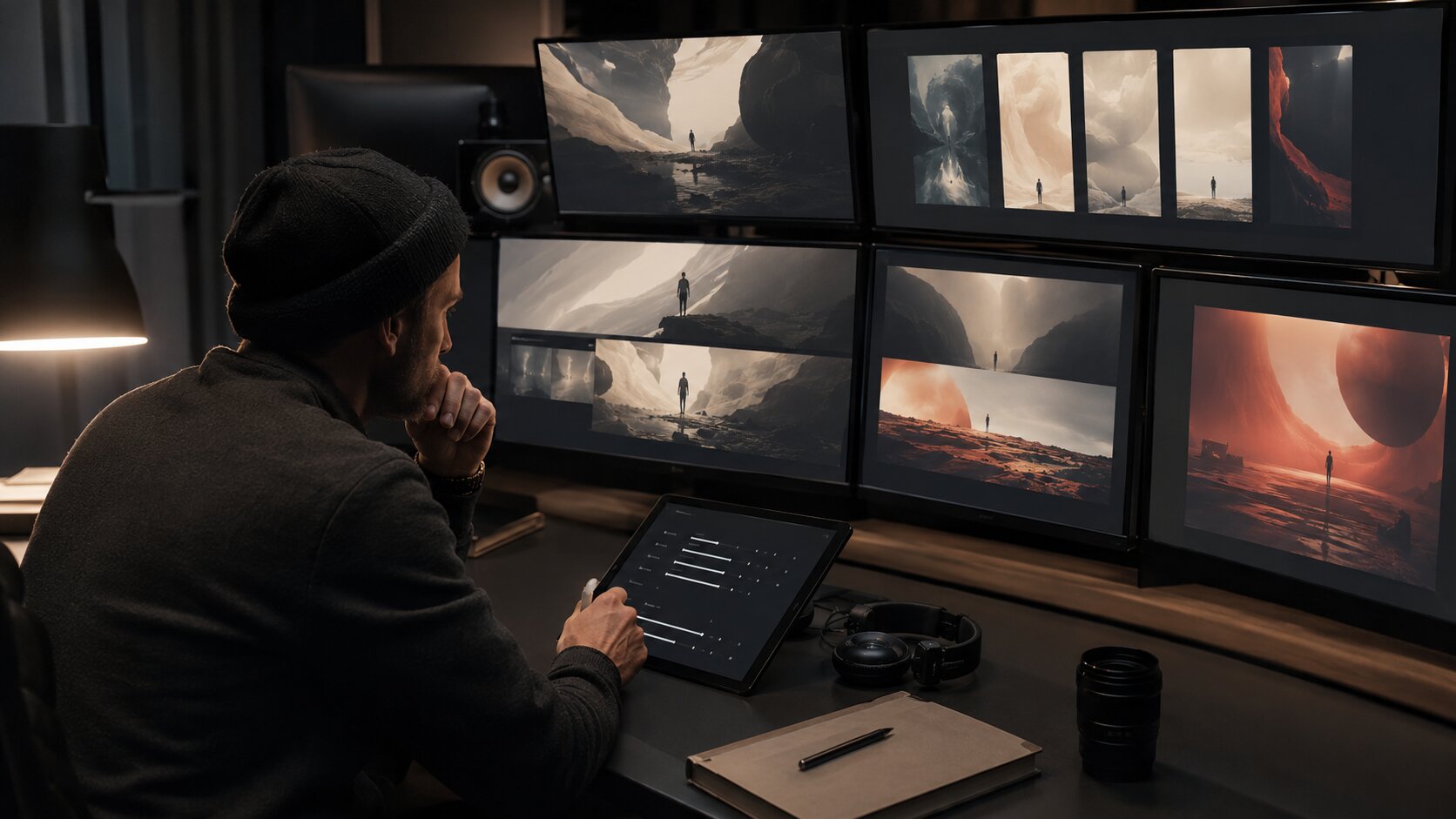
Use AI to Pressure-Test Hooks, Moods, and Promises
Once you have several angles, use AI to test how each one behaves under pressure. A good angle should not collapse when translated into hooks, visuals, captions, thumbnails, or short-form scripts.
TikTok’s ad testing guidance recommends treating testing as an ongoing learning process, documenting what works and what does not, and experimenting with creative elements such as hooks. TikTok’s creative best practices also emphasize vertical video basics, sound, and early attention in the opening moments.
For creators, this does not mean every post has to become a paid ad test. It means the same discipline is useful before publishing: vary the hook, compare the mood, and check whether the promise is clear.
Test hook families, not isolated lines
Instead of asking for “20 hooks,” ask for hook families. For example:
| Hook Family | Best For | Example Direction |
|---|---|---|
| Tension hook | Work with conflict, change, or contradiction | “I made this because I was tired of…” |
| Identity hook | Creator brands with strong POV | “For people who never felt at home in…” |
| Process hook | Behind-the-scenes content | “This started as a voice note and became…” |
| Outcome hook | Tutorials, campaigns, launches | “Before you publish, test this one thing…” |
| Mystery hook | Visual storytelling and cinematic releases | “The object in this image explains the whole song.” |
Then ask AI to generate three versions of each hook family for the same angle. This helps you see whether the angle has range.
Test mood without losing meaning
AI is also useful for mood testing, especially for visual campaigns. Ask it to translate one angle into different visual treatments:
- Minimal and quiet
- Dark and cinematic
- Bright and playful
- Raw and documentary
- Editorial and premium
- Surreal and symbolic
The mistake is treating mood as decoration. Mood should support the angle. A vulnerable song may not need the darkest possible visual world. A high-energy creator series may not need over-polished cinematic styling. A premium brand campaign may not benefit from a chaotic trend aesthetic.
Test the promise
Every angle makes a promise. Some promises are emotional: “this will make you feel seen.” Some are practical: “this will help you make better content.” Some are identity-based: “this is for people like you.” AI can help identify whether that promise is clear or buried.
Use this prompt:
“For each creative angle below, identify the implied promise to the audience. Then rate whether the promise is clear, specific, believable, and visually expressible. Suggest how to strengthen weak promises without exaggerating.”
This is especially useful for ethical AI-assisted content. Do not let AI inflate claims. A stronger campaign is not the same as a louder promise.
Turn the Best Angles into Controlled Creative Variants
After narrowing the field, build controlled variants. This is where many creators lose the thread. They test Angle A as a dark video, Angle B as a bright static image, and Angle C as a carousel with completely different copy. When results come back, they cannot tell whether the audience responded to the angle, the format, the pacing, the visual style, or the platform.
Controlled variation means changing one meaningful variable at a time.
Meta’s A/B testing documentation describes comparing versions by changing variables such as ad image, text, audience, or placement, while Meta’s creative testing feature is designed to try new creative in existing campaigns. The same principle is useful even for organic creative review: avoid changing everything at once.
A clean pre-launch variant system
Create three layers:
- Angle variants: Different strategic framings of the same idea.
- Expression variants: Different hooks, captions, visual metaphors, or mood treatments inside the same angle.
- Format variants: Different platform-ready versions: vertical short, square post, wide hero, thumbnail, email header, playlist canvas, or story frame.
For example, a release campaign could test:
- Angle: “late-night confession”
- Hook variant A: direct emotional statement
- Hook variant B: mysterious lyric fragment
- Hook variant C: process-based studio moment
- Visual variant A: close-up object
- Visual variant B: empty room
- Visual variant C: abstract light pattern
- Format variants: Reel, Story, YouTube thumbnail, Spotify promo graphic, website hero
Spotify for Artists positions its artist tools around release engagement, conversion insights, pre-release hype, and campaign support across the release cycle, which makes this kind of pre-launch asset planning especially relevant for musicians.
Keep a variant naming system
Use clear labels so the test does not become messy:
- A1: Confession / direct hook / close-up object
- A2: Confession / lyric hook / empty room
- B1: Cinematic world / mystery hook / symbolic object
- B2: Cinematic world / trailer hook / wide environment
This makes it easier to discuss results with collaborators, designers, editors, managers, or label teams.
Pro Tip: Do not generate 50 options if you only have time to review 8 properly. Too much variation can create decision fatigue and weaken the campaign.
Read Test Signals Without Killing the Creative Idea
Testing creative angles does not always require a full paid media setup. Depending on your project, you can look at early signals from private review, small audience previews, organic posts, newsletter clicks, community polls, YouTube thumbnail/title tests, or platform analytics.
YouTube now provides official title and thumbnail A/B testing guidance inside YouTube Studio, allowing creators to test titles, thumbnails, or combinations depending on eligibility and video type. YouTube also emphasizes that thumbnails and titles help viewers understand what a video is about before they decide to watch.
The lesson is not “always let the metric choose.” The lesson is that packaging affects interpretation. A strong video can underperform if the title and thumbnail frame it poorly. A strong song can be ignored if the release visual communicates the wrong mood. A strong campaign can feel flat if the first asset does not give people a clear doorway in.
Useful pre-launch signals
| Signal | What it may reveal | What it cannot prove |
|---|---|---|
| Private creative review | Whether the concept feels clear and on-brand | Real audience demand |
| Small audience poll | Which angle is easiest to understand | Long-term campaign strength |
| Organic teaser response | Early resonance and comment language | Final conversion potential |
| Thumbnail/title test | Packaging clarity and watch-time impact | Full brand value |
| Email click pattern | Which promise earns interest | Whether the creative is emotionally strongest |
| Paid creative test | Comparative performance under media spend | Artistic importance or cultural value |
Avoid overreacting to weak signals
A small poll does not always identify the best creative idea. A loud comment section does not always represent the full audience. A high-click hook may attract attention but misrepresent the work.
This is where creators need judgment. Testing should sharpen the creative idea, not flatten it into whatever gets the fastest reaction.
Google’s ABCD framework for effective YouTube ads — Attention, Branding, Connection, and Direction — is a useful lens because it reminds creators that performance is not only about grabbing attention; the creative also needs brand presence, emotional relevance, and a clear next step.
Run a Final Human Review Before Anything Goes Live
AI-generated options still need human review. This is not a formality. It is where you protect the project from generic output, inconsistent messaging, accidental rights issues, unclear disclosure, weak taste, or platform mismatch.
Adobe describes Content Credentials as metadata that can show how content was made, including whether it was captured by a camera, generated by AI, or edited in tools such as Photoshop. Adobe’s generative AI user guidelines also state that Content Credentials may be attached or published for content created or modified with generative AI features.
Creators should treat this as part of a broader review habit: know how the work was made, what tools were used, what references influenced it, and whether the final asset can be published responsibly.
Final review checklist
Before launch, check each selected angle and asset for:
- Brand fit: Does this feel like your world, not just an attractive trend?
- Message accuracy: Does the hook promise what the work actually delivers?
- Visual consistency: Do the assets belong to the same campaign system?
- Platform adaptation: Is each version built for the format where it will appear?
- Rights and references: Are source materials, likenesses, fonts, and music handled responsibly?
- AI transparency: Does the asset need disclosure, metadata, or extra context?
- Human taste: Would you still stand behind this if the metric response is mixed?
Common mistakes to avoid
The most common mistake is publishing the best-looking asset instead of the clearest angle. Another is letting AI generate disconnected visuals without a shared creative direction. A third is confusing early attention with long-term resonance.
A launch angle should be strong enough to guide multiple assets, but flexible enough to adapt. It should make the work easier to understand without reducing it to a shallow marketing line.
How Orias AI Supports Pre-Launch Creative Testing
Orias AI is built for creators, artists, musicians, and visual storytellers who need to move from rough ideas into clearer creative systems. For pre-launch testing, that means using AI to organize references, compare campaign angles, shape visual direction, generate asset variations, and prepare stronger creative packs before publishing pressure arrives.
Instead of treating every prompt as a one-off output, creators can use Orias AI to develop a more consistent launch world: hooks, moods, promo visuals, campaign materials, release assets, and publish-ready variations that still leave room for human taste and final curation.
The goal is not to replace the creator’s voice. The goal is to make the decision process clearer before the launch goes public.
Frequently Asked Questions
What does it mean to test creative angles with AI?
It means using AI to compare different ways of framing the same project before launch. You might test emotional angles, visual moods, hook styles, audience tensions, story concepts, or promo directions before producing final assets.
Is creative angle testing only for paid ads?
No. Paid ads are one use case, but creators can also test angles through organic teasers, private review, community polls, email subject lines, YouTube thumbnails, short-form hooks, and pre-launch asset comparisons.
How many creative angles should I test before launch?
For most independent creators, three to six strong angles is enough. More than that can become hard to review. The goal is not maximum variation; it is meaningful contrast between different strategic directions.
Can AI tell me which creative angle will perform best?
AI can help identify strengths, weaknesses, clichés, and possible audience reactions, but it cannot guarantee performance. Real results depend on audience, platform, timing, execution, distribution, and the quality of the underlying work.
How do musicians use this workflow for a release?
A musician can test whether a release should be framed around emotion, story, lyrics, visual world, fan participation, or cultural mood. From there, the strongest angle can guide cover-adjacent visuals, teasers, Spotify promo assets, short-form clips, captions, and release-week content.
What should I avoid when using AI for creative testing?
Avoid random prompting, copying trends without adapting them, publishing unreviewed AI outputs, changing too many variables at once, and choosing an angle only because it looks visually impressive. The angle needs to match the work.
Do AI-generated launch assets need extra review?
Yes. Review for rights, likeness, disclosure needs, platform fit, brand consistency, and accuracy. AI can speed up exploration, but publishing still requires human responsibility.