
Captions in music marketing: boost engagement by 80%
Learn how captions in music marketing can boost video completion by 80%, improve discoverability, and drive fan engagement across TikTok, Instagram, and YouTube.

Most musicians pour everything into their sound, but over 80% of fans watch videos with the sound off. That single fact changes everything about how you should be promoting your music online. Without captions, your carefully crafted lyrics, your mood, your story — all of it disappears the moment someone scrolls past on mute. Captions are not just an accessibility feature. They are a core part of your music marketing strategy. This guide walks you through why captions matter, how to write ones that actually work, and how to use AI tools to make the whole process faster and smarter.
TL;DR:
- Captions significantly increase viewer engagement and reach for music videos.
- Using lyric-based captions and psychological triggers like FOMO enhances audience connection.
- AI tools streamline caption creation, ensuring consistency and optimizing music marketing strategies.
Table of Contents
- Why captions matter in music marketing
- Crafting effective captions: formulas and audience psychology
- How captions drive music discovery and fan engagement
- Leveraging AI tools to create impactful music captions
- Our take: why most music captions still miss the mark
- Take your music marketing further with advanced AI caption tools
- Frequently asked questions
Key Takeaways
| Point | Details |
|---|---|
| Captions boost reach | Adding captions makes music content accessible and increases discoverability on major platforms. |
| Engagement improves dramatically | Videos with captions see higher completion rates, user interactions, and ad recall. |
| Formulas and psychology matter | The most effective captions use clear hooks, emotional triggers, and strategic calls to action. |
| AI simplifies captioning | Creative tools streamline the caption creation process, making consistency and testing easy for musicians. |
Why captions matter in music marketing
Now that you know what’s at stake, let’s break down why captions are non-negotiable in music marketing.
Video captions are the on-screen text that appears alongside your video content. For musicians, they come in three main forms: on-screen lyrics that follow the song in real time, callouts that highlight key phrases or emotional moments, and explanatory text that gives context about the track, the story behind it, or a call to action.
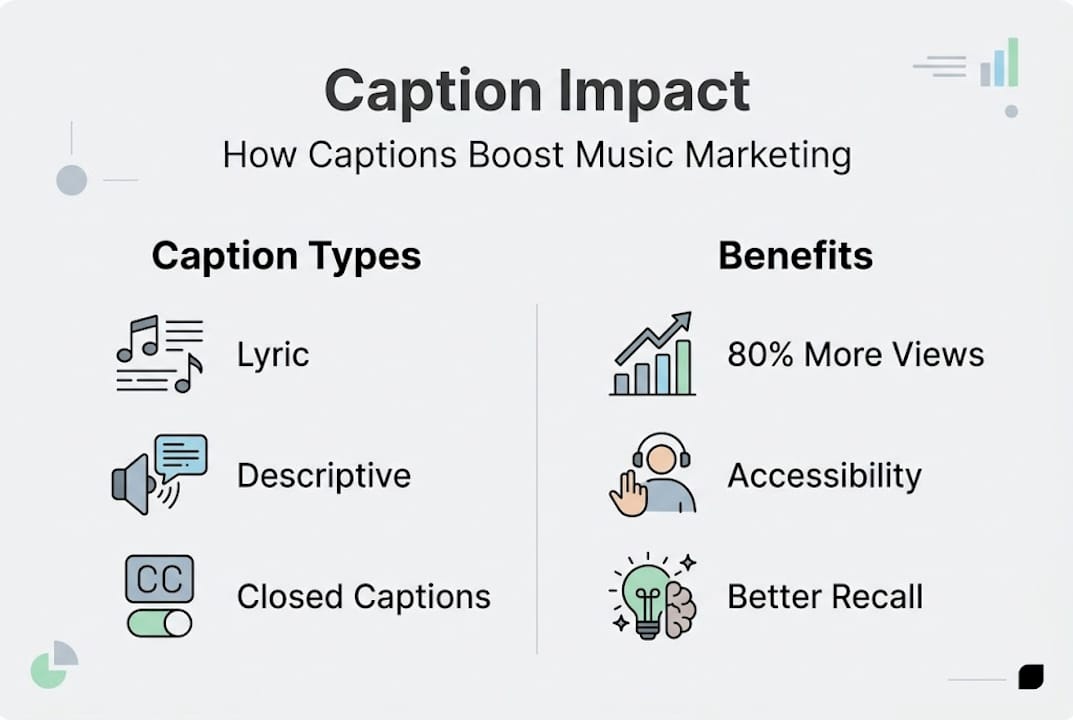
Each type serves a different purpose, but all three share one major benefit: they keep viewers engaged even when the audio is off.
Accessibility and reach
Captions make your content available to fans with hearing loss and to anyone watching in a quiet environment, a commute, a waiting room, or a late-night scroll session. That is a significant portion of your potential audience. Ignoring them means leaving real fans behind.
Engagement and completion rates
Viewers are 80% more likely to finish a video when captions are present. That is not a small bump. Completion rate is one of the most important signals platforms use to decide how widely to distribute your content. Higher completion means more reach, more plays, and more fans discovering your music organically.

Ad recall and brand memory
Captions also produce an 8% higher ad recall, which means viewers remember your music and your name better after watching captioned content. For artists building a visual identity for musicians, that kind of recall is essential.
SEO and discoverability
Platforms index the text in your captions. When you include your song title, genre keywords, or mood descriptors in your captions, you increase the chance of being found by new listeners searching for exactly what you make.
| Benefit | Impact |
|---|---|
| Video completion rate | 80%+ increase with captions |
| Ad recall | 8% higher than uncaptioned |
| Accessibility reach | Fans with hearing loss + silent viewers |
| SEO discoverability | Keyword indexing by platforms |
- Use high-contrast fonts so captions are readable on any background
- Keep caption text short per frame — three to five words at a time works best
- Match caption timing to the beat or vocal rhythm for a more dynamic feel
Pro Tip: Choose bold, sans-serif fonts with a subtle drop shadow. They stay readable whether your video background is bright, dark, or busy.
Crafting effective captions: formulas and audience psychology
Understanding the why is just the start — next, discover the science behind what makes captions work.
The most effective music captions follow a simple but powerful structure: Hook + Value + CTA. The hook grabs attention in the first line. The value gives the viewer a reason to stay, usually through a lyric, a feeling, or a bold statement. The CTA tells them what to do next, whether that is streaming the track, sharing the post, or tagging a friend.
Song lyric captions versus generic text
| Caption type | Example | Typical engagement |
|---|---|---|
| Song lyric caption | “‘I’d rather burn out than fade away’ — new single out now” | High: emotional resonance |
| Generic text caption | “New music out now, go listen” | Low: no emotional hook |
Lyric-based captions outperform generic ones because they trigger emotional recognition. When a fan reads a line that matches how they feel, they stop scrolling. That pause is everything.
Psychological triggers that work
Three triggers consistently drive caption performance for music content:
- FOMO (fear of missing out): “Everyone’s talking about this track — have you heard it yet?”
- Relatability: “For everyone who’s ever felt like they didn’t belong.”
- Community: “Tag someone who needs to hear this right now.”
These aren’t manipulative tactics. They are honest invitations that connect your music to real human emotions.
Steps for writing a high-impact caption
- Start with the strongest lyric or emotional line from the track
- Add one sentence of context — the mood, the story, or the moment it was made for
- Close with a direct, low-friction CTA (“Stream now,” “Save this,” “Tag a friend”)
- Include one or two relevant hashtags that match the genre or mood
- Test two versions and track which one drives more saves and shares
“Captions with a clear hook and lyric can boost likes by up to 71% — making lyric-forward captions one of the highest-return moves in music marketing.”
Knowing how to write hooks for TikTok follows the same logic: the first line has to earn the next one.
Pro Tip: Always run A/B tests on your captions. Post the same video with two different caption approaches and compare the engagement data after 48 hours. Small wording changes can produce surprisingly different results.
How captions drive music discovery and fan engagement
After unpacking formulas and psychology, let’s see how strategic caption use directly impacts your music’s reach and fan loyalty.
Captions do something that audio alone cannot: they communicate mood, theme, and personality instantly, even to someone scrolling with the sound off. A well-written caption tells a new listener who you are before they ever hear a note. That first impression matters more than most musicians realize.
Major platforms actively prioritize captioned videos because they improve both accessibility and retention. TikTok, Instagram, and YouTube all use engagement signals like watch time and completion rate to decide how widely to push your content. Captions directly improve those numbers, which means the algorithm works in your favor.
Platform-specific caption strategies
- TikTok: Keep on-screen captions short and punchy. Lyric reveals timed to the drop fuel trend participation and challenge formats. Captions that ask a question or prompt a reaction drive comment volume.
- Instagram Reels: Use the caption field to add context and hashtags. On-screen text should focus on the emotional core of the track. Stories benefit from interactive stickers paired with short lyric callouts.
- YouTube: Closed captions improve search indexing significantly. Use the description and pinned comment to reinforce the caption message and drive playlist saves.
For music video engagement, captions are one of the most reliable levers you have. Pairing them with strong visuals for higher engagement creates a compounding effect.
Five concrete ways captions elevate music content
- They make your content accessible to a wider audience without any extra production cost
- They increase the chance of appearing in search results on YouTube and Google
- They give fans shareable text to quote in their own posts and stories
- They reinforce your brand voice and artistic identity with every post
- They improve viewer completion rates, which feeds the algorithm and expands your reach
For more on boosting music content, the combination of strong visuals, consistent captioning, and platform-native formatting is what separates artists who grow from those who plateau.
Leveraging AI tools to create impactful music captions
To make captioning effortless and scalable, it’s time to harness the tools built for artists in the digital era.
Manually writing captions for every post, every platform, and every format is time-consuming. AI tools change that. They can generate caption variations in seconds, suggest lyric-based hooks, and even match caption tone to your track’s mood. For musicians releasing content regularly, this kind of workflow efficiency is not optional — it is essential.
Platforms like Reap and Submagic are purpose-built for caption creation and customization. They handle auto-captioning, styling, and timing, so you spend less time on production and more time on the music itself. Orias AI takes this further by integrating caption generation into a broader creative workflow that includes visuals, promo assets, and release packaging.
Top features to look for in an AI captioning solution
- Auto-generation from audio: The tool should transcribe and time-sync captions directly from your track or video
- Style customization: Font, color, animation, and placement options that match your visual brand
- Caption variants: The ability to generate multiple caption versions for A/B testing
- Platform export presets: One-click formatting for TikTok, Instagram, and YouTube specs
- Mood and tone matching: AI that reads the emotional direction of your content and suggests copy accordingly
Integrating these tools with your social media scheduling workflow means you can batch-create captioned content for an entire release campaign in one session. That consistency matters for storytelling with AI and for maintaining a coherent brand presence across platforms.
For artists refining their creative process best practices, AI captioning tools remove one of the most repetitive bottlenecks in content production.
Pro Tip: Let the AI generate five caption variations for each post, then pick the two strongest for an A/B test. You get better data and better captions without spending extra time writing from scratch.
Our take: why most music captions still miss the mark
With tools and strategies in place, it’s worth reflecting on what most marketers overlook — and how you can stand out.
Here is the uncomfortable truth: most musicians treat captions as an afterthought. They drop in a lyric line, add a few hashtags, and call it done. That approach wastes the most visible real estate in your entire content strategy.
Captions that actually move the needle are built around context, not just content. A lyric caption on TikTok should feel native to TikTok culture. The same lyric reframed for Instagram should match the emotional register of that platform’s audience. Generic copy pasted across every channel signals to both the algorithm and your fans that you are not paying attention.
The advanced move is layering in dynamic elements: timed lyric reveals that sync to the beat, emotional cues that prime the viewer before the hook lands, and interactive CTAs that invite participation rather than just directing traffic. These are not complicated techniques. They just require intentionality.
Even great music gets skipped if the caption does not immediately connect. Your music identity and captions should work together as a single system, not as separate tasks. That alignment is where most artists leave real engagement on the table.
Take your music marketing further with advanced AI caption tools
Ready to elevate your music marketing efforts with the right tools? Here’s your next step.
Orias AI is built for exactly this kind of work. It brings together caption generation, visual asset creation, and release packaging into one focused workspace, so you can move from a rough idea to a publish-ready promo pack without switching between a dozen different tools.
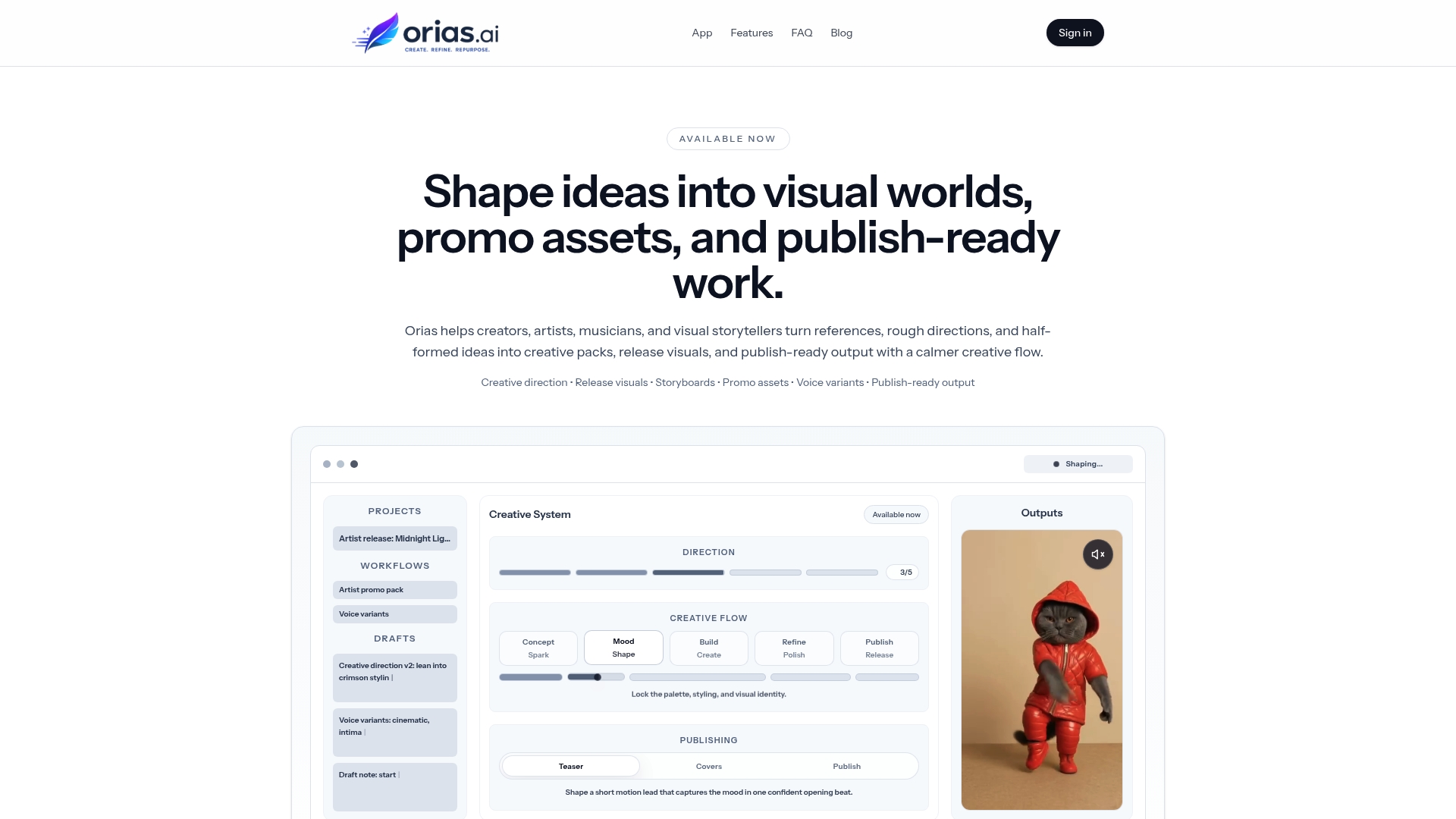
Whether you are preparing a single drop, an album campaign, or ongoing content for your social channels, the Orias AI creative workspace gives you the speed and consistency that modern music marketing demands. Pair it with the strategies in this guide and you will have a captioning workflow that actually supports your growth. Start with your next release and see how music engagement with AI changes what is possible.
Frequently asked questions
Do captions really increase music video engagement?
Yes. Captions boost completion by 80% or more and produce an 8% increase in ad recall, making them one of the highest-impact additions to any music video.
Which platforms benefit the most from music captions?
TikTok, Instagram, and YouTube all reward captioned content with better distribution, since captions drive discovery by improving both accessibility scores and retention metrics.
Can AI tools really help musicians with captions?
Absolutely. Platforms like Reap, Submagic, and Orias AI streamline the entire process, and lyrics in captions generated or refined by AI consistently outperform manually written generic text.
What is the best formula for writing music captions?
The Hook plus Value plus CTA structure works best, especially when it draws on FOMO and relatability psychology to create an emotional connection before asking for any action.