
Music marketing terminology: boost your promo strategy
Master key music marketing terms like pre-save, algorithmic playlist, and conversion rate to boost streams, avoid scams, and grow your music career strategically.

TL;DR:
- Algorithmic playlists drive 31% of streams, emphasizing the importance of engagement signals.
- Understanding key terms like pre-save, metadata, and conversion rate offers a strategic marketing advantage.
- Avoid scams by recognizing red flags such as guaranteed streams and suspicious geographic spikes.
Most independent artists assume a bigger budget is the only path to more streams. The reality is more precise: algorithmic playlists drive 31% of total streams, meaning the right terminology and tactics can outperform raw spending every time. Terms like “pre-save,” “metadata,” and “conversion rate” aren’t just industry jargon reserved for label executives. They’re the operational language of modern music promotion, and fluency in them gives you a measurable edge. This guide breaks down the most important music marketing terms, shows you how to apply them, and helps you avoid the traps that cost artists real money and credibility.
Table of Contents
- Why terminology matters in music marketing
- Core music marketing terms every artist should know
- From strategy to action: Applying music marketing terminology
- Avoiding pitfalls: Fraudulent streams, playlist traps, and red flags
- Our take: Why terminology is your secret music marketing weapon
- Take your music marketing further with smart tools
- Frequently asked questions
Key Takeaways
| Point | Details |
|---|---|
| Master key terms | Understanding music marketing terminology gives you powerful tools to boost your career. |
| Apply strategies wisely | Using the right language helps you execute effective campaigns, land playlist spots, and maximize early engagement. |
| Stay authentic | Recognize and avoid fraudulent tactics to protect your reputation and maximize streaming revenue. |
| Leverage data | Focus on engagement metrics like save-to-stream ratio and conversion rates for sustained growth. |
Why terminology matters in music marketing
With the stage set, let’s explore why learning these terms isn’t just academic—it’s a strategic advantage in your music career.
Most artists focus on the creative side and leave the marketing vocabulary to managers or label reps. That gap is costly. When you don’t know what a distributor means by “metadata optimization” or what a curator expects when they say “engagement metrics,” you lose control over how your music reaches listeners. Language is leverage, and in music marketing, it shapes every decision from release timing to campaign structure.
Here’s a quick-reference glossary of the terms you’ll encounter most:
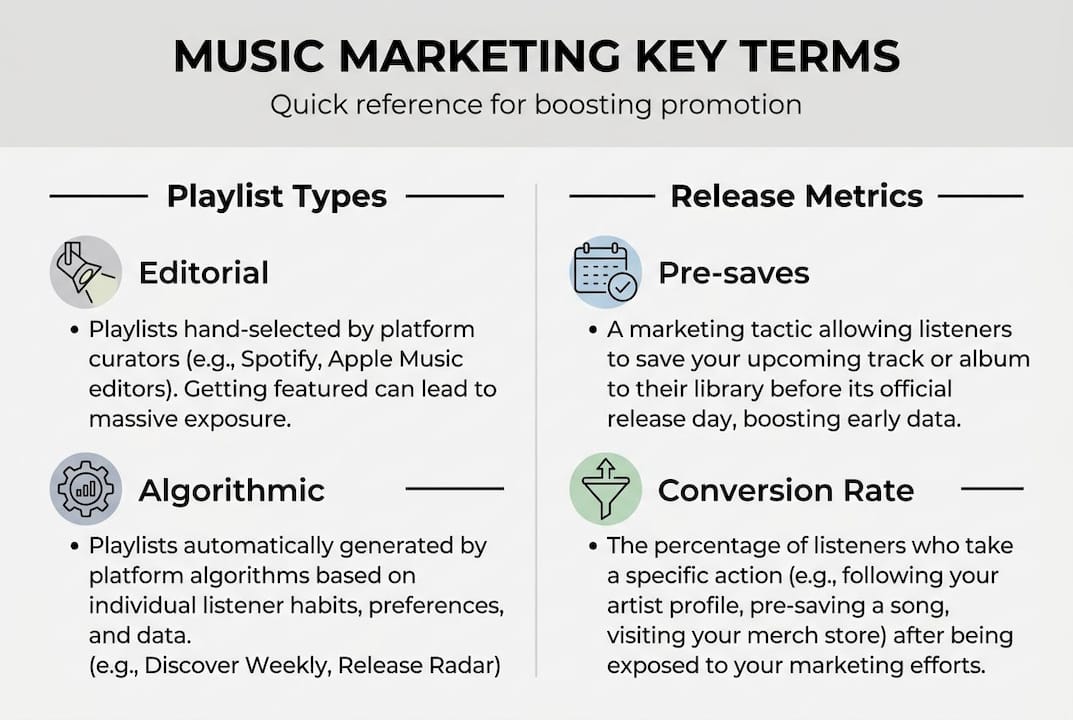
- Pre-save: A fan action that saves your unreleased track to their library before the release date, signaling early demand to algorithms.
- Editorial playlist: A curated list created and managed by platform staff, like Spotify’s “New Music Friday.”
- Algorithmic playlist: A system-generated playlist driven by listener behavior and engagement data, such as Spotify’s Discover Weekly.
- Waterfall release: A strategy where you release tracks one at a time, with each new single replacing the last on the album’s lead track slot to maximize algorithmic attention.
- Metadata: The structured data attached to your track—title, artist name, genre, ISRC code, and lyrics. Incorrect metadata kills discoverability.
- Conversion rate: The percentage of people who take a desired action, like saving your track or clicking a link, out of total people reached.
- Engagement metrics: Data points like saves, shares, playlist adds, and skip rates that signal how listeners actually interact with your music.
“Consistent and early pitching supported by accurate metadata triggers both algorithmic and editorial playlisting.”
Artists who understand these terms don’t just communicate better. They make smarter decisions. When you know what a save-to-stream ratio is, you can evaluate your campaign health without waiting for a manager to explain it. When you understand visual tips for music releases, you realize that release visuals aren’t decoration—they’re conversion tools that affect how many people click, save, and follow.
This fluency also bridges the gap between you and collaborators. Pitching to a playlist curator, briefing a publicist, or reviewing a distributor’s report all become more productive when you speak the same language. Building a consistent magnetic visual identity starts with understanding how visual language intersects with marketing metrics.
Core music marketing terms every artist should know
Having established the role of lingo, let’s break down the most powerful terms you’ll hear—and use—in modern music marketing.
The mechanics of a modern release depend on coordinating several moving parts. Pitching unreleased tracks 7–14 days early, optimizing metadata, and orchestrating pre-save campaigns are foundational steps that separate reactive artists from proactive ones.

Understanding the differences between playlist types is especially important, because each type functions differently and requires a different approach:
| Playlist type | Who controls it | Lifespan | Best for |
|---|---|---|---|
| Editorial | Platform staff/curators | Short-term (weeks) | Initial buzz and press coverage |
| Algorithmic | Platform algorithm | Ongoing, data-driven | Sustained streams and discovery |
| Independent | Third-party curators | Variable | Niche audiences and genre-specific fans |
Algorithmic playlists tend to deliver the most long-term value because they respond to real listener engagement. Editorial playlists offer a spike in visibility but are less predictable and harder to earn. Independent playlists serve a niche role, reaching highly targeted listeners who are more likely to convert into true fans.
Here are some common pitfalls artists run into when they misunderstand these terms:
- Focusing exclusively on editorial playlists while neglecting the engagement signals that feed algorithms.
- Misreading the “save-to-stream” ratio—a high stream count with low saves often signals passive listening or artificial traffic, not genuine interest.
- Ignoring metadata accuracy, which leads to your music being miscategorized or excluded from relevant algorithmic recommendations.
- Underestimating captions in music marketing, which can boost engagement significantly when crafted with intention.
- Skipping pre-save campaigns because they seem like extra work, missing out on the early demand signal they provide.
A well-crafted promo visuals guide can also help you understand how release visuals tie directly into these metrics, turning passive viewers into active followers.
From strategy to action: Applying music marketing terminology
Definitions are only half the battle—here’s how you apply the right terms, at the right time, to get measurable results.
Knowing the vocabulary means nothing if you can’t use it in a real campaign. The sequence below maps terminology directly to action, giving you a framework to plan releases with precision.
- Set your metadata first. Before anything else, confirm your track title, artist name, genre tags, and ISRC code are accurate with your distributor. Errors here create downstream problems for discoverability.
- Pitch 7–14 days before release. Submit your track to editorial curators through your distributor’s platform. Include a short bio, genre context, and the mood of the track. Timing matters more than most artists realize.
- Launch a pre-save campaign. Use a landing page tool to collect pre-saves. Promote it across your social channels in the two weeks before release. A conversion rate above 25% signals strong fan demand.
- Monitor engagement metrics on release day. Watch your save rate, skip rate, and playlist adds in real time. These numbers tell you whether listeners are connecting or bouncing.
- Sustain with content. Post release, keep feeding the algorithm with consistent social activity, behind-the-scenes content, and engagement-driven posts. Algorithms reward ongoing listener activity.
Here’s a quick reference for benchmarks that help you evaluate your campaign performance:
| Metric | Benchmark | What it signals |
|---|---|---|
| Pre-save conversion rate | Above 25% | Strong early demand |
| Save-to-stream ratio | Above 20% | Genuine listener interest |
| Skip rate | Below 30% | Strong track retention |
| Algorithmic stream share | Up to 31% of total | High algorithmic traction |
Applying these metrics to your streamlining creative projects workflow means you’re not guessing—you’re iterating based on real data. A solid digital content workflow also helps you stay consistent between releases without burning out.
Pro Tip: Set your pre-save goal before launch. If you’re targeting 500 pre-saves and your conversion rate is 25%, you need 2,000 landing page visits. That gives you a concrete traffic goal, not just a vague hope.
Algorithmic playlists drive 31% of streams, which means every engagement signal you generate before and after release feeds your long-term discoverability. That’s the compounding effect of understanding these terms in action.
Avoiding pitfalls: Fraudulent streams, playlist traps, and red flags
Mastering terminology also means knowing what to avoid—so you stay authentic, build trust, and maximize revenue.
Not every service offering playlist placement or streams has your best interests in mind. Some are outright scams. Others operate in gray areas that can get your tracks flagged or removed from platforms. Knowing the red flag terms protects your career.
Here are the warning signs to watch for:
- “Guaranteed streams” — No legitimate service can guarantee streams. This phrasing almost always signals bot traffic.
- “Instant playlisting” — Real curators and algorithms take time. Instant results are a red flag for fake engagement.
- “Bot promotion” — Some services openly sell bot plays. This inflates your numbers but destroys your save-to-stream ratio and signals fraud to platforms.
- Unusually high geographic spikes — If your streams suddenly jump from a country with no prior audience, that’s a signal worth investigating.
- Zero save growth despite high stream counts — Real listeners save tracks they like. If streams are climbing but saves aren’t, your traffic may not be authentic.
Spotify deleted 75 million spam tracks in 2025, and an estimated 5–10% of global streams are fraudulent.
The scale of this problem is real, and platforms are actively fighting it. Indie artists must prove authenticity through press coverage, diverse traffic sources, and consistent engagement patterns. Relying on artificial streams doesn’t just risk account suspension—it undermines the trust you’re trying to build with real fans.
Pro Tip: Check your analytics weekly in the first month after release. Look for anomalies: geographic traffic spikes, save counts that stay flat, or skip rates that suddenly jump. Catching these early lets you pivot before they affect your algorithmic standing.
Building a magnetic visual identity as part of your authentic presence also matters here. Artists who maintain consistent visual branding tend to attract organic followings that generate real engagement—the kind algorithms actually reward.
Our take: Why terminology is your secret music marketing weapon
Beyond technical application, here’s why we believe in mastering music marketing language as the essential edge for modern artists.
There’s a tendency in the music industry to treat terminology as gatekeeping—something reserved for executives and label strategists. We think that framing is exactly backward. The artists who grow consistently aren’t the ones with the biggest budgets. They’re the ones who understand what they’re measuring and why it matters.
When you know what a conversion rate represents, you stop guessing and start optimizing. When you understand the difference between editorial and algorithmic playlists, you allocate your effort where it actually compounds. These aren’t buzzwords. They’re levers. And the artists who pull them intentionally build careers that survive industry shifts, platform changes, and trend cycles.
Terminology also gives you agency in conversations you’d otherwise defer. You don’t need to wait for a manager to explain your analytics. You can evaluate a pitch service before signing up. You can spot a scam playlist without losing money to it first. Understanding best practices for creativity means you stay proactive, not reactive, and that mindset is what separates artists who grow from those who stall.
Take your music marketing further with smart tools
Ready to put your new marketing fluency to work? Here’s how you can use AI-driven tools to advance your career.
Knowing the terminology is your foundation. Acting on it consistently is where results actually happen. That’s where Orias AI comes in—an AI-powered creative workspace built specifically for musicians and visual artists who want to move from idea to publish-ready asset without the bottleneck of manual production.
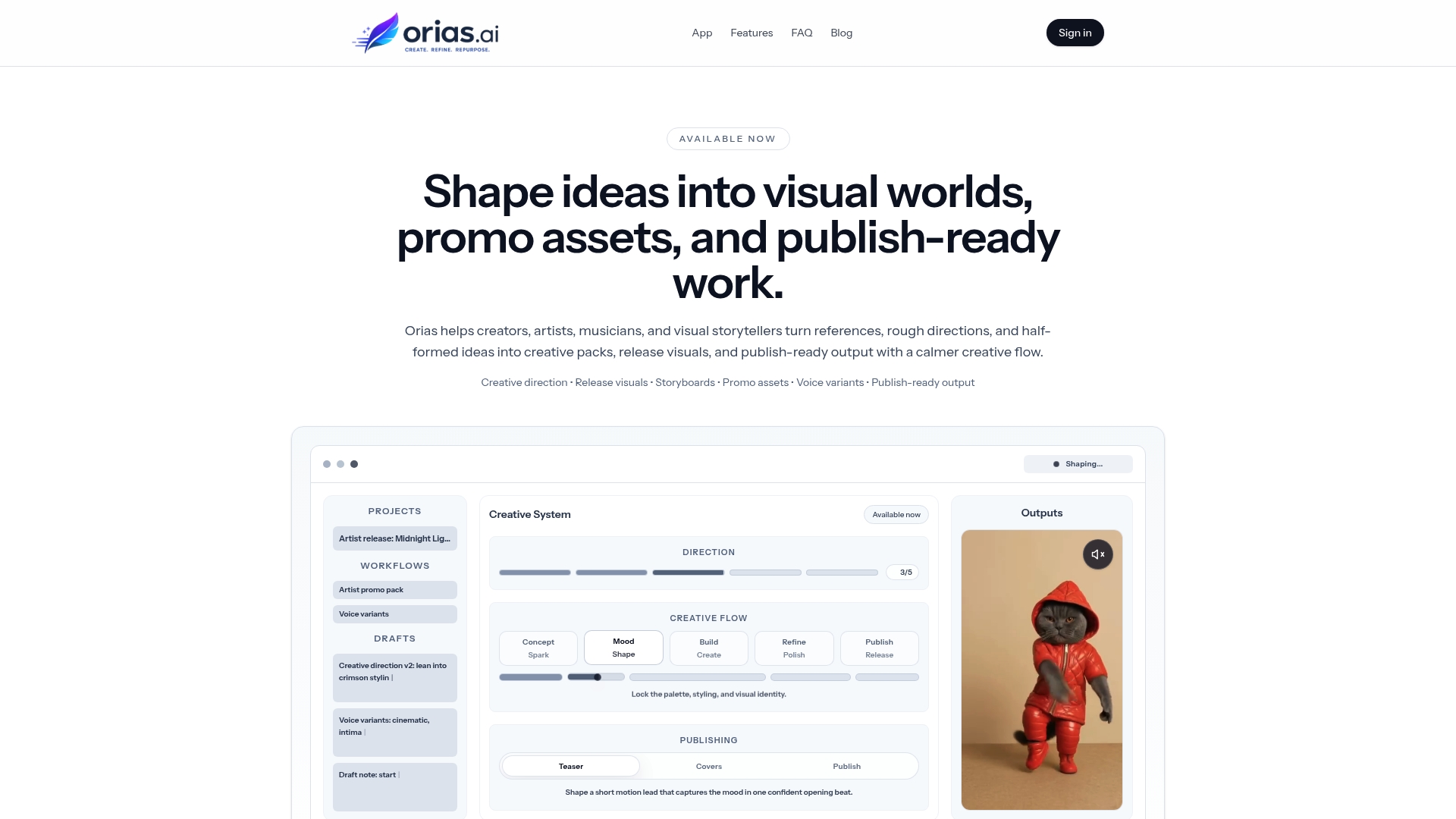
Whether you’re building promo visuals for a pre-save campaign, developing your visual identity across platforms, or creating consistent release assets, Orias AI helps you produce polished, on-brand content at the speed your release schedule demands. Explore visual marketing strategies to see how smart asset creation ties directly into the metrics you’ve just learned to track. Your strategy is only as strong as the tools you use to execute it.
Frequently asked questions
What is the difference between algorithmic and editorial playlists?
Editorial playlists are temporary and less predictable, offering short-term exposure curated by platform staff, while algorithmic playlists use listener engagement data to deliver sustained, data-driven stream growth over time.
How early should I pitch my track for playlists?
Pitch your unreleased tracks at least 7–14 days before release. Pitching 14+ days early doubles your editorial playlist odds and gives algorithms time to respond to early engagement signals.
How can I spot fraudulent streams or scam playlist services?
Warning signs include guaranteed-play claims, unusual geographic traffic spikes, low save-to-stream ratios, and a lack of transparent curator credentials. Vet services carefully and diversify your traffic sources to avoid platform penalties.
What is a pre-save campaign and why does it matter?
A pre-save campaign invites fans to save your track before it releases, generating early demand signals for both algorithms and editorial curators. Pre-save conversion rates above 25% indicate strong demand and help trigger algorithmic playlist placement.