AI music promotion: 5 essential strategies for artists
Discover 5 essential AI music promotion strategies for independent artists. Learn how to use AI tools for visual assets, audience targeting, and smarter releases.
TL;DR:
- Over half of music producers now use AI for promotion and visual content creation.
- AI automates tasks like cover art, social media posts, and fan analytics for independent artists.
- Strategic use of AI signals, visuals, and metadata enhances discoverability and competitiveness.
Over half of music producers now use AI specifically for promotion and visual assets, not just mixing or production. That shift changes what’s possible for independent artists. For years, major labels had the budget and the teams to run data-driven campaigns, build visual identities, and push personalized content at scale. Now, 87% of producers use AI in their workflows, and the tools that power those campaigns are accessible to anyone with a laptop and a release to promote. This article breaks down exactly how independent musicians can use AI to build smarter promotion strategies, from visual asset creation to audience targeting, without needing a label behind them.
Table of Contents
- Understanding AI’s impact on music promotion
- Key AI technologies and tools for music promotion
- Personalization and audience reach: AI in action
- Visual storytelling and content creation with AI
- The real-world challenge: What most musicians miss about AI in promotion
- Elevate your music promotion with Orias AI
- Frequently asked questions
Key Takeaways
| Point | Details |
|---|---|
| AI accelerates music promotion | AI streamlines promotion tasks, enabling musicians to reach audiences faster and more effectively. |
| Personalization is crucial | Optimizing engagement signals and metadata helps indie musicians compete with major artists on streaming platforms. |
| Visual assets drive discovery | AI-generated visuals and captions boost fan engagement and make your music releases stand out. |
| Early adoption gives advantage | Musicians who leverage AI for branding and content creation gain a substantial promotional edge. |
Understanding AI’s impact on music promotion
AI is not just a production shortcut. It has quietly become the backbone of how music gets discovered, shared, and remembered. For independent artists, understanding this shift is the first step toward using it strategically rather than reactively.
At the most practical level, AI tools now automate tasks that used to require either significant budget or significant time. Cover art generation, caption writing, social post scheduling, and fan behavior analytics are all areas where AI has cut the manual workload dramatically. According to one study, 52% of producers use AI specifically for promotion, including cover art, fan analytics, and social content creation. That number signals a real behavioral shift, not a passing trend.
But there is a structural tension worth naming. The same AI that helps you create promotional assets is also powering the recommendation engines on Spotify, Apple Music, and YouTube. Those platforms use AI to personalize what listeners hear next, and they tend to favor artists with stronger engagement signals and larger catalogs. As Forbes reports on AI automation, AI is reshaping how artists approach marketing, but it also means the competition for algorithmic attention is more intense than ever.
Here is what AI-powered promotion typically covers for independent musicians:
- Visual asset creation: Album covers, release banners, social media graphics, and short-form video thumbnails
- Content automation: Scheduled posts, caption variants, and platform-specific formatting
- Fan analytics: Identifying who is listening, where they are, and what content drives retention
- Metadata optimization: Genre tagging, mood classification, and release descriptions that improve discoverability
| Promotion task | Manual approach | AI-assisted approach |
|---|---|---|
| Cover art creation | Hire a designer or use templates | Generate variants from mood and style inputs |
| Social captions | Write individually per post | Produce multiple caption alternatives instantly |
| Fan targeting | Broad demographic guesses | Data-driven niche audience identification |
| Metadata tagging | Manual genre and mood entry | AI-suggested tags based on audio analysis |
For AI-powered visual tips specific to music releases, the focus is on building a consistent visual identity that reinforces your sound, not just producing one-off graphics. That consistency is what makes AI promotion feel intentional rather than automated.
Key AI technologies and tools for music promotion
Now that you understand AI’s role, let’s examine the specific technologies and tools available to creators today. The landscape has expanded quickly, and not every tool fits every artist’s workflow or goals.
The most impactful category for independent musicians is visual asset generation. Platforms that transform a mood reference, a color palette, or a rough concept into publish-ready visuals are saving artists hours per release cycle. These tools are especially useful for artists who have a clear sonic identity but struggle to translate it into consistent visual branding.
Social media scheduling and content automation tools have also matured significantly. They now integrate AI to suggest optimal posting times, generate caption variants, and adapt content formats across platforms. The result is a more consistent release cadence without the daily manual effort.
For audience targeting, AI-powered analytics tools analyze streaming data, social engagement, and playlist placement to identify which listener segments are most likely to convert into long-term fans. This is where indie artists can genuinely compete, because niche targeting often outperforms broad reach for independent releases.
52% of producers utilize AI for cover art, fan analytics, and social content, which tells you these are the three areas with the clearest return on effort.
| Tool category | Best for indie artists | Best for major artists |
|---|---|---|
| Visual asset generation | Release visuals, cover art, promo packs | Large-scale campaign assets |
| Social automation | Consistent posting, caption variants | Multi-platform campaign management |
| Fan analytics | Niche targeting, engagement tracking | Broad demographic analysis |
| Metadata AI | Discoverability optimization | Catalog-wide tagging at scale |
For a practical breakdown of building your visual output, the promo visuals guide covers how to structure assets for maximum engagement. If you are starting from scratch with your visual identity, the magnetic visual identity guide walks through how to build one that holds up across platforms and release cycles.
Pro Tip: Start with the AI tools that solve your most time-consuming problem first. If cover art creation is slowing down your release schedule, prioritize visual generation tools before investing time in analytics platforms.
Personalization and audience reach: AI in action
With a toolkit in hand, let’s explore how to use AI to boost personalized marketing and audience reach, giving indie artists a real edge in a crowded space.
Personalization is where AI delivers its most measurable impact for independent musicians. Rather than broadcasting to a general audience and hoping for traction, AI tools allow you to identify specific listener segments and tailor content to match their preferences. This is not just about targeting ads. It applies to the tone of your captions, the visual style of your posts, and even the timing of your release announcements.

Streaming platforms use AI to reward artists who generate strong early engagement signals. That means the first 48 to 72 hours after a release are critical. Artists who optimize their metadata, release consistent visual content, and drive early saves and playlist adds are more likely to trigger algorithmic recommendations. This is a system you can work with intentionally.
Here are four practical steps for using AI to maximize personalized reach:
- Identify your niche audience segments using analytics tools that break down listener demographics, geographic clusters, and behavioral patterns
- Generate platform-specific content variants so your Instagram post, TikTok clip, and Spotify canvas each feel native to that platform
- Optimize your release metadata with AI-suggested genre tags, mood descriptors, and release descriptions that improve search and recommendation visibility
- Schedule content around engagement windows using AI scheduling tools that identify when your specific audience is most active
“84% of producers want more AI tools for social content and audience reach” — a signal that personalization is the next frontier for music promotion, not just production.
That 84% of producers want more AI for social content and audience reach confirms that the demand for smarter targeting tools is outpacing what’s currently available. Early adopters who build these workflows now will have a structural advantage as the tools continue to improve.
For caption strategy specifically, AI-driven captions can significantly lift engagement rates by matching tone and format to platform expectations. And for building a sustainable creative process around these tools, AI creativity best practices offers a framework for iterating without burning out.
Visual storytelling and content creation with AI
A strong visual presence is essential. Here is how AI helps artists build compelling content that maximizes promotion and keeps fans engaged across every touchpoint.
Visual assets are no longer optional for music promotion. They are the primary hook that determines whether someone stops scrolling or keeps moving. For independent artists, the challenge has always been producing enough high-quality visual content to stay visible without a design team or a large budget. AI changes that equation significantly.
AI tools now allow musicians to generate cover art, release banners, short-form video visuals, and social graphics from mood references, color inputs, or conceptual descriptions. The output is not just fast. It is iterative, meaning you can refine the direction until it matches your creative vision rather than settling for the first result. AI helps generate cover art and social visuals, and the engagement data consistently shows that releases with strong visual packages outperform those without.
Here is what a complete AI-assisted visual content workflow looks like for a single release:
- Pre-release: Generate cover art variants, tease graphics, and mood boards that establish the visual identity of the track
- Release day: Publish coordinated visuals across platforms, including platform-specific formats like Spotify canvas, Instagram stories, and TikTok overlays
- Post-release: Create lyric graphics, fan engagement assets, and milestone posts that extend the promotional window
- Ongoing: Build a consistent visual language that connects releases and reinforces your artist brand over time
For innovative visual storytelling ideas that go beyond standard cover art, the focus is on narrative continuity across a release cycle. And for practical execution, visual tips for music releases covers the specific formats and approaches that drive the most engagement.
Pro Tip: Treat your visual assets as a system, not a series of one-off graphics. When each piece of content references the same mood, palette, and style, your release builds recognition rather than just impressions.
The real-world challenge: What most musicians miss about AI in promotion
Most music promotion guides focus on which tools to use and how to use them. That is useful, but it misses the deeper issue that separates artists who grow from those who plateau.
The real differentiator is not automation. It is signal optimization. Streaming platforms use AI to decide who gets recommended to new listeners, and those decisions are based on early engagement signals, metadata quality, and visual consistency. Platforms favor major artists by default because they arrive with existing signals. Independent artists have to build those signals intentionally from day one of a release.
This means that using AI to generate a cover art graphic is only valuable if that graphic is part of a coordinated effort to drive early saves, playlist adds, and engagement. A great visual with no distribution strategy behind it does not move the needle. But a well-optimized release with consistent visuals, strong metadata, and a clear audience targeting strategy can absolutely compete.
Building a strong visual identity for musicians is not just an aesthetic choice. It is a signal to both fans and algorithms that you are a serious, consistent presence worth recommending. That combination of creative quality and strategic intent is what most artists overlook when they first start using AI tools.
Elevate your music promotion with Orias AI
If you are ready to apply these strategies, here is how Orias AI can take your music promotion to the next level.
Orias AI is built specifically for creators who want to move from idea to publish-ready assets without the friction of manual production. The platform transforms mood references, rough concepts, and emotional directions into complete visual and promotional packs, covering everything from cover art to caption variants to release visuals.
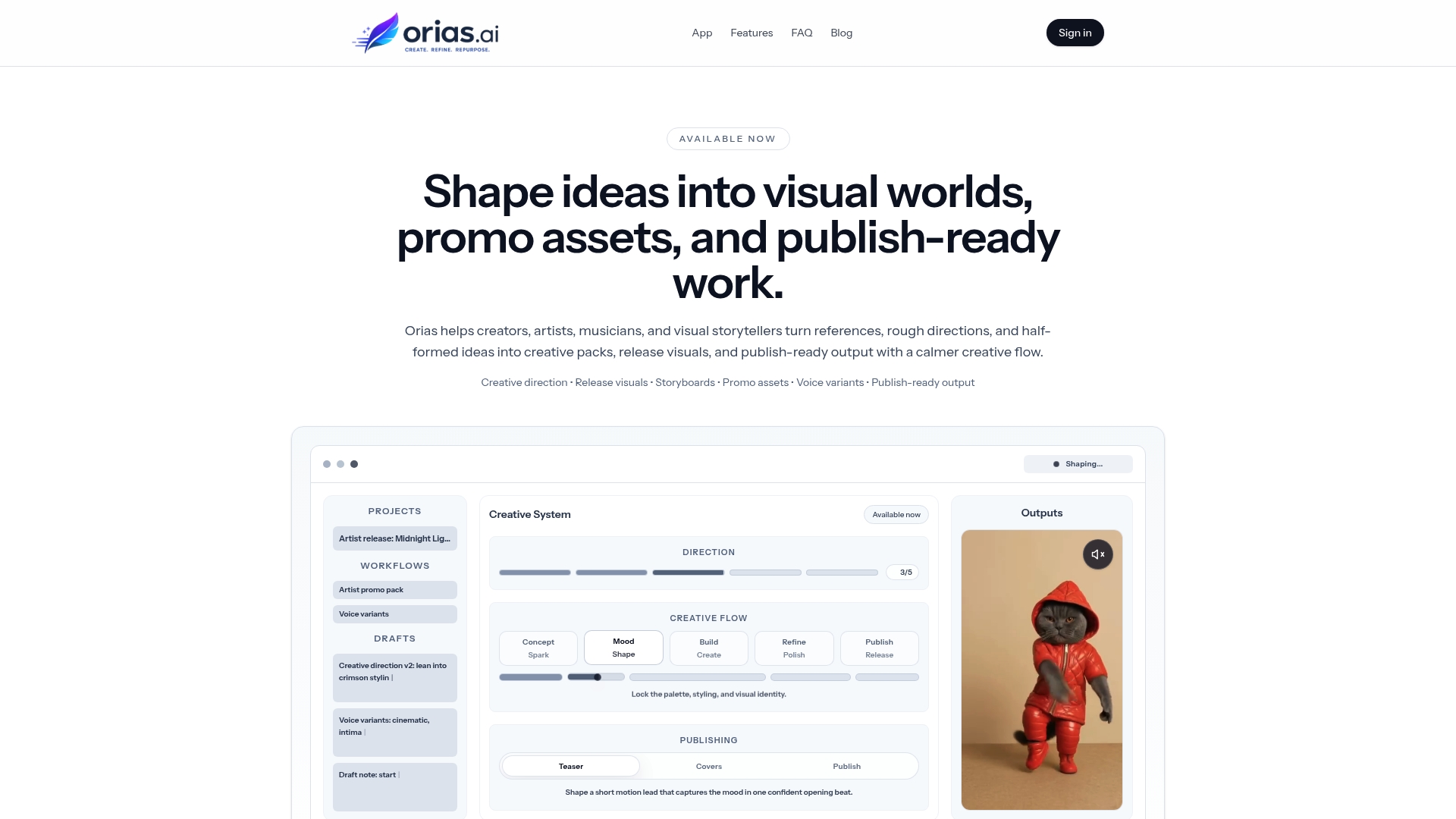
For independent musicians, that means a structured workflow that supports every stage of a release, from early concept to post-release engagement. The AI creative workspace is designed to reduce overthinking and keep your creative process moving. If you want to see how visual assets come together in practice, the promo visuals guide is a strong starting point for building your first AI-assisted release pack.
Frequently asked questions
How do independent musicians use AI for music promotion?
AI helps musicians create cover art, analyze fan insights, automate social content, and personalize marketing strategies for wider audience reach. 52% use AI specifically for cover art and fan analytics, making these the most common entry points.
Can AI boost engagement for music releases?
Yes, AI-driven visuals enhance engagement for new music releases by making promotional content more consistent, platform-native, and visually compelling across the full release cycle.
What AI tools are best for indie artists?
Top tools include those for visual asset generation, social media automation, and audience analytics. The best fit depends on your release cadence and where you lose the most time in your current workflow. AI-powered platforms for cover art and audience targeting are the most widely adopted starting points.
Does AI favor major artists on streaming platforms?
AI personalization favors major artists by default, but indie musicians can compete by optimizing metadata and engagement signals early. Platforms use AI signals for personalization, which means strategic signal-building is a real competitive lever for independents.
Is visual storytelling important for AI-based music promotion?
Absolutely. Strong visual storytelling helps musicians stand out and attract fans, especially when enhanced by AI tools. AI helps generate cover art and social visuals that drive measurable engagement increases across platforms.