Creative workflow examples: boost efficiency with AI tools
Explore real AI-powered creative workflow examples for music, visual storytelling, and campaigns. Find the right approach for your next project.

TL;DR:
- Effective creative workflows prioritize clarity, flexibility, AI integration, collaboration, and traceability.
- AI tools enable rapid iteration and scalable production across music, visual storytelling, and campaigns.
- Human judgment remains essential, with AI serving as an augmentative tool rather than a replacement.
Table of Contents
- What makes an effective creative workflow?
- Music creation workflows: From recording to release
- Visual storytelling workflows: Bringing concepts to life
- Campaign and promo asset workflows: AI-powered content at scale
- Comparison: Which workflow fits your project?
- Why workflow agility will define creative success in 2026
- Next steps: Power up your creative workflow with Orias AI
- Frequently asked questions
Key Takeaways
| Point | Details |
|---|---|
| Smart workflow criteria | Define goals, flexibility, and AI integration for a smooth creative process. |
| Real-world AI examples | Music, visual storytelling, and campaign workflows all boost speed and quality with AI. |
| Collaboration is key | Choose tools that make sharing and group iteration easier for the team. |
| Agility drives results | Being able to shift, adapt, and iterate matters more than the specific tool you use. |
What makes an effective creative workflow?
Before evaluating specific tools or processes, it helps to define what a truly effective creative workflow looks like. Not every workflow is built the same, and the wrong structure can create more friction than it solves.
An effective workflow for creative professionals typically includes these core attributes:
- Clarity in goals and steps: Every contributor knows what the output looks like and what each phase requires. Vague briefs lead to wasted iterations.
- Flexibility for iteration: Creative direction shifts. A good workflow accommodates pivots without requiring you to rebuild from scratch.
- AI integration to fill skill gaps: Not every creator has a full production team. AI tools can handle tasks like sound variation, image generation, or caption writing, accelerating output without sacrificing quality.
- Collaboration features: Whether you’re working solo or with a team, workflows need structured review points and shared asset access.
- Output traceability: Especially for music and visual work, knowing which version was used, who contributed, and whether compensation is owed matters for both legal and ethical reasons.
As noted in AI-enhanced creativity research, AI augments rather than replaces creativity, enabling self-sufficient creators while still requiring human taste to guide outcomes. That distinction is important. The tool does not make the decision. You do.
Pro Tip: Before choosing any AI tool, map your workflow on paper first. Identify where you lose the most time or make the most mistakes. That’s where AI integration will have the highest payoff.
For more on structuring your process from the ground up, explore efficient creative process best practices and structured workflow tips tailored for independent creators.
Music creation workflows: From recording to release
Having clarified what makes a workflow effective, let’s explore how these principles manifest in AI-driven music production.
Music workflows have evolved significantly with AI. The old model required expensive studio time and a full team for production, mixing, and mastering. Today, a solo artist can move from a rough voice memo to a polished, release-ready track using a structured AI-assisted process.
Here’s a practical step-by-step breakdown:
- Upload your rough demo to Suno. Musicians upload rough recordings to Suno for transformation and evolution, iterating hundreds of times to explore different sonic directions without re-recording from scratch.
- Refine in your DAW. Once a direction feels right, bring the output into your digital audio workstation (DAW) for fine-tuning. This is where your human ear makes the final calls on arrangement and tone.
- Generate sample variations with Splice. Splice Variations create multiple sample versions, ensuring creator compensation and seamless DAW integration so you can experiment freely without licensing risk.
- Export finalized versions for distribution. Prepare stems, full mixes, and alternate edits for streaming platforms, sync licensing, and promotional use.
“The iteration is the process. Hundreds of small decisions, guided by taste, produce something that feels original even when AI is involved.”
This workflow works especially well for independent musicians who need to move fast without compromising on sound quality. It also creates a traceable record of creative decisions, which matters when questions of authorship or compensation arise.
Pro Tip: Export at least three versions of each track during the Suno iteration phase: one safe, one experimental, one stripped-back. You’ll often find the stripped version works better for visual content and reels.
For guidance on pairing your audio output with strong visuals, check out these visual tips for music releases and the streamlined workflow for musicians.
Visual storytelling workflows: Bringing concepts to life
With music workflows covered, let’s see how visual storytellers use similar iterative methods for their own unique needs.
Visual creators face a different challenge: translating an emotional concept or narrative idea into a sequence of images, motion, and sound that holds an audience’s attention. AI tools have made that translation faster and more precise.
Here’s how a strong visual storytelling workflow looks in practice:
- Generate concept art with Midjourney. Start with a text prompt that captures mood, palette, and setting. Midjourney enables rapid visual world-building and storyboarding, while Sousaku powers animation and Adobe Premiere handles the final edit sync.
- Build your storyboard. Arrange generated images in sequence, adjusting for pacing and narrative flow. This stage is where your editorial instincts matter most.
- Add motion with Sousaku. Bring key frames to life with subtle animation. Even minimal motion increases viewer retention significantly.
- Sync to audio in Adobe Premiere. Lock your visual sequence to the music or voiceover, refining cuts for rhythm and emotional payoff.
Key benefits of this approach include:
- Faster concept validation before committing to full production
- Ability to test multiple visual styles in parallel
- Consistent mood and palette across all assets
- Reduced dependency on large production crews
Stat worth noting: One documented project developed an 11-song album through hundreds of iterations over four years, using AI-assisted visual and audio tools throughout the entire creative arc. That kind of sustained iteration would have been cost-prohibitive without AI support.
For more inspiration on applying these techniques, explore visual storytelling ideas built specifically for independent artists and creators.
Campaign and promo asset workflows: AI-powered content at scale
Beyond individual works, large campaigns also benefit from automated, scalable workflows. Let’s break one down.

When a campaign requires dozens of assets across multiple formats and platforms, manual production becomes a bottleneck fast. AI-powered workflows solve this by generating large asset pools quickly, then using collaborative curation to narrow down to the best options.
Adobe created a full 1-minute social campaign video using Firefly, generating over 500 image assets for collaborative curation and final production. That’s a scale of output that would take a traditional team weeks to produce manually.
Here’s how the workflow breaks down:
| Stage | Tool | Output |
|---|---|---|
| Asset generation | Adobe Firefly Boards | 500+ image variants |
| Collaborative review | Shared board curation | Shortlisted scenes |
| Editing and motion | Premiere / After Effects | Polished video cuts |
| Extended motion | Runway or Pika | AI-generated transitions |
| Final delivery | Export for social platforms | Campaign-ready assets |
Key advantages of this workflow include:
- Speed: A complete campaign video in under two weeks
- Diversity: Broad visual range from a single generation session
- Scalability: Easy to adapt assets for different formats and platforms
- Collaboration: Teams can review and direct without being in the same room
For a deeper look at building promo assets that actually drive engagement, the promo visuals guide covers practical strategies for modern content creators.
Comparison: Which workflow fits your project?
To make sense of the examples, here’s how each workflow stacks up for different creative needs.
Choosing the right workflow is not just about the tools available. It’s about matching the process to your project scale, team size, and the kind of creative output you’re building toward. As research on creative AI workflows confirms, each workflow addresses different aspects of creativity, from rapid iteration to large-scale campaign production.
| Workflow type | Best for | Iteration speed | Collaboration | Traceability |
|---|---|---|---|---|
| Music (Suno + DAW) | Solo musicians, EP/album releases | Very fast | Low to medium | Medium |
| Visual storytelling | Artists, filmmakers, animators | Fast | Medium | Medium |
| Campaign production | Brands, content teams, agencies | Moderate | High | High |
Factors to weigh when making your choice:
- Project scale: A solo track release needs a leaner workflow than a multi-platform campaign.
- Team size: Larger teams benefit from workflows with built-in review and approval stages.
- Artistic goals: If experimentation is central to your process, prioritize workflows with high iteration speed and low friction.
- Budget and tools: Some platforms require subscriptions or credits. Map your tool costs before committing to a workflow.
For a broader overview of how digital content workflows are structured across creative disciplines, the content workflow overview is a useful starting point.
Why workflow agility will define creative success in 2026
Here’s the part most workflow guides skip: the tool stack is almost secondary. What actually separates creators who produce consistently from those who stall is how quickly they can adapt when a workflow stops working.
AI tools are evolving fast. A process that felt optimal six months ago may already have better alternatives. Rigid workflows become obsolete quickly, while creators who treat their process as something to iterate on, just like their work, build a genuine creative edge over time.
With an 87% adoption rate among creators who see AI as an enhancement rather than a threat, the mindset shift is already happening. The question is whether you’re treating AI as a collaborator with a defined role, or just as a shortcut.
Human taste is not replaceable. It’s the filter that turns 500 generated assets into one compelling campaign, or 200 Suno iterations into a track worth releasing. The creative process best practices that hold up over time are the ones built around that principle: use AI to expand your options, then apply your judgment to make the final call.
Next steps: Power up your creative workflow with Orias AI
The workflows covered here are proven, practical, and adaptable. But applying them well requires a workspace designed for creative iteration, not just task completion.
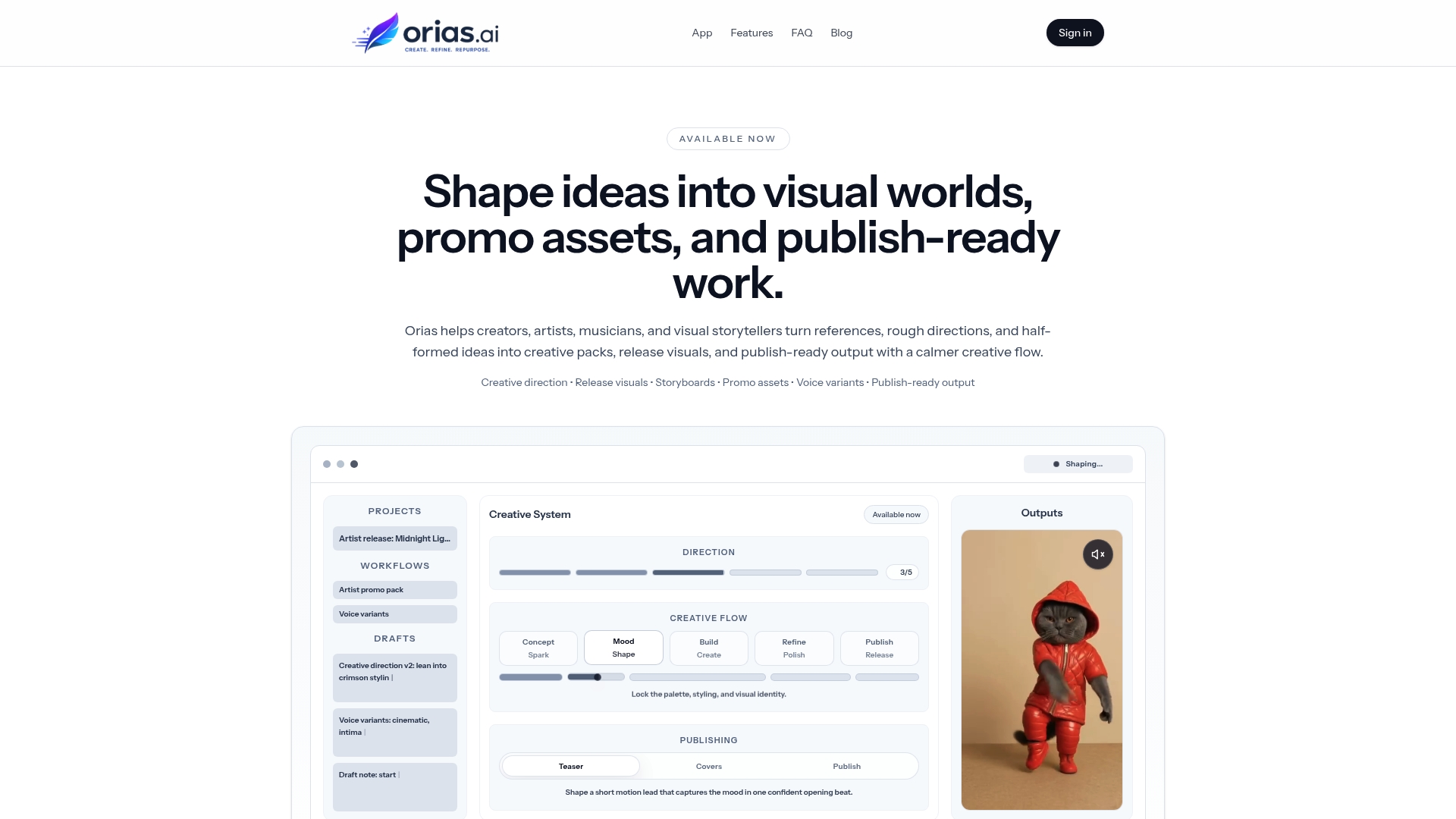
Orias AI is built specifically for creators who want to move from rough concept to publish-ready asset without losing creative clarity along the way. Whether you’re developing a music release, building a visual campaign, or producing promo content at scale, Orias AI gives you the structure and tools to do it efficiently. Start by exploring the get started with best practices guide, and put these workflow principles into practice with a platform designed to support every stage of your creative process.
Frequently asked questions
How do AI tools support creative iteration?
AI tools like Suno and Firefly generate and evolve creative assets rapidly, letting you explore dozens of directions in the time it would normally take to produce one. Musicians iterate hundreds of times using Suno alone before arriving at a final direction.
What makes a workflow suitable for collaborations?
Effective collaborative workflows include shared asset libraries, structured review stages, and flexible iteration so every team member can contribute meaningfully. Adobe’s Firefly campaign demonstrated this by producing 500+ assets for team-directed curation.
Can AI replace creative professionals?
No. AI augments rather than replaces creative work. Human direction, taste, and judgment remain the deciding factors in what makes output worth publishing.
How do AI workflows handle copyright and compensation?
Platforms like Splice build traceability directly into the generation process. Splice Variations track sample usage and ensure original creators are compensated whenever their assets are used in new productions.


