
Achieve Creative Clarity: A Practical Guide for Musicians
Discover practical frameworks to achieve creative clarity as a musician, from a 5-stage creative process to visual branding strategies that make your music seen.

TL;DR:
- Creative clarity is achieved through focused decision-making, not by generating endless ideas.
- A structured five-stage process helps musicians transform raw ideas into finished, promotable work.
- Applying constraints and deliberate systems enhances originality and builds consistent visual branding.
Most musicians assume that creative clarity means having a constant flood of ideas. More demos, more concepts, more options. But top creators know the opposite is true: clarity comes from narrowing focus, not widening it. The real challenge isn’t generating ideas — it’s knowing which ones serve your artistic vision and how to develop them into finished, promotable work. This guide walks you through the specific frameworks, stages, and branding strategies that move you from scattered creative energy to focused output, including how your visual identity fits into the same deliberate process as your music.
Table of Contents
- Understanding creative clarity: Myths vs. reality
- The musical creative process: Stages and strategies
- The role of constraints and intuition in creativity
- From creative clarity to visual branding: Making your music seen
- A fresh perspective: The real reason clarity escapes most musicians
- Level up your creative clarity with the right tools
- Frequently asked questions
Key Takeaways
| Point | Details |
|---|---|
| Clarity needs structure | Intentional creative frameworks help musicians move from idea overload to effective execution. |
| Constraints unlock creativity | Deliberate limitations spark originality and help develop a distinctive sound and brand. |
| Visuals reinforce your message | Strong visual branding translates musical clarity into audience recognition across platforms. |
| Iterate, don’t wait | Most breakthroughs come from repeated cycles and processes, not from waiting for inspiration. |
Understanding creative clarity: Myths vs. reality
The most persistent myth in music is that clarity arrives on its own. You wait for the right mood, the perfect acoustic space, or a bolt of inspiration. When nothing comes, you assume something is wrong with your talent rather than your process. This framing keeps a lot of skilled musicians stuck.
True creative clarity isn’t a feeling — it’s a set of decisions you make about what matters and what doesn’t. It means knowing your artistic essence, the emotional core of what your music communicates, well enough to make fast, confident choices. Without that foundation, every decision feels equally important, and paralysis follows.
Three common myths worth addressing:
- Clarity means having all the answers before you start. In reality, clarity emerges through the work itself, not before it.
- More ideas equals more progress. Volume is useful early in the process, but undirected accumulation replaces action.
- Inspiration is the primary driver. Sustained creative output relies on systems, not moods.
Producer Rick Rubin offers a more useful frame. His approach to creative clarity centers on reducing to essence, breaking rhythms, forgetting rules, and cultivating an abundant mindset. He treats creativity as a way of being rather than a transaction where effort produces results on demand. That shift matters because it removes the pressure of expecting every session to deliver breakthroughs.
“Creativity is not a talent. It is a way of operating.” — Rick Rubin
For musicians, this matters beyond sound. Your visual presentation, promotional materials, and public identity all reflect the same clarity — or lack of it — as your music. Audiences form impressions from everything they see before they hear a single note. Exploring best creativity practices gives you a fuller picture of how to build clarity across both your sound and your image.
With the stage set for why clarity matters, let’s examine the core creative process musicians can use.
The musical creative process: Stages and strategies
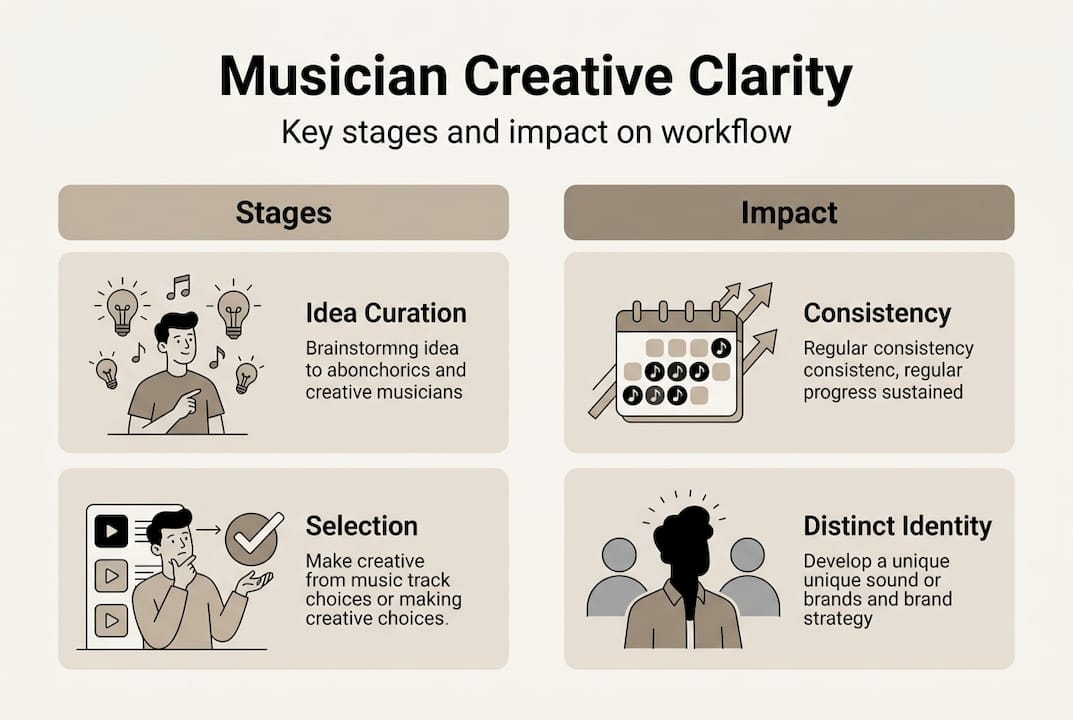
Having an intentional process is what separates musicians who finish work from those who circle the same ideas indefinitely. A five-stage framework gives you a repeatable structure to follow, even when motivation is low.
Here’s an overview of the five stages:
| Stage | Focus | Goal |
|---|---|---|
| 1. Idea Curation | Generate volume | Capture without judging |
| 2. Selection | Filter raw ideas | Identify what’s worth developing |
| 3. Development | Expand chosen ideas | Build structure and detail |
| 4. Refinement | Polish and edit | Strengthen what’s working |
| 5. Release Prep | Finalize for output | Package for audience |
This approach, detailed in the five stages framework, prioritizes idea volume in the early stage before any filtering begins. The reason is straightforward: premature judgment kills momentum. You need material to work with before you can start making meaningful choices.
Here’s how to move through the stages effectively:
- Set a timer for idea generation. Give yourself 20 minutes to record voice memos, sketch chord progressions, or jot lyrics without stopping to evaluate.
- Separate curation sessions from creation sessions. Your critical mind works against you when you try to judge and create at the same time.
- Use a scoring method for selection. Rate each idea on emotional resonance, originality, and fit with your current artistic direction.
- Iterate in short cycles. Thirty-minute focused work blocks with defined objectives beat open-ended marathon sessions.
- Build your release prep into the process from the start. Thinking about your magnetic visual identity early means fewer last-minute scrambles when a drop approaches.
Pro Tip: Borrow the design thinking cycle for your music practice. Listen to what your instincts produce, play with variations, iterate on the strongest elements, and bring in a collaborator for a fresh perspective before finalizing anything.
Process awareness is also the most effective antidote to perfectionism. When you know which stage you’re in, you stop expecting Stage 1 output to look like Stage 4 output. A useful resource for structuring creative workflow can help you build these stages into a practical daily or weekly routine.
Now that the value of clarity is clear, here’s how musicians can apply proven frameworks to their workflow.
The role of constraints and intuition in creativity
Creative freedom sounds appealing, but too many options often produce worse results. When everything is possible, nothing feels urgent. The blank page is paralyzing precisely because it offers no resistance.
Constraints change that. They create a boundary that forces your creative energy into a specific channel, and the pressure of that channel often produces originality. A well-known example: Bach’s Goldberg Variations emerged from a simple bassline as a structural constraint. The limitation didn’t suppress creativity — it focused it.
Here’s a comparison of how analog and digital workflows affect the creative process:
| Workflow Type | Constraints | Effect on Output |
|---|---|---|
| Analog | Fixed channels, physical tools | Encourages flow states, forces commitment |
| Digital (unlimited) | Infinite options, easy undo | Can create decision fatigue and shallow iteration |
| Digital (constrained) | Self-imposed limits applied | Combines flexibility with productive focus |
Setting artificial constraints is a practical skill:
- Limit yourself to three instruments per track for one month.
- Write a song using only notes from a single scale.
- Finish a rough demo in 90 minutes with no revisions allowed during that window.
- Commit to releasing a piece of content before it feels fully ready.
Intuition plays an equally important role, but it needs to be understood correctly. Musical intuition draws from implicit memory — the accumulated patterns you’ve absorbed through years of listening and creating. It’s not random. But relying on intuition alone tends to produce formulaic output, because you naturally gravitate toward what’s familiar.
The productive balance is pairing your perceptual knowledge with deliberate surprise elements. Bring in an unfamiliar scale, collaborate with someone from a different genre, or record in an environment you’ve never tried. Constraint plus unexpected input gives you the conditions for genuine originality.
Pro Tip: Set one artificial constraint per project before you start. Write it down and commit to it. You’ll likely find that the constraint becomes one of the defining features of the final piece.
For musicians thinking about visual identity, the same principle applies. Limiting your color palette or typography choices creates a more recognizable brand. Visual storytelling ideas can give you a starting point for applying constraint-based thinking to your promotional visuals.
With a process and understanding of clarity, it’s vital to get practical about tools that bring your creative vision to life, especially visually.
From creative clarity to visual branding: Making your music seen
Your music communicates an emotional experience. Your visual branding should do exactly the same thing — with consistency, intention, and the same clarity you bring to your sound.

A common mistake is treating visual assets as an afterthought, something rushed together when a release date is approaching. That approach produces a disjointed public image that doesn’t reinforce the music. Audiences notice the gap, even if they can’t name it.
The iterative process that works for music works equally well for visual development. Research on design thinking parallels in creative fields confirms that musicians and designers use strikingly similar cycles: listen, play, iterate, collaborate. Applying that same loop to your visual work — generating rough concepts, testing them, refining based on feedback — produces stronger assets and protects you from the perfectionism trap.
Practical quick wins for building visual clarity:
- Album art: Start with three rough concepts before committing to one direction. Test them with a small audience for emotional response.
- Promo packs: Build a template system using your defined fonts, colors, and logo placement so each release maintains a consistent look.
- Social visuals: Use a consistent image style — whether that’s high-contrast photography, illustration, or type-led design — across all platforms.
- Release visuals: Plan your visual rollout alongside your audio rollout. Both should build anticipation toward the same emotional payoff.
Pro Tip: Lock in two to three brand fonts and a core color palette before your next release. Apply them across every touchpoint — covers, story frames, press shots. Consistency in these small details builds platform recognition faster than one standout visual ever could.
For deeper guidance on applying this to real releases, visual tips for music releases and a promo visuals guide cover the specifics of building assets that actually drive engagement.
Understanding how clarity plays out in every part of your creative process prepares you for the final practical steps.
A fresh perspective: The real reason clarity escapes most musicians
Here’s the uncomfortable part: most musicians don’t have a talent problem. They have a systems problem. The assumption that clarity will arrive when the right conditions align — when you feel inspired, when the room sounds right, when the pressure is off — is the exact thinking that keeps output inconsistent.
Clarity isn’t something that happens to you. It’s something you build through repeated, structured action, even on days when the work feels mechanical and uninspired. The five-stage creative process works precisely because it treats creativity as an operating system rather than a mood state. When you follow the system, you generate usable output regardless of how inspired you feel.
Perfectionism compounds the problem. It masquerades as high standards while actually functioning as avoidance. The rough idea you dismissed last Tuesday might have been the seed of something strong if you’d developed it through a few iterations. Acting on imperfect material is not a compromise. It’s the actual work.
Designing a visual identity with the same system-first thinking reinforces this shift. When your creative process is reliable, your output — musical and visual — becomes recognizable and sustainable.
Level up your creative clarity with the right tools
Applying these frameworks consistently is where most musicians run into friction. The principles make sense, but translating them into actual assets — promo visuals, release packs, consistent branding — takes time and tools that match the pace of creative work.
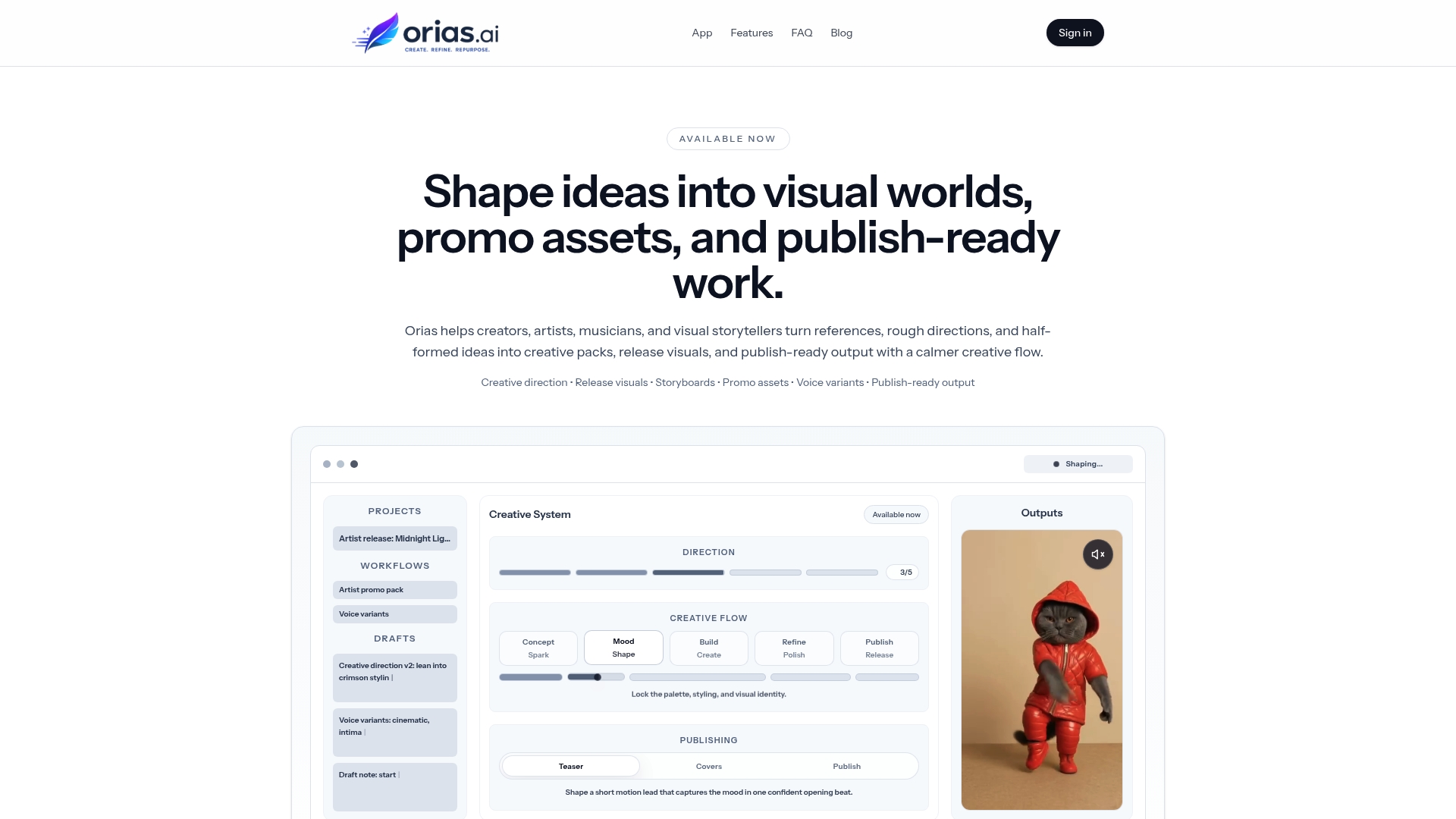
Orias AI is built specifically for that gap. As an AI Creative Workspace, it transforms rough ideas and emotional directions into publish-ready visual and promotional assets, helping you move from concept to release without the usual bottleneck. You can shape mood, generate variants, and export complete creative packs — all within a focused, iterative workspace. Browse creative workflows resources to see how other creators are applying these principles with the platform.
Frequently asked questions
How can musicians overcome creative blocks for better clarity?
Musicians can overcome blocks by focusing on process awareness — breaking work into stages, starting with idea quantity, and using structured iteration rather than waiting for inspiration to arrive.
Do limitations help or hinder musical creativity?
Limitations help creativity significantly — constraints focus creative energy and push musicians toward original solutions instead of defaulting to familiar, formulaic patterns.
How does visual branding relate to creative clarity for musicians?
Clear visual branding translates your musical identity into a recognizable public image, and applying intentional visual strategies makes every promotional asset work harder for you across platforms.
Is intuition enough to achieve creative clarity?
Intuition is a valuable starting point, but balancing intuition with deliberate process — including constraints and structured iteration — consistently produces stronger creative results than intuition alone.


