Brand Character Systems: Building a Repeatable Mascot or Persona with AI
Build a recognizable AI brand character that can survive new poses, scenes, campaigns and formats without slowly turning into someone else.
TL;DR:
- A repeatable AI character starts with fixed visual rules, not one unusually good prompt.
- Define the traits that must never change, build a small approved reference pack, and test the character in difficult scenes before using it across a campaign.
- Keep human judgment in the loop for selection, editing, originality, rights, and the final call on whether every image still feels like the same character.
The first image is usually the easy one.
You write a prompt, try a few directions, adjust the clothing, fix the expression, and eventually get a character that feels right.
Maybe it is an illustrated mascot for a product.
Maybe it is a virtual persona for a music project.
Maybe it is a recurring character that needs to appear across covers, social posts, campaign visuals, videos, and promotional assets.
Then you make the second image.
The face changes slightly.
The jacket has different proportions.
The eye color drifts.
A distinctive mark disappears.
Ten generations later, you no longer have one character appearing in different situations.
You have ten distant relatives.
Reference-based AI tools can help. Current image systems can use reference images to guide recurring characters, objects, styles, and compositions.
But references do not remove the need for creative direction.
If a character is meant to become part of a recognizable brand world, the useful question is not, "How do I write the perfect prompt?"
It is:
What needs to stay true every time this character appears?
That is where a character system begins.
Table of Contents
- Key Takeaways
- Start With Rules, Not a Face
- Build a Character Bible That Can Survive a Hundred Generations
- Separate Locked Traits From Creative Freedom
- Create a Reference Pack Instead of One Perfect Image
- Stress-Test the Character Before the Campaign Needs It
- Turn the Approved Character Into a Production System
- Keep Human Authorship, Provenance, and Control Visible
- Using Orias AI to Build the Character World
- Frequently Asked Questions
- Sources Used
Key Takeaways
| Point | Details |
|---|---|
| Consistency starts before generation | Define the character's physical, visual, and behavioral rules before creating campaign scenes. |
| One reference is fragile | Use approved views from different angles, distances, expressions, and poses instead of relying on one hero image. |
| Not every trait needs to be locked | Separate identity-defining features from clothing, settings, props, and other elements that can change. |
| Difficult scenes reveal weak systems | Test different lighting, emotions, camera angles, actions, and formats before depending on the character publicly. |
| Save decisions, not just images | Keep approved references, prompt structures, rejected directions, and the reasons behind important creative choices. |
| Human review remains essential | AI can produce variations, but taste, originality, rights checks, editing, and final brand fit still require human judgment. |
Start With Rules, Not a Face
When character consistency starts breaking, the usual reaction is to make the prompt longer.
You add the hair color again.
Then the jacket.
Then eye shape.
Then phrases like "same exact character" and "identical face."
Sometimes that helps.
But it does not solve the underlying problem if you have never decided which traits actually define the character.
Imagine a fox mascot.
"Cute orange fox wearing a green jacket" describes a category.
It does not describe one specific character.
A stronger definition might include:
- Large triangular ears that are slightly oversized for the head
- A short muzzle rather than a narrow realistic fox face
- A small dark patch above the left eye
- A loose dark-green work jacket
- A cream-colored chest
- Large paws and slightly shortened legs
- A relaxed, mildly curious expression
- A slightly hunched standing posture
Now you have something repeatable.
The same principle applies to a realistic virtual persona.
Hair color alone rarely creates recognition.
Recognition comes from combinations: face shape, proportions, hairstyle, distinctive details, clothing silhouette, posture, expression, and how the character is usually photographed.
Pro Tip: Describe the character well enough that an illustrator who has never seen the original image could create a recognizable version from your notes.
If the description is vague to a person, it will probably remain vague inside an AI workflow too.
Build a Character Bible That Can Survive a Hundred Generations
A character bible does not need to become a forty-page brand manual.
One clear page is enough to start.
Its job is simple.
It tells you what the character is supposed to be before new images start pulling the idea in different directions.
Define the Physical Framework
Record the character's height, proportions, head shape, body shape, limb length, and overall silhouette.
For a stylized mascot, proportions may matter more than realistic anatomy.
A character with a huge head and very short torso can stop feeling recognizable surprisingly quickly if those proportions drift toward realism.
Document the Face
Define eye shape, nose, mouth, eyebrows, hairline, fur pattern, freckles, scars, makeup, or any other recurring feature.
Do not list every microscopic detail.
Focus on the few things that change recognition when they disappear.
Give Color a Job
"Blue and red" is not much of a system.
Decide where colors belong.
Maybe pale blue is always used for the main clothing layer, while a warmer red appears only as a small accessory.
That relationship can become more recognizable than either color on its own.
Define Behavior, Not Only Appearance
A useful character system also describes how the character behaves visually.
Are they energetic?
Quiet?
Slightly awkward?
Always looking directly into the camera?
Usually caught in motion?
A character that suddenly behaves like a completely different personality can feel inconsistent even when the face is technically correct.
Lock the Visual Medium When It Matters
Decide whether the character lives in editorial photography, clean 3D, flat illustration, hand-drawn ink, clay-like forms, collage, or another specific treatment.
Current tools often separate character or object references from style and composition references.
That is a useful way to think about the system even if you change tools later.
| Layer | What It Controls |
|---|---|
| Character identity | Face, body, distinguishing traits, recurring clothing, proportions |
| Visual style | Texture, medium, lighting language, rendering treatment, color behavior |
| Composition | Camera position, framing, placement, pose, spatial relationships |
| Scene | Location, action, props, weather, story, campaign context |
Separate Locked Traits From Creative Freedom
Consistency does not mean freezing everything.
If every image uses the same expression, outfit, camera angle, background, and pose, the character may be consistent but the creative system becomes useless.
Divide the character into three levels instead.
Level One: Never Change
These are the identity anchors.
- Core face shape
- Key proportions
- Distinctive marks
- Primary color relationships
- Eye color when it matters to recognition
- Basic silhouette
If several of these change at once, the character often stops reading as the same person or mascot.
Level Two: Change Carefully
These elements can move, but they still contribute to identity.
- Jackets and secondary clothing
- Hairstyle variations
- Accessories
- Emotional intensity
- Color saturation
- Degree of stylization
Level Three: Change Freely
This is where most of the creative range should live.
- Location
- Pose
- Camera angle
- Props
- Weather
- Story situation
- Asset format
- Action
Instead of asking AI to "make the same character but something different," you can deliberately change only the third layer.
This gives the character room to live.
A good mascot should be able to appear on stage today, inside a social story tomorrow, and on packaging next month without becoming a different character.
You do not need identical images.
You need persistent identity.
Create a Reference Pack Instead of One Perfect Image
One image hides a lot of missing information.
If the character only exists from the front, the profile is still undefined.
If every reference uses the same calm expression, an angry or laughing version is still mostly guesswork.
If you only have close portraits, body proportions may exist mainly in your head.
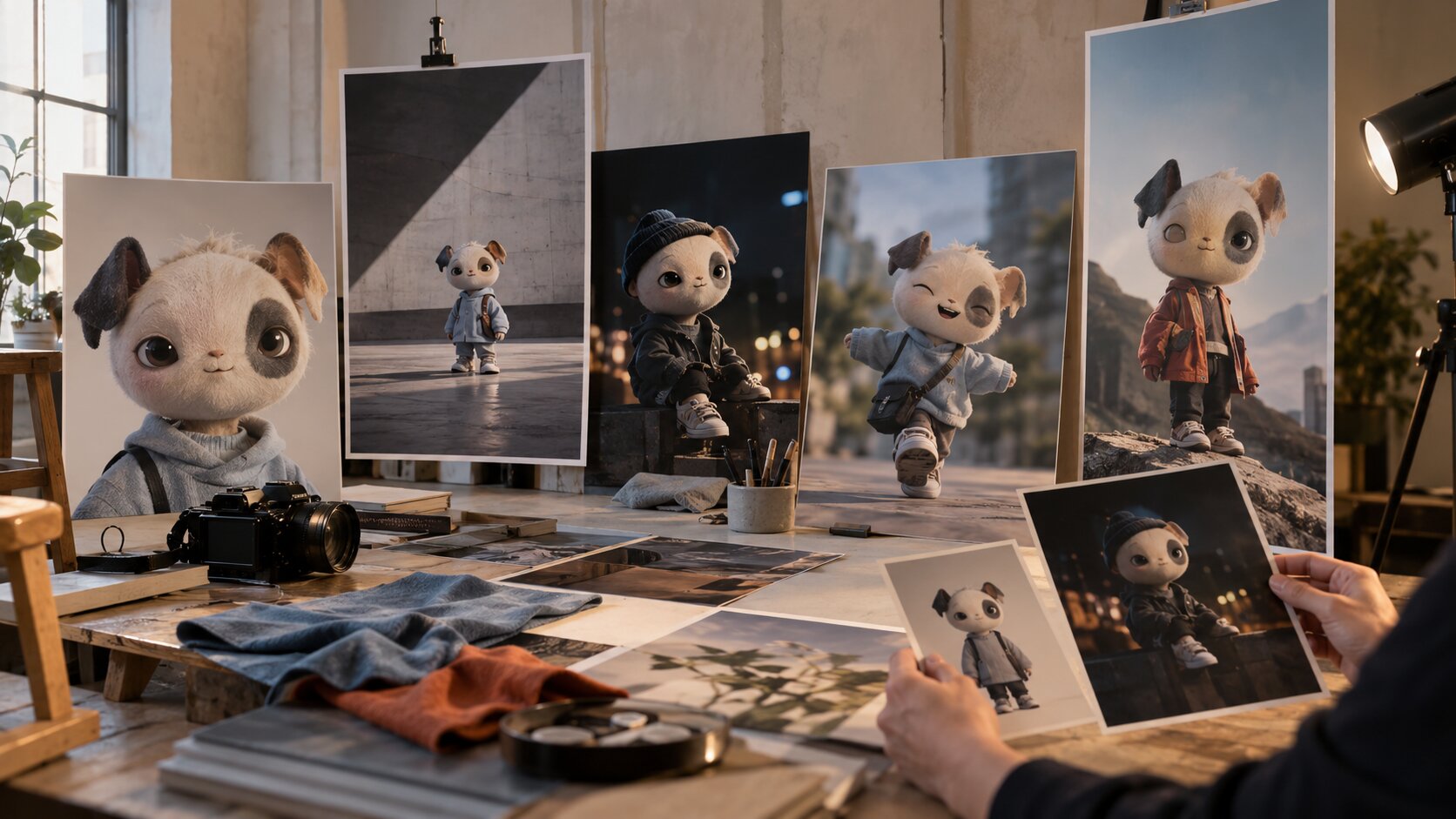
Build a small approved reference pack before you start producing dozens of campaign assets.
A Useful Starter Reference Pack
- Neutral front-facing portrait
- Profile view
- Three-quarter view
- Full-body view
- One strong emotional expression
- One image showing the character in motion
For an illustrated mascot, a clean silhouette can also be surprisingly useful.
For a realistic persona, keep at least one clear portrait where important facial features are visible without extreme lighting or heavy styling.
Current Midjourney workflows, for example, include reference-based methods for carrying characters and objects into new images, while Adobe Firefly provides separate controls for visual style and composition references.
The practical lesson is broader than any one platform.
A reference gives the model visual evidence.
The prompt still needs to explain what should happen next.
A reference should reduce ambiguity, not replace creative direction.
Stress-Test the Character Before the Campaign Needs It
Six nearly identical portraits are not a convincing consistency test.
They are the easiest possible situation.
Problems usually appear when context changes.
Before building a full campaign around the character, make the system uncomfortable.
Change the Scale
Generate a close portrait, then move the same character into a wide full-body scene.
Check whether the body still matches the identity established by the face.
Change the Light
Move the character from soft daylight into a dark night scene, colored stage light, or hard directional studio light.
Some distinguishing details disappear surprisingly quickly when lighting changes.
Change the Emotion
If the neutral expression works, try laughter, surprise, frustration, or concentration.
Facial identity should survive expression.
Change the Pose
Ask the character to sit sideways, run, reach for an object, turn away from the camera, or interact with another subject.
Difficult body positions often reveal where the character definition is still too loose.
Change the Format
Test a vertical social asset, a wide campaign image, a square profile composition, and a tighter editorial crop.
Then stop asking whether each image looks good.
Ask whether they all still look like the same character.
| Check | Question |
|---|---|
| Silhouette | Would the character remain recognizable without facial detail? |
| Face | Are the important facial proportions still present? |
| Color | Are key colors drifting between assets? |
| Clothing | Have required identity elements disappeared or changed shape? |
| Personality | Does the character still behave like the same persona? |
| Style | Does the image still belong to the same visual world? |
If several of these fail in a difficult scene, do not compensate by generating another fifty images.
Go back and strengthen the rules or reference pack.
Turn the Approved Character Into a Production System
Once the character starts behaving consistently, save more than the finished images.
Save the process that created them.
This becomes especially important for creative teams, recurring campaigns, music eras, product mascots, and anyone who expects to return to the character months later.
brand-character/
approved-references/
character-bible/
prompt-templates/
approved-outfits/
expressions/
campaign-scenes/
rejected-tests/
final-exports/
Keeping selected rejected tests can be useful too.
Maybe smaller eyes made the mascot feel too generic.
Maybe the polished leather jacket looked attractive but broke the personality.
Maybe a realistic rendering style made the character strangely serious.
Those are creative decisions worth remembering.
Otherwise, a few months later, somebody will generate the same wrong direction again and wonder why it feels off.
Save the Reason Behind the Decision
Do not record only:
Version 12 approved.
Record:
Version 12 approved because the wider eye spacing, shorter muzzle, and looser jacket match the original reference character better.
That small note becomes part of the system.
Over time, you are not just building a library of images.
You are building creative memory.
Keep Human Authorship, Provenance, and Control Visible
There is another reason not to reduce an important brand character to one prompt and a folder full of exports.
Rights and authorship matter.
The U.S. Copyright Office has explained that purely AI-generated material without sufficient human authorship is not protected by copyright simply because a person supplied prompts.
Human-created expression, selection, arrangement, modification, and other creative contributions can still matter, with copyright questions depending on the specific work.
That does not mean creators need to avoid AI.
It means a long-term character benefits from meaningful human creative work around the generation step.
- Create the original concept deliberately.
- Define your own visual and behavioral rules.
- Select and combine elements rather than accepting every output as final.
- Edit important assets.
- Make deliberate composition decisions.
- Use human-created source material where appropriate.
- Keep a record of the creative development process.
Realistic personas add another concern.
Avoid building a commercial character around another person's recognizable face or voice without understanding the permissions and rights involved.
The U.S. Copyright Office has separately examined the legal concerns around unauthorized digital replicas of real people.
Keep Provenance Where It Is Useful
For long-lived character systems, keeping information about how important assets were created and edited can also be useful.
Content Credentials are one approach designed to attach provenance information to digital content.
Adobe, for example, uses Content Credentials with Firefly-generated content to provide information about its origin.
Transparency does not make a character less creative.
It makes the workflow easier to understand later.
Using Orias AI to Build the Character World
The awkward part of building a recurring character often happens between the initial idea and the finished campaign.
You have one promising image.
Then references.
Then visual experiments.
Then decisions about clothing, color, expression, environments, campaign assets, and which variations actually belong together.
Orias AI is built around moving from rough ideas, references, moods, and concepts toward clearer visual directions, campaign materials, and more coherent creative packs.
That kind of structured workflow fits character development well.
Start with the character idea.
Define its personality and visual anchors.
Collect references.
Explore several directions without treating every generated image as a new identity.
Choose one direction.
Then expand it into useful campaign formats while keeping the core character rules visible.
The goal is not to generate the largest possible number of images featuring a mascot.
The goal is to make sure you can return six months later, create something new, and still recognize the same character immediately.
Frequently Asked Questions
Can AI Create the Exact Same Character in Every Image?
Not reliably in every situation.
Reference-based tools can improve consistency, but difficult poses, lighting changes, new outfits, facial expressions, and small details may still drift.
Important brand assets should still go through selection and, where needed, manual refinement.
What Matters More, a Good Prompt or a Reference Image?
Usually, you need both.
A reference provides visual evidence of the character, while the prompt explains the new scene, action, styling, and any identity traits that need reinforcement.
An extremely long prompt is not a substitute for a clear visual system.
How Many Reference Images Does an AI Mascot Need?
There is no universal number.
A practical starter pack should at least reveal the front, profile, three-quarter view, full body, and a few different expressions or poses.
The goal is to remove important visual ambiguity.
Should an AI Character Wear the Same Outfit Every Time?
Not necessarily.
If clothing is central to recognition, keep a few signature elements stable.
If the character should remain recognizable across wardrobe changes, test that deliberately before making outfit variation a major part of the campaign.
Can the Same Character Use Different Visual Styles?
Yes, but change styles deliberately.
Core character traits need to survive the transition.
If the face, proportions, colors, clothing, and rendering style all change at once, recognition can collapse quickly.
Can a Repeatable AI Character Work for a Music Project?
Yes.
A recurring character can appear across cover-adjacent visuals, teasers, social posts, merchandise concepts, lyric visuals, videos, and the broader story around a release.
Decide whether the character represents the artist, accompanies the artist, or belongs only to one release era.
Should AI-Generated Character Images Be Edited Before Publishing?
Important brand assets should always receive a final review.
Check anatomy, facial drift, hands, clothing details, colors, unwanted objects, image quality, format requirements, rights concerns, and whether the character still matches the approved creative direction.
Sources Used
- Midjourney Documentation, Omni Reference
- Midjourney Documentation, Modifying Your Creations
- Adobe Firefly, Style Reference Images
- Adobe Firefly, Match Image Composition to Reference Image
- U.S. Copyright Office, Copyright and Artificial Intelligence, Part 2: Copyrightability
- U.S. Copyright Office, Copyright and Artificial Intelligence, Part 1: Digital Replicas
- Adobe, Content Credentials Overview
- Orias AI