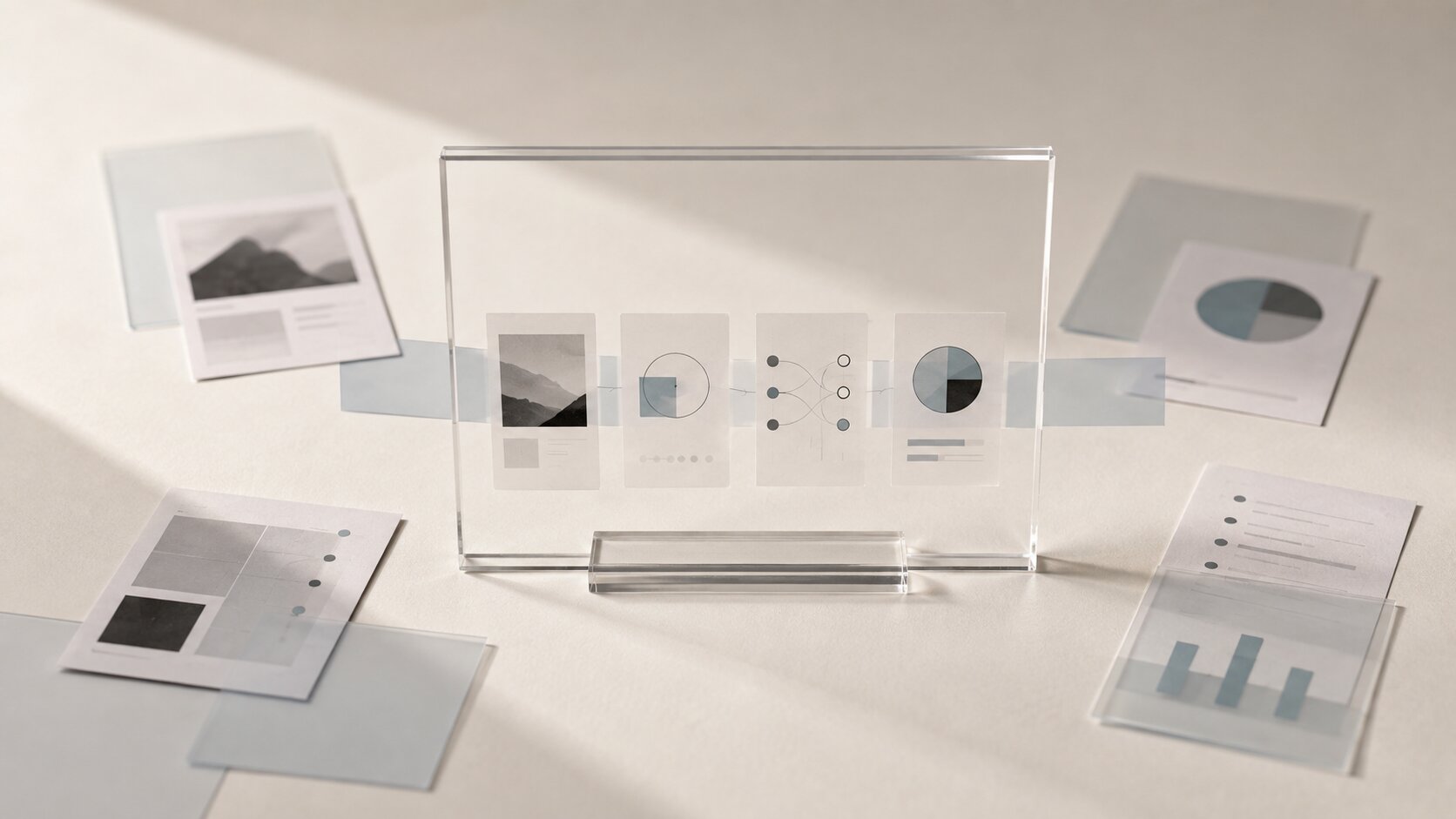
Migration Story Assets: Showing Why Switching Tools Is Worth the Effort
Create migration story assets that make switching tools feel understandable, reduce perceived risk and show why the effort of moving can be worth it.

TL;DR:
- A convincing migration story does not pretend switching tools takes no work. It shows that the work is understood, contained, and worth doing.
- Strong migration assets make three things visible: what staying with the old setup costs, what the move actually involves, and what becomes better afterward.
- Use workflow comparisons, migration stages, risk maps, validation assets, and role-specific stories instead of relying on a simple old-tool-versus-new-tool graphic.
A new tool can be clearly better and still lose the decision.
That happens because people are rarely comparing two products in isolation.
They are comparing one product they already know, with all its annoying habits and workarounds, against another product that comes with a migration project attached.
Files have to move. Workflows may need rebuilding. Permissions have to be checked. Integrations can break. A team has to learn where things live now.
That friction is real.
Official migration documentation from platforms such as Notion, Slack, Atlassian, and Figma all describes limitations, testing, permissions, integrations, or cleanup that may need attention during a move.
So if you are creating campaign visuals, launch materials, sales content, customer stories, or product education around switching tools, the creative problem is not simply:
How do we make the new product look good?
The more useful question is:
How do we make the entire change feel worth it?
That is where migration story assets become useful.
Table of Contents
- Key Takeaways
- The Real Objection Is Usually the Move, Not the Product
- Make the Cost of Staying Visible
- Show Migration as a Sequence, Not a Leap
- Turn Migration Risk Into Visible Proof
- Build Different Assets for Different Kinds of Doubt
- Make the After-State Specific Enough to Compare
- Build the Migration Story as a Connected Asset System
- Using Orias AI to Develop the Creative Direction
- Frequently Asked Questions
- Sources Used
Key Takeaways
| Point | Details |
|---|---|
| Do not hide migration effort | People already expect switching to require work. Acknowledging the work can make the story more credible. |
| Compare against staying put | Show the repeated friction, manual steps, duplication, or limitations people continue accepting if they do nothing. |
| Break the move into stages | A visible path from preparation to validation feels more manageable than one giant switch-now moment. |
| Show evidence around risk | Testing, data checks, permission reviews, integration plans, and rollback options are often more persuasive than broad reassurance. |
| Create assets for specific objections | A team lead, administrator, creator, and executive may care about completely different parts of the migration. |
| Show what life looks like afterward | The strongest payoff is a concrete new workflow, not a vague promise that everything becomes better. |
The Real Objection Is Usually the Move, Not the Product
Imagine a creative team has spent three years building its workflow around a tool it no longer loves.
There are messy folders. A few strange naming conventions. One integration that only works because nobody touches it. Everyone knows the shortcuts. Nobody remembers who originally configured the system.
Then a better platform appears.
Its workflow is cleaner. It could remove several repetitive steps. It may even replace multiple tools.
Still, the response is:
Looks good. Maybe later.
That "later" is often where migration marketing fails.
A typical campaign keeps adding product benefits:
- Faster workflow
- Cleaner collaboration
- Better organization
- More powerful features
- Fewer tools
But none of those claims answer the question sitting in the reader's head:
What happens to everything we already have?
Your migration story needs to deal with that question directly.
A useful migration asset should help someone understand at least one of these things:
- What needs to move?
- What does not need to move?
- What will need rebuilding?
- What can stay connected?
- How will the team know the migration worked?
- What does the new workflow look like afterward?
That is a much more believable story than simply placing before and after screenshots next to each other.
Make the Cost of Staying Visible
Migration has a visible cost.
Staying with the current setup often has an invisible one.
That imbalance matters.
The effort required to change tools may happen during one concentrated period.
The inefficiencies of the existing system can repeat every day: exporting, reformatting, copying files between apps, rebuilding the same asset for different platforms, hunting through folders, or maintaining workarounds that nobody actually likes.
A migration story becomes stronger when it compares these two forms of effort.
Instead of:
Switch to one simpler workspace.
Show something more concrete.
| Current Workflow | After Migration |
|---|---|
| Idea → notes app → AI tool → image tool → shared folder → copy document → publishing tool | Idea → creative direction → visuals and copy → refinement → publish-ready pack |
The point is not to make the first workflow look absurd.
Keep it believable.
People can spot an unfair comparison immediately.
A Useful Visual: Accumulated Friction
One strong migration asset can show repeated effort over time.
For example, imagine two paths.
The existing workflow requires five small manual handoffs every time a campaign is produced.
The new workflow requires a setup and migration phase first, but fewer repeated handoffs afterward.
You are no longer saying:
Switching is easy.
You are saying:
There is work upfront, but here is the repeated work it removes.
That is a much stronger argument.
Show Migration as a Sequence, Not a Leap
One giant arrow labeled OLD TOOL → NEW TOOL is rarely enough.
Real migrations happen in stages.
Atlassian recommends testing migrations before production and validating data afterward through review and user acceptance testing.
Slack also describes its import process as a sequence of phases rather than one instant transfer, with opportunities to review selections before the import runs.
Your visual story should borrow that logic.
- Inventory. Identify the files, projects, users, workflows, integrations, and historical material that matter.
- Prepare. Clean up what does not need to come with you.
- Move. Transfer supported data and rebuild whatever cannot be transferred directly.
- Check. Review permissions, links, integrations, asset relationships, and key workflows.
- Run in parallel if needed. Keep the old environment available while the new setup is being verified.
- Cut over. Move normal work into the new system.
- Refine. Fix the small problems that only appear once people start working normally again.
That sequence can become a horizontal story strip, short animation, landing-page illustration, carousel, onboarding graphic, or sales enablement asset.
The important part is psychological.
A sequence looks solvable.
A leap looks risky.
Turn Migration Risk Into Visible Proof
One of the weakest migration messages is:
Do not worry, migration is seamless.
Sometimes it is.
Sometimes it absolutely is not.
Notion's own import documentation explains that certain app-specific features, formatting, permissions, comments, automations, or other structures may not always carry over directly depending on the source and import method.
Figma also warns that moving files can affect access, while transferring files containing published libraries can change how library updates behave.
A better story shows how uncertainty is handled.
That can become creative material.
| Concern | Stronger Asset |
|---|---|
| Will our files survive? | Migration coverage diagram |
| What happens to permissions? | Permission review checklist |
| Will integrations still work? | Integration mapping graphic |
| Can we test it first? | Pilot migration timeline |
| What happens if something fails? | Recovery or rollback path |
| How do we know everything moved? | Validation checklist |
| Will the team know how to use it? | Role-based onboarding sequence |
These are not glamorous assets.
That is partly why they work.
They answer the questions that glossy campaign visuals usually ignore.
Pro Tip: Do not make every risk asset look like documentation. A checklist can become a visual sequence. A workflow comparison can be expressed through paths, materials, spaces, or repeated objects. A validation story can use testing, alignment, calibration, fitting, or controlled transfer as a visual metaphor.
The metaphor should clarify the process, not decorate it.
Build Different Assets for Different Kinds of Doubt
Not everyone is worried about the same thing.
A team member may think:
Am I going to have to relearn everything?
A creative lead may think:
Are our files and references going to become a mess?
An administrator may think:
What happens to accounts, permissions, integrations, and data?
A manager may simply ask:
Is this worth interrupting everyone's work?
One giant migration graphic cannot answer all four questions well.
Build a small asset system instead.
For Everyday Users
Focus on continuity.
Show what familiar tasks look like in the new workflow.
Keep the story around actual work: creating something, reviewing it, finding a file, sharing a reference, or preparing an asset.
For the Person Responsible for Migration
Focus on control.
Show what moves automatically, what requires manual work, what needs checking, and where testing fits.
For Creative Leads
Focus on preservation.
Will the visual system survive?
Will references remain accessible?
Do asset relationships still make sense?
If a design system or shared library is involved, this becomes especially important.
Figma recommends keeping libraries and their files together during certain transfers because moving them separately can affect future updates.
For Decision-Makers
Focus on the trade.
What short-term effort removes what long-term friction?
This audience probably does not need a detailed import diagram.
It needs the clearest possible explanation of why the organization is accepting temporary disruption.

Make the After-State Specific Enough to Compare
"Better workflow" means almost nothing on its own.
A migration story needs a destination people can picture.
Instead of showing a glowing new interface, show what becomes different in the work itself.
Before
A campaign idea starts in notes. References live somewhere else. Visual experiments happen across different tools. Copy gets drafted separately. Final assets are manually gathered into folders.
After
The campaign begins with one creative direction. Visual ideas, variations, copy, and supporting assets are developed around that same direction, then refined into a coherent publishing pack.
Notice the difference.
The second version is not about features.
It is about behavior.
This aligns with how Orias AI approaches creative workflow: bringing ideas, visuals, and content into a more connected process rather than treating every output as an isolated task.
The same principle works for almost any migration story.
Show the new working pattern.
Do not stop at the new product.
Build the Migration Story as a Connected Asset System
You rarely need one migration visual.
You need several assets that each do one job well.
1. The Reason-to-Switch Visual
Show the repeated friction in the current setup.
This is your "why change?" asset.
2. The Migration Path
Show the move as clear stages.
This is your "how will this work?" asset.
3. The Risk Map
Show what can move automatically, what needs review, and what needs rebuilding.
This is your credibility asset.
4. The Before-and-After Workflow
Show what the same real task looks like on both sides.
This is your value asset.
5. The Proof Asset
Use a customer example, verified migration result, pilot outcome, or factual demonstration of what survived the move.
Avoid invented numbers here.
If the evidence is not verified, do not turn it into a statistic.
6. The First-Week Asset
Show what someone does immediately after switching.
Where do they begin?
What should they learn first?
What can they ignore until later?
This reduces the fear that migration simply ends with users being dropped into an unfamiliar system.
You can then repurpose the same narrative across a landing page, social carousel, sales presentation, onboarding sequence, email campaign, short video, customer story, or help article.
The message stays consistent, but the asset changes depending on the question it needs to answer.
Using Orias AI to Develop the Creative Direction
Migration stories can become visually boring very quickly.
You start with a useful idea and somehow end up with arrows, boxes, screenshots, and six shades of blue.
Orias AI can be useful earlier in the process, when the challenge is still creative rather than purely production-focused.
Start with the actual migration tension:
- High switching effort versus repeated old-workflow friction
- Temporary disruption versus long-term simplicity
- Uncertainty versus a controlled process
- Scattered creative work versus a clearer shared system
Then explore several visual interpretations around the same idea.
One version might use a physical transfer process.
Another could use architecture or space.
Another might use a single object that changes function after passing through a controlled transformation.
From there, refine the strongest direction into a connected set of campaign visuals, supporting copy, format variations, and publish-ready assets.
AI can help generate options and accelerate iteration, but the final choice still needs human judgment.
The metaphor has to fit the real migration experience, and any factual claims about data, compatibility, time, or product behavior need to be checked against the actual tools involved.
Frequently Asked Questions
What Are Migration Story Assets?
Migration story assets are visuals, diagrams, videos, case studies, workflow comparisons, landing-page sections, or other creative materials that explain why moving from one tool or system to another is worth the disruption.
They do not just advertise the destination. They explain the transition.
Should Migration Marketing Make Switching Look Easy?
Not if the migration is genuinely complicated.
A better approach is to make the process look understood and manageable.
Clear stages, realistic limitations, testing, and validation can be more convincing than promising a frictionless switch.
What Is the Best Visual for Explaining a Tool Migration?
There is no single best format, but a before-and-after workflow is often a strong starting point because it connects migration effort to an actual improvement in daily work.
For more complex migrations, pair it with a migration path and a risk or coverage asset.
How Do You Show Migration Value Without Relying on Statistics?
Use operational changes.
Show fewer handoffs, clearer ownership, simpler asset organization, reduced duplication, easier reuse, or a more connected workflow.
These benefits can often be demonstrated visually without inventing performance numbers.
Should You Mention Migration Limitations in Marketing Content?
Yes, when those limitations affect the decision.
You do not need to turn the campaign into technical documentation, but hiding obvious constraints can damage trust.
Explain what requires extra work and show how that work is handled.
Can AI Help Create Migration Campaign Assets?
Yes.
AI is useful for exploring visual metaphors, developing different creative directions, drafting supporting copy, creating asset variations, and adapting concepts to different formats.
Final assets should still be reviewed for accuracy, originality, brand fit, rights considerations, and platform requirements.
What Is the Biggest Mistake in a Migration Story?
Focusing entirely on the new tool.
People deciding whether to switch are evaluating the transition as much as the destination.
If the creative never explains what happens between the two, the most important part of the story is missing.