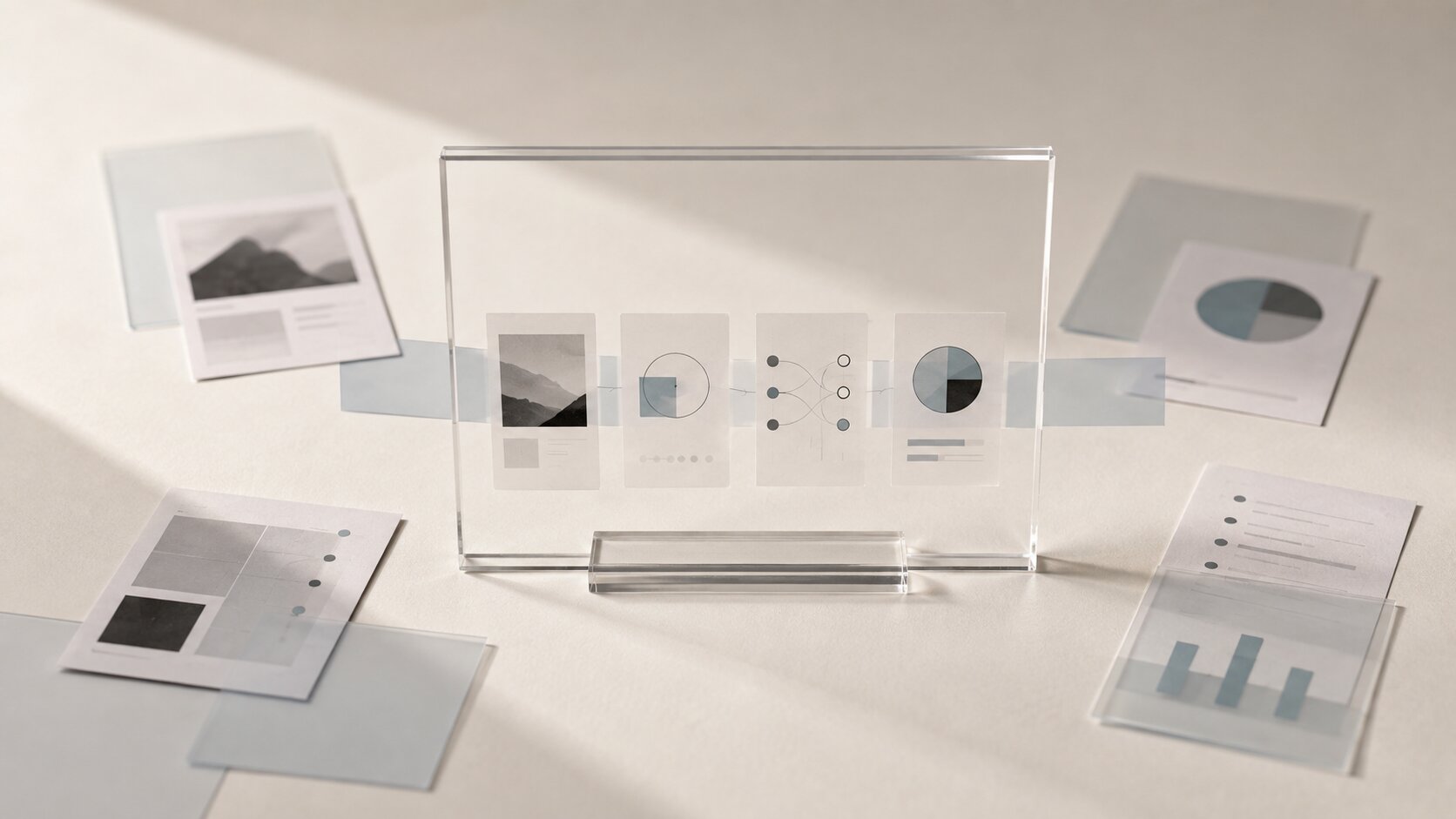
Case Study Visuals: Turning Customer Wins into Assets That Sell
Turn real customer results into case study visuals, sales assets, social content, testimonial graphics and reusable creative systems.

TL;DR:
- A good customer case study should not end as one long page. One verified customer result can become a complete system of visual assets.
- Start by locking down the problem, change, result, numbers, and approved customer quotes. Then adapt those facts into website assets, sales decks, social posts, video, and other formats.
- The main rule is simple: the format and composition can change, but the evidence should stay the same.
Most companies handle their best customer stories in a strangely limited way.
A team spends a month collecting interviews, approving numbers, getting permission to use a logo, and writing a full case study... then publishes it once in a Customer Stories section and moves on.
The result is an expensive piece of content that hardly gets used.
Yet a strong case study usually already contains everything needed for dozens of useful assets: a real problem, a recognizable situation, a human quote, a concrete result, a working process, useful evidence, and a clear before-and-after story.
LinkedIn recommends using case studies not only on websites, but also in branded social posts, sales presentations, marketing collateral, webinars, and other formats.
Canva also suggests repurposing finished case studies into blog content, reels, social assets, and advertising materials.
So the job is not to invent new content every time.
The real job is to find the proof inside the customer story that actually means something, then carefully reshape it for different stages of marketing and sales.
Table of Contents
- Key Takeaways
- Find the Proof That Makes Sense in Five Seconds
- Do Not Fit the Entire Case Study Into One Visual
- Build the Visual Story Around Change
- Turn One Customer Win Into an Asset System
- Give AI Variation, but Do Not Let It Change the Facts
- Adapt the Case Study to the Sales Moment, Not Just the Screen Size
- Keep the Case Study Alive After Publishing
- Where Orias AI Fits Into the Workflow
- Frequently Asked Questions
- Sources Used
Key Takeaways
| Point | Details |
|---|---|
| Start with proof | Choose one verified result, problem, or change that the audience can understand quickly. |
| Do not make one asset do everything | A landing page, sales deck, carousel, testimonial asset, and short video all serve different purposes. |
| Show the change | Strong case study visuals often work best when they make the before, intervention, and after easy to understand. |
| Build a system | One approved customer story can become a reusable set of marketing and sales assets. |
| Do not let AI change the facts | Use AI for compositions, visual directions, and variations, not for inventing numbers, quotes, or results. |
| Approve repurposing early | Clarify where the customer's name, logo, imagery, metrics, quotes, and other material can be used. |
Find the Proof That Makes Sense in Five Seconds
Case studies are often written from the context outward.
Who the customer is. How long the company has existed. How many employees it has. What the team does.
That is fine for the full story.
For a visual, it is usually too slow.
A case study visual should begin with proof.
A weak version might say:
How Team X Improved Its Marketing Process.
A concrete change is much stronger:
The team reduced campaign preparation from five days to two.
Or:
One designer can now support 12 regional teams.
Or:
The new process removed three manual approval stages.
You do not need a dramatic percentage to make the story convincing.
Sometimes the most useful result is not financial at all.
It might be:
- less manual work;
- a faster launch process;
- one clear workflow instead of scattered work;
- the ability to do more with a smaller team;
- fewer rounds of rework;
- more consistent visual output.
But every number and claim should be verified.
HubSpot recommends defining the purpose of the case study early, getting customer permission, and agreeing on how information such as company names, logos, job titles, and imagery can be used.
Create a Proof Sheet Before Design
Before Figma, image generation, or social templates, create a simple table containing the approved source material.
| Element | Approved Version |
|---|---|
| Problem | What was happening before the solution |
| Change | What the customer actually changed |
| Result | The verified outcome |
| Metric | Only the approved number |
| Quote | The exact approved wording |
| Logo / image | Whether public use is permitted |
| Restrictions | What cannot be published |
This becomes your source of truth.
The design can change as much as needed. This table should not change without a new approval.
Do Not Fit the Entire Case Study Into One Visual
One of the most common mistakes looks something like this.
A large square template gets filled with the customer logo, a portrait, a quote, four metrics, the problem statement, a product screenshot, a CTA, and a few decorative elements.
Technically, all the information is there.
In practice, almost none of it is easy to read.
It is better to stop asking, “How do we design the case study?” and ask:
Which individual moments from this story are worth showing?
One asset should usually answer one main question.
Visual 1: What Changed?
Show the main metric or the clearest outcome.
Visual 2: What Was Wrong?
Show one recognizable customer problem.
Visual 3: What Did the Process Look Like?
Use a simple workflow or before-and-after structure.
Visual 4: What Does the Customer Say?
Use a short approved quote with clear attribution.
Visual 5: Why Does It Matter to a Similar Buyer?
Connect the customer result to a specific use case.
Together, these assets are usually much more useful than one overloaded poster-style visual.
Pro Tip: If the visual cannot be understood without reading tiny supporting text, it is probably trying to say too much.
Build the Visual Story Around Change
A customer case study is not interesting simply because the customer is happy.
It is interesting because something changed.
That change should shape the visual concept.
Imagine a story like this:
A creative team used to rebuild campaign assets manually across several tools. After moving to a more structured workflow, the team could adapt one creative direction across several channels more efficiently.
You could place a polished interface next to a customer quote.
But that does not really show what changed.
It is much more useful to visualize the transition itself.
| State | What to Show |
|---|---|
| Before | Many disconnected source assets → manual rebuilding → inconsistent outputs |
| After | One approved direction → a system of formats → consistent outputs |
Now the visual language is connected to the actual change that happened.
Look for a Physical Metaphor, Not a Decorative Image
For a more editorial visual, you can move away from interfaces altogether.
A story about consistency might be shown as one material passing through several forming processes while keeping the same core structure.
A story about removing a bottleneck could show a physical flow that first gets compressed into a narrow passage and then moves freely after the system changes.
A story about scaling might show one verified source branching into several finished formats.
These metaphors are especially useful when the product itself is hard to show visually, or when a normal screenshot does not explain the customer result.
But the connection to the case study still needs to be obvious.
A beautiful abstract AI image that does not carry the evidence adds very little.
Turn One Customer Win Into an Asset System
Once the main story is approved, create an asset map.
This should not be a random list of deliverables. It should be a set of assets designed for specific jobs.
| Asset | Main Job |
|---|---|
| Full case study page | Tell the complete story and provide supporting evidence |
| Hero result visual | Communicate the main outcome quickly |
| Quote asset | Bring the customer's voice into the story |
| 3–5-slide carousel | Tell the story step by step |
| Sales deck slide | Support a specific use case during a sales conversation |
| Short vertical video | Introduce the story to a new audience |
| Email graphic | Give the reader one clear reason to open the full case study |
| Website proof block | Place customer evidence close to a product claim |
LinkedIn recommends reusing the strongest parts of a case study across websites, social content, sales presentations, webinars, and other promotional formats.
Canva also notes that one marketing case study can be repurposed into blog posts, reels, social assets, and advertising materials.
This is where an important distinction appears.
Repurposing does not mean copying.
A square social post should not be a reduced version of a landing page.
A sales slide should not be a screenshot of a carousel.
Every format should establish its own visual emphasis.
The facts stay the same. The composition changes.
Give AI Variation, but Do Not Let It Change the Facts
AI is very useful at this stage.
Once the proof has been locked, AI can help with:
- exploring several visual directions;
- creating rough compositions;
- developing metaphor-based scenes;
- testing different environments and backgrounds;
- storyboard exploration;
- adapting compositions to different proportions;
- early motion concepts;
- generating supporting imagery.
Where does the problem start?
When AI starts “improving” the case study itself.
A real reduction from 12 hours to 8 might suddenly become “50% faster.”
A restrained customer quote might turn into a dramatic testimonial the customer never actually said.
A real interface might be replaced by a fictional product screen that shows a feature that does not exist.
That is no longer creative exploration.
It is distortion of the evidence.
Rule: AI can change the presentation. AI does not change the source of truth.
Before publishing, a human should still verify numbers, wording, brand fit, rights, and whether the final visual remains faithful to the approved customer story.
A similar principle applies to SEO.
Google recommends creating original, helpful, reliable content for people and demonstrating real value rather than producing pages primarily for search traffic.
A genuine customer story already gives you that kind of material: first-hand experience, real outcomes, and primary evidence.
Adapt the Case Study to the Sales Moment, Not Just the Screen Size
Many teams think about adaptation like this:
- 16:9
- 1:1
- 4:5
- 9:16
But canvas size does not explain what the asset is supposed to accomplish.
A better question is:
At what moment will someone see this asset?
When the Audience Does Not Know the Problem Yet
Show a recognizable situation.
Every campaign launch required manually rebuilding more than 20 assets.
At this stage, the pain matters more than the product.
When Someone Is Already Considering a Solution
Show the process change.
One approved direction became the source for the entire campaign system.
When the Buyer Is Comparing Options
This is where evidence and specificity matter.
Show a verified metric, an approved customer quote, or a concrete before-and-after comparison.
When Sales Is Already Talking to the Lead
Use the most relevant proof available.
You probably do not need the entire customer story.
Sometimes one slide is enough:
A team of a similar size solved this exact problem in this way.
That is much easier to use in a real sales conversation.
Keep the Case Study Alive After Publishing
A customer story does not need to be a one-time project.
If your team regularly launches products, campaigns, and social content, it is useful to maintain customer stories as a proof library.
For each customer, you might keep a dedicated folder or structured record containing:
- the approved story;
- approved metrics;
- approved quotes;
- logo files;
- customer imagery;
- product screenshots;
- visual direction;
- reusable templates;
- finished social variations;
- the date the information was last reviewed.
This is especially useful for creative teams.
Instead of saying, “We had a good case study about this somewhere,” a marketer or sales rep can search by the actual problem.
workflow speed
brand consistency
content scaling
release campaign
small creative team
Then they can quickly find the proof that matches the conversation.
Templates also make sense here.
Adobe shows examples of large teams using shared template libraries for quote assets, client wins, carousel posts, and differently sized assets so they can maintain a consistent visual language while producing content at scale.
Just do not turn the template into a cage.
The template should lock the foundation: typography, spacing, logo treatment, hierarchy, and perhaps the motion language.
The customer story should still determine the visual emphasis.
Where Orias AI Fits Into the Workflow
For creative teams, the difficult part often appears between “we have a strong customer story” and “now we need ten usable assets from it.”
Orias AI can be useful in that middle stage: bringing together a rough idea, references, customer evidence, and creative direction, exploring several visual approaches, then developing the selected direction into a more coherent creative pack.
For example, one verified customer result can become the foundation for a hero visual, social carousel, testimonial treatment, promo image, and several format variations.
A practical workflow might look like this:
- Collect the approved customer story and supporting evidence.
- Choose the one problem or change the visual needs to explain.
- Decide whether a before-and-after structure, process flow, customer quote, result visual, or physical metaphor fits best.
- Explore several genuinely different visual directions.
- Select the direction that explains the customer result most clearly.
- Verify the metrics, quotes, product details, and usage rights.
- Adapt the approved direction across social, website, sales, and campaign formats.
- Run a final factual review before publishing.
The goal is not to make AI invent a more impressive case study.
The goal is to give one real customer success story a strong enough visual system that people actually see it and teams actually use it.
Frequently Asked Questions
What Are Case Study Visuals?
Case study visuals are visual assets built around a real customer story, including results, quotes, process changes, metrics, or before-and-after comparisons.
They can appear inside a full case study or work separately as sales slides, social posts, videos, and website proof blocks.
Which Visuals Work Best for a Customer Case Study?
A good starting point is usually a result visual, an approved quote asset, a simple before-and-after explanation, and one sales-focused slide.
From there, expand the system based on the channels where the team will actually use the story.
Do Case Studies Always Need Numbers?
No.
Numbers are useful when they are accurate, meaningful, and approved.
But a strong piece of evidence might also be a workflow change, fewer manual steps, a new capability, or a specific customer quote.
Can AI Be Used for Case Study Visuals?
Yes.
AI is especially useful for exploring ideas, visual metaphors, compositions, storyboards, and format variations.
The facts, metrics, quotes, and product claims should still come from verified source material.
How Do You Keep Case Study Assets Visually Consistent?
Start by defining shared rules for typography, color, image treatment, hierarchy, logo usage, and a small set of repeatable layouts.
Then adapt the composition to each format instead of mechanically resizing one design.
Do You Need Customer Permission Before Publishing?
Public use of customer material should be agreed in advance.
Define which names, logos, titles, imagery, quotes, project details, and metrics can be used.
Specific legal requirements will depend on your agreements and jurisdiction.
How Do You Know Whether a Case Study Visual Works?
Measure it according to the job of the specific asset.
For a website proof block, that might mean clicks into the full case study or product page.
For a sales deck, it may be more useful to look at whether the sales team actually uses the asset and whether it fits real conversations with prospects.
For social assets, useful signals might include saves, shares, qualified clicks, and the engagement that follows.
Do not judge every format with the same metric.