AI Creative Governance: Brand Safety, Rights and Quality Rules in One Place
Build one AI creative governance system for brand safety, rights, quality control, and consistent publish-ready assets.

TL;DR:
- AI creative governance helps creators decide what AI can generate, what must be reviewed, what rights need checking, and what quality standard an asset must meet before publishing.
- The practical takeaway is simple: do not treat governance as legal bureaucracy.
- Treat it as a creative control layer that protects your voice, your audience, your collaborators, and your release schedule.
AI can help a creator move faster than ever: generate visual directions, test campaign angles, adapt one concept into multiple formats, explore voice variants, and prepare assets for different platforms. But speed creates a new problem. A visual that looks finished can still be off-brand, derivative, misleading, low quality, incorrectly sized, or risky to publish.
For independent artists, musicians, visual storytellers, and small creative teams, the danger is not only “bad AI output.” The deeper issue is scattered decision-making. One prompt lives in a notes app. A reference image came from somewhere nobody remembers. A designer exports a cover crop without checking platform specs. A social post uses a synthetic scene that feels real, but no one asks whether disclosure is needed.
AI creative governance brings those decisions into one place. It gives your workflow a clear set of rules for brand safety, rights, approvals, quality, transparency, and publishing readiness. This guide shows how to build that system without making your creative process feel rigid or corporate.
Table of Contents
- Key Takeaways
- Define the Creative Boundaries Before Generating Anything
- Separate Brand Safety from Brand Fit
- Create a Rights Checkpoint for Every Asset
- Set Quality Rules That Match the Final Use Case
- Build an AI Disclosure and Transparency Layer
- Use Human Review as a Creative Filter, Not a Bottleneck
- Turn Governance into a Repeatable Creative Pack Workflow
- How Orias AI Fits into a Governed Creative Workflow
- Frequently Asked Questions
- Sources Used
Key Takeaways
| Point | Details |
|---|---|
| Governance should protect creative direction, not slow it down | A clear rule system helps creators move faster because fewer decisions are made from scratch at the end. |
| Brand safety and brand fit are different | Brand safety avoids harmful or inappropriate contexts; brand fit checks whether the asset feels right for your identity, audience, and campaign. |
| Rights checks need to happen before publishing | Track references, source material, collaborators, likenesses, music, fonts, image inputs, and AI-generated outputs before final approval. |
| AI transparency is now part of publishing hygiene | Platforms such as YouTube require disclosure for realistic AI-generated or meaningfully altered content in specific cases. |
| Quality rules should be format-specific | A release cover, vertical Reel, YouTube thumbnail, artist header, and press asset all need different review criteria. |
| Human judgment remains the final layer | AI can accelerate ideation and variation, but taste, originality, ethics, rights, and final selection need human review. |
Define the Creative Boundaries Before Generating Anything
The first governance mistake is starting with prompts before defining boundaries. If your only rule is “make it cinematic,” every output can look impressive while still failing the project.
Before using AI, define the creative container:
- What is the campaign or release about?
- What mood should the audience feel?
- Which visual references are acceptable?
- Which references are only mood inspiration, not styles to imitate?
- What subjects, symbols, colors, or environments are off-limits?
- Which formats are needed?
- Who approves the final work?
This is not about restricting imagination. It is about giving the AI workflow a stable creative center.
A simple governance brief
For each project, create a short governance brief before generating assets:
| Rule Area | What to Define |
|---|---|
| Brand world | Mood, visual tone, recurring symbols, lighting, texture, composition logic. |
| Audience sensitivity | Topics, visuals, or associations that may feel inappropriate or confusing. |
| Rights boundaries | No unlicensed logos, celebrity likenesses, copyrighted characters, unclear reference ownership, or unauthorized collaborator material. |
| Output use | Cover art, social post, ad creative, YouTube thumbnail, press image, campaign banner. |
| Human approval | Who checks creative fit, who checks rights, who signs off for publishing. |
For musicians, this can prevent a release campaign from becoming visually inconsistent across the cover, teaser clips, canvas-style motion assets, and social posts. For creators, it prevents every platform asset from feeling like it came from a different brand.
Mistake to avoid: treating every AI generation as a blank canvas. Without boundaries, your creative identity gets replaced by tool defaults.
Separate Brand Safety from Brand Fit
Brand safety and brand fit are often used together, but they are not the same thing.
Brand safety is about avoiding unsafe, harmful, offensive, misleading, or high-risk associations. Brand fit is more specific: it asks whether the creative belongs in your world. An asset can be technically safe and still feel wrong for your audience.
Advertising platforms make this distinction in their own tools. Google describes content suitability settings as additional filtering that helps advertisers find the right fit for their product or brand, beyond the policies that define what content can be monetized. TikTok also frames brand suitability around giving advertisers control over the kinds of content shown beside their ads, including inventory tiers based on sensitivity or risk.
Creators can apply the same principle to AI-generated creative work.
Brand safety questions
Ask these before publishing:
- Could this image be interpreted as offensive, exploitative, violent, hateful, deceptive, or insensitive?
- Does the asset include realistic people, places, events, or crisis imagery that could mislead viewers?
- Does it place the creator, artist, sponsor, or collaborator in an unwanted context?
- Could the asset be inappropriate for the platform, audience age, or campaign placement?
- Does the asset create a false association with another person, brand, artist, or public figure?
Brand fit questions
Ask these after the safety check:
- Does this feel like our visual world?
- Does it match the tone of the release, story, campaign, or creator identity?
- Does it use the same atmosphere, color behavior, and symbolic language as the rest of the assets?
- Would a fan recognize this as part of the same project?
- Is the AI output too generic, polished, or trend-driven for our voice?
Pro Tip: create two separate approval labels: “safe to publish” and “right for the brand.” An asset should need both.
Create a Rights Checkpoint for Every Asset
Rights management is where many AI creative workflows become fragile. A finished image may involve references, prompts, source images, generated variations, edits, typography, mockups, music, voice, and collaborator feedback. If nobody tracks those inputs, nobody can confidently explain where the final asset came from.
The U.S. Copyright Office has been examining AI-related copyright issues, including copyrightability of AI-generated outputs and the use of copyrighted materials in AI training. Its AI report process includes Part 2 on copyrightability, published in January 2025. The practical lesson for creators is simple: do not assume that every AI-generated output automatically gives you the same protection, ownership position, or clearance as a fully human-made work. Rights questions can vary by jurisdiction, tool terms, source material, and human contribution.
This is not legal advice, but it is good workflow hygiene: document your inputs and review risky outputs before publishing.
What to track
Create an asset record for every important visual, campaign pack, or release asset:
| Item | Why It Matters |
|---|---|
| Prompt or creative direction | Shows the intended concept and helps recreate or revise the asset. |
| Reference sources | Helps confirm whether references were licensed, owned, public domain, commissioned, or only used for mood. |
| Source images | Important if you uploaded photos, sketches, screenshots, brand assets, or collaborator files. |
| AI tool used | Tool terms and output policies may differ. |
| Human edits | Shows creative contribution, refinement, selection, compositing, retouching, typography, or layout decisions. |
| Final format | Connects the asset to its intended use: release cover, ad, post, thumbnail, banner. |
| Approval status | Prevents draft assets from being accidentally published. |

Rights risks to flag
Flag an asset for deeper review if it includes:
- A recognizable real person who did not approve use
- A public figure likeness
- A logo or trademark-like mark
- A style imitation request tied to a living artist or identifiable brand
- A copyrighted character, album cover, movie still, or game asset
- Unlicensed fonts or design elements
- A collaborator’s unreleased material
- Generated voice, music, or realistic performance elements
- A reference image found online without usage rights
Mistake to avoid: waiting until the final export to ask rights questions. By then, the team may be emotionally attached to the asset and less willing to revise.
Set Quality Rules That Match the Final Use Case
Quality control should not be vague. “Looks good” is not enough. AI outputs can have hidden problems: strange hands, inconsistent typography, artifacts, over-sharpening, warped objects, weak cropping, unrealistic lighting, fake UI text, or details that fall apart at full size.
Your governance system should define quality rules by asset type.
Release artwork
For music releases, cover art has specific format expectations. Spotify says cover art should use TIFF, PNG, or JPG with lossless encoding, be the highest resolution available, sit between 640 and 10,000 pixels wide and tall, use a 1:1 aspect ratio, and be encoded in sRGB color space. Spotify also says not to upscale images.
A governed AI workflow should therefore include a release-cover checklist:
- Square composition works at thumbnail size
- No accidental text, fake logos, or unreadable marks
- No upscaled low-resolution output
- No visual artifacts in key focal areas
- sRGB export checked
- Final file matches distributor requirements
- Rights record complete
Artist profile visuals
Artist images have different requirements from cover art. Spotify’s artist image guidelines list different minimum dimensions for avatars, headers, and gallery images, and also warn against infringing or offensive material, text, advertising, busy backgrounds, and using artist images to promote an upcoming tour or album release.
That means an image that works as a campaign teaser may not work as an artist profile header. Governance should prevent cross-use mistakes.
Social and campaign assets
For social formats, quality rules should include:
- Safe crop for vertical, square, and wide versions
- Main subject remains clear on mobile
- Captions or overlays are readable after compression
- No important detail sits under platform UI areas
- Visual tone matches the rest of the campaign
- Export versions are named clearly
- Final captions, hashtags, and disclosures are reviewed separately
Pro Tip: review AI visuals at three sizes: full screen, mobile preview, and thumbnail. Many AI images look strong at full size but fail when compressed into a feed.
Build an AI Disclosure and Transparency Layer
Not every AI-assisted asset needs the same level of disclosure, but creators need a system for deciding when transparency is required or appropriate.
YouTube requires creators to disclose when AI is used to meaningfully alter or generate photorealistic content. Its examples include making a real person appear to say or do something they did not do, altering footage of a real event or place, and generating a realistic scene that did not actually occur. YouTube also notes that minor edits, production assistance, idea generation, and some non-realistic AI uses do not require the same disclosure.
For creators, this means disclosure should not be an afterthought. It should be part of the asset review.
Disclosure decision framework
Ask:
- Does the content look realistic?
- Could a viewer believe the person, place, event, or scene actually existed?
- Does AI change the meaning of what happened?
- Does the asset involve a real person’s likeness, voice, or performance?
- Is the content being used in a sensitive context: news, health, politics, crisis, endorsements, or public claims?
- Does the platform require a label or upload disclosure?
- Would disclosure preserve trust with the audience?
For sponsored content, disclosure has another dimension. The FTC’s endorsement resources address disclosure of material connections between advertisers and endorsers, including social media and influencer marketing. If a creator is using AI-generated visuals in a paid campaign, both AI transparency and sponsorship disclosure may need to be considered.
Provenance and content credentials
Content provenance is becoming part of creative operations. Adobe describes Content Credentials as an industry-standard metadata type that can show information about a creator and how content was made, including whether it was captured by a camera, generated by AI, or edited in tools like Photoshop. C2PA’s technical specification describes a system for storing and accessing cryptographically verifiable information, including signed provenance data associated with a digital asset.
For everyday creators, provenance tools are not a complete substitute for review, rights clearance, or ethical judgment. But they can support attribution, transparency, and internal asset tracking.
Mistake to avoid: assuming that “AI-assisted” and “AI-generated” are always the same disclosure category. A script outline, lighting adjustment, and photorealistic synthetic scene carry different audience risks.
Use Human Review as a Creative Filter, Not a Bottleneck
Human review often fails because it happens too late. By the time the final pack is ready, everyone is tired, the release date is close, and “review” becomes a rushed yes-or-no decision.
A better governance model uses human review at several points:
- Before generation: approve the creative direction.
- After exploration: select promising routes and reject unsafe or generic outputs.
- Before refinement: decide which assets deserve editing time.
- Before export: check rights, quality, format, and platform use.
- After publishing: review performance and audience response.
The four-reviewer model
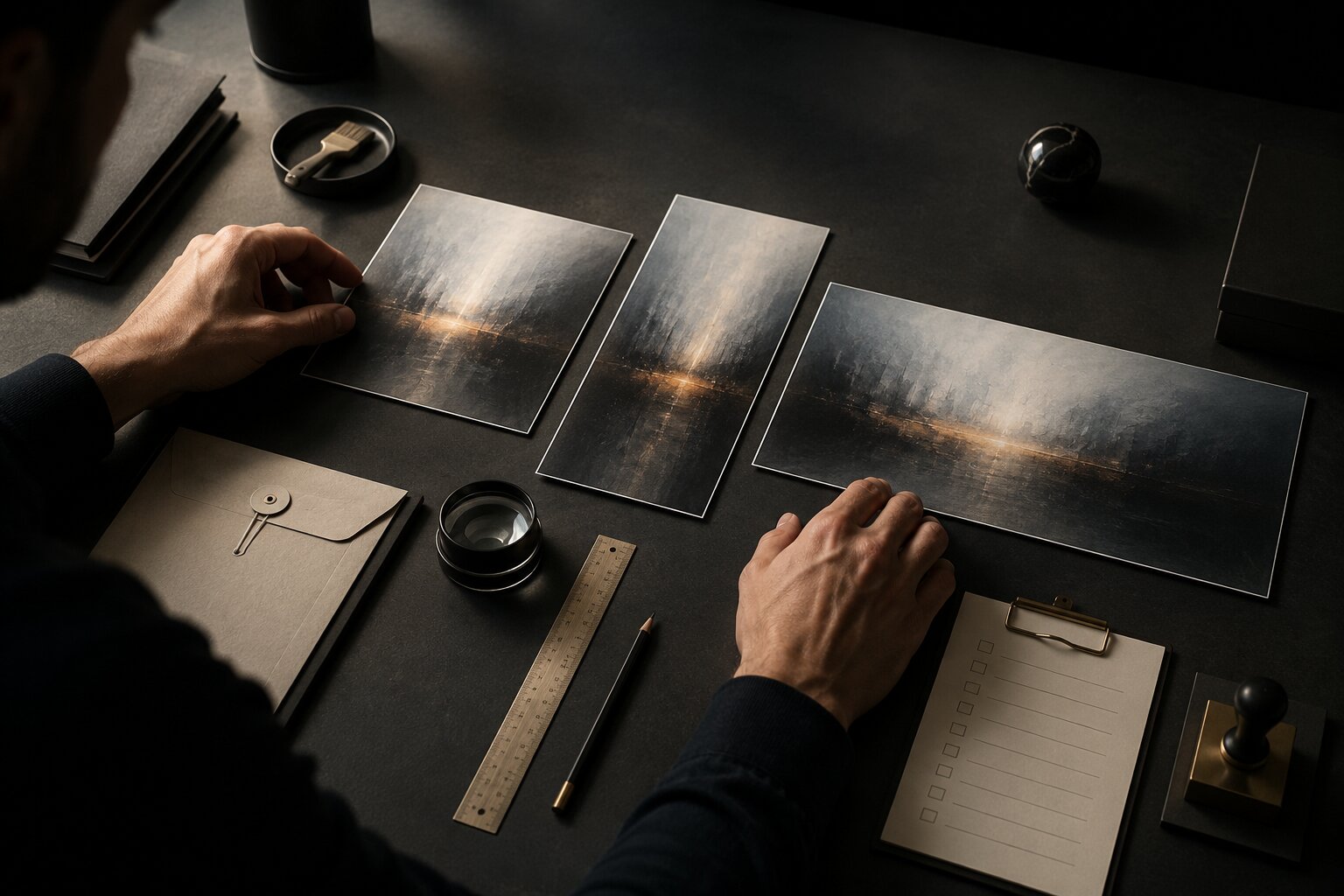
Even if you are a solo creator, think in four roles:
| Role | Review Question |
|---|---|
| Creative director | Does this express the right mood, story, and identity? |
| Rights reviewer | Are references, likenesses, source files, and usage permissions acceptable? |
| Quality reviewer | Is the asset technically strong enough for its final format? |
| Audience reviewer | Could this confuse, mislead, offend, or feel off to the people it is meant for? |
In a small team, one person may cover multiple roles. The point is not to create bureaucracy. The point is to stop judging every asset only by visual appeal.
What human judgment should catch
AI can generate options, but humans should catch:
- Generic style drift
- Visual clichés
- Misaligned emotional tone
- Cultural or audience sensitivity issues
- Inconsistent identity across formats
- Subtle rights or likeness risks
- Weak hierarchy in thumbnails and posts
- Overproduction that removes the artist’s original edge
Pro Tip: do not ask, “Is this good?” Ask, “Is this the right asset for this campaign, this audience, this platform, and this moment?”
Turn Governance into a Repeatable Creative Pack Workflow
The best governance system is not a PDF that nobody opens. It should live inside the creative workflow.
For Orias-style creative work, that means connecting governance to the full journey from rough idea to publish-ready pack.
A practical governed workflow
| Stage | Governance Rule |
|---|---|
| Idea | Define the campaign goal, audience, emotional promise, and non-negotiables. |
| Mood / references | Label each reference as owned, licensed, commissioned, public domain, or mood-only. |
| Creative direction | Approve visual rules before generating final assets. |
| AI exploration | Generate multiple routes, but reject unsafe, derivative, or off-brand outputs early. |
| Refinement | Edit selected assets for composition, detail, hierarchy, and format. |
| Rights review | Check likenesses, references, source files, typography, music, logos, and claims. |
| Quality control | Test resolution, crop, readability, artifacts, export settings, and platform specs. |
| Publishing | Apply required disclosures, captions, file names, alt text, and format-specific versions. |
| Review | Track what worked, what confused the audience, and what rules should change. |
This system is especially useful for music releases and campaign launches because pressure increases near the deadline. Governance moves decisions earlier, when they are cheaper and easier to fix.
Naming and version control
Use clear naming conventions:
project_asset-format_status_versionmidnight-release_cover_review-v03tour-teaser_reel-approved-v02visual-world_header-rightscheck-needed-v01
Avoid vague names like final_final_new2.png. Version chaos is a governance problem.
Minimum approval statuses
Use simple statuses:
- Draft
- Creative approved
- Rights review needed
- Revision needed
- Format approved
- Publish approved
- Archived
For solo creators, this may feel excessive at first. But once you are managing cover art, teasers, short-form videos, thumbnails, banners, and captions, status labels prevent mistakes.
How Orias AI Fits into a Governed Creative Workflow
Orias AI is useful when creators need to turn rough ideas, references, moods, and campaign concepts into clearer creative directions and publish-ready asset systems. In a governed workflow, the goal is not to generate random outputs until something looks exciting. The goal is to move from an idea to a controlled creative pack with a consistent visual world, usable variations, and reviewable decisions.

For artists and visual storytellers, that can mean shaping a release mood into cover directions, promo visuals, social formats, and caption variants. For creative teams, it can mean keeping brand rules, references, visual tone, and campaign materials aligned before assets move into final production.
The strongest use of AI is structured exploration followed by human curation. Orias AI supports that kind of workflow: start with a creative direction, generate options inside a defined world, refine what fits, and prepare assets with brand safety, rights, and quality checks in mind.
Frequently Asked Questions
What is AI creative governance?
AI creative governance is a practical rule system for managing AI-assisted creative work. It defines what can be generated, which references are acceptable, how outputs are reviewed, when rights checks happen, what quality standards must be met, and who approves assets before publishing.
Do independent creators really need governance?
Yes, but it does not need to be complicated. A solo creator can use a one-page checklist covering brand fit, rights, quality, platform requirements, and disclosure. The point is to prevent avoidable publishing mistakes, especially during campaign pressure.
Is brand safety only relevant for advertisers?
No. Advertisers use formal brand safety and suitability controls, but creators also need to protect their reputation. A musician, artist, or visual storyteller can damage trust by publishing misleading, offensive, low-quality, or rights-risky AI content.
How should I check rights for AI-generated visuals?
Track your references, source images, uploaded files, prompt intent, AI tool used, human edits, and final usage. Flag anything involving real people, public figures, logos, copyrighted characters, recognizable artworks, unlicensed fonts, or unclear source material. For important commercial releases, get professional legal advice.
When should AI-generated content be disclosed?
Disclosure depends on the platform, context, and type of AI use. A realistic synthetic scene, altered real event, or generated likeness may require disclosure on some platforms. Production assistance, ideation, minor edits, and clearly unrealistic visuals may be treated differently, but creators should check platform rules before publishing.
How can I keep AI assets from looking generic?
Start with a defined creative world: mood, symbols, lighting, texture, composition, color behavior, and audience intent. Then use AI for variation inside that system. Generic results usually come from generic direction, not from AI alone.
What should be reviewed before publishing an AI creative pack?
Review brand fit, safety risks, rights and references, visual consistency, technical quality, platform format, captions, disclosures, file names, and final approval status. Every asset should have a clear intended use before it goes live.
Sources Used
- U.S. Copyright Office — Copyright and Artificial Intelligence
- YouTube Help — Disclosing use of GenAI content
- Google Ads Help — About content suitability
- TikTok for Business — Brand Suitability: Control Where Your Ads Appear
- Spotify for Artists — Cover art requirements
- Spotify for Artists — Artist image guidelines
- Adobe Creative Cloud Help — Content Credentials overview
- C2PA Technical Specification — Content Credentials provenance architecture
- Federal Trade Commission — Endorsements, Influencers, and Reviews


